

Tailor-made safaris. Since 1991



Serengeti National Park: Tanzania's Wild Heart
Serengeti at a glance:
Location: north-western Tanzania | Size: 14,750 km² (national park); 31,667 km² including adjacent reserves |
UNESCO World Heritage Site: Yes, listed in 1981 | Main access: fly into Kilimanjaro International (JRO), then charter flight (~1.5 hrs) |
Best known for: Great Wildebeest Migration, Big Five, year-round wildlife viewing | Migration presence: hosts the Great Migration year-round |
Wider ecosystem: unfenced, spans the Kenya-Tanzania border | Recommended stay: minimum 3 nights, ideally 4–5 |
Why visit Serengeti National Park?
In northern Tanzania lies a wilderness so vast that the Maasai named it siringet – a place where the land runs forever. Serengeti National Park is where sweeping grasslands, rocky kopjes, riverine woodlands, and fertile volcanic soils combine to support one of the richest concentrations of wildlife on Earth. This is the ultimate safari destination, home to the Great Wildebeest Migration and dependable, year-round encounters with the Big Five.
Covering almost 14,750 km² within a wider ecosystem stretching across the Kenya-Tanzania border to include the Masai Mara, Serengeti hosts close to two million wildebeest and zebra on their clockwise circuit between calving grounds and river crossings. Beyond the herds, resident lion, leopard, and cheetah populations, a healthy presence of elephants and buffalo, and around 500 bird species reward visitors whatever the season. Whether witnessing chaotic Mara River crossings, walking quietly through wilderness far from any road, or simply watching a lion pride doze on a sunlit kopje, Serengeti delivers safari at its most elemental. It rewards both first-time travellers seeking the classic African safari and seasoned enthusiasts drawn back by its sheer, uncrowded scale. Away from the well-known Mara River crossing points, vast tracts of the park see remarkably few vehicles, leaving room for genuine solitude even during the busiest months.
Check out our additional resources on Serengeti National Park:
When is the best time to visit the Serengeti? Explore our month-by-month guide.
How many days should you spend in the Serengeti? Find the ideal safari length.
Is a Serengeti balloon safari worth it? Find out what to expect.
Which Serengeti safari style suits you? Compare lodges, mobile camps and fly-in safaris.
5 reasons we love the Serengeti
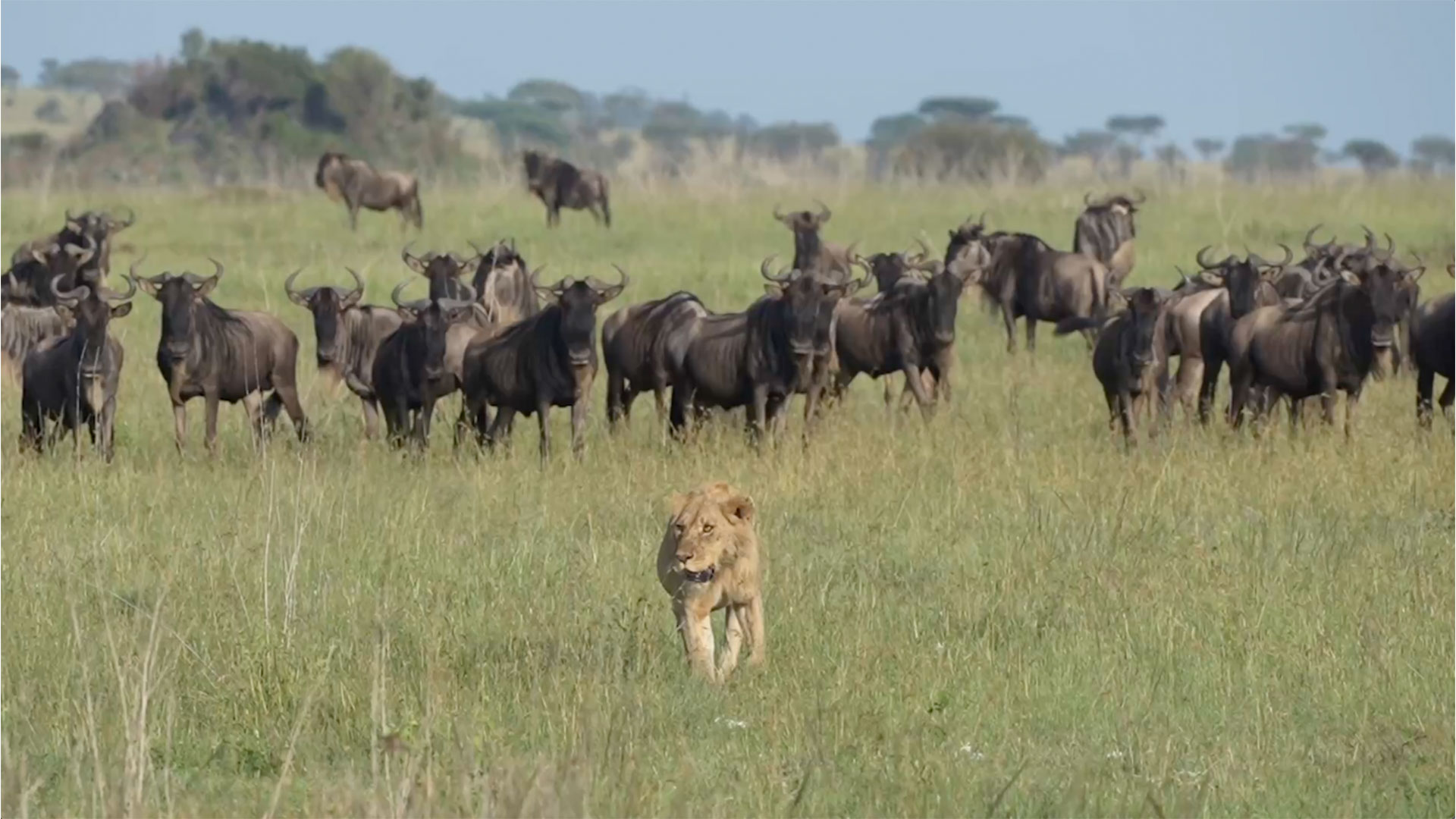
Great Migration: Serengeti hosts the Migration all year, from dramatic Mara River crossings in the north to calving season on the southern plains.
Bush and beach combo: Serengeti pairs beautifully with Zanzibar's beaches, and even further afield with the Seychelles, for an unforgettable finale.
Secret season: Visit outside the busy August-September and February-March periods and enjoy the vast landscape and wildlife largely to yourself.
Big Five country: Search for lion, leopard, elephant, buffalo and black rhino, alongside cheetah, serval, hyena and countless other species.
Astonishing scale: At roughly 31,667 km², the wider Serengeti ecosystem dwarfs the neighbouring Maasai Mara by a factor of ten.
Our favourite Serengeti safari ideas
All you need to know about the Serengeti
About Serengeti National Park
Serengeti National Park forms the heart of a 40,000km² unfenced ecosystem spanning the Kenya-Tanzania border. It connects seamlessly with Kenya's Maasai Mara to the north, while Grumeti and Ikorongo Game Reserves lie to the west, Maswa to the south and Loliondo to the east. Just southeast sits the famous Ngorongoro Crater and its Conservation Area.
Serengeti is one of the largest and most intact natural ecosystems on Earth, dominated by open plains, savannah, riverine forest and scattered woodland. Ancient volcanic eruptions from the Ngorongoro highlands blanketed these plains in nutrient-rich ash, creating a mineral-rich, calcareous soil base containing calcium, sodium and zinc that supports exceptionally nutrient-dense grasses, and in turn, the region's abundant herbivores and predators.
Things to do in the Serengeti
Game drives: Explore with expert guides at dawn and dusk, tracking lion, leopard and cheetah across open savannah and rocky kopjes.
Hot air balloon safari: Drift over the plains at sunrise for roughly an hour, followed by a champagne bush breakfast on landing.
Walking safaris: Cover remote ground on foot with an armed guide, exploring wilderness far beyond the usual vehicle tracks.
Witness the Great Migration: Watch chaotic Mara River crossings or the southern calving season, depending on when you travel.
Maasai cultural visits: Meet local communities for an authentic look at their traditions, daily life and enduring connection to this land.
Birdwatching: Track down regional endemics such as Jackson's widowbird, Usambiro barbet and the rufous-tailed weaver.
What wildlife will I see in the Serengeti?
Serengeti National Park offers a year-round wildlife spectacle, including:
Great Migration herds: Nearly two million wildebeest and zebra move in an endless circuit, culminating in dramatic Mara River crossings.
The Big Five: Lion, leopard, elephant, buffalo and black rhino all inhabit the park, though rhino sightings remain genuinely rare.
High predator density: Significant lion, cheetah, leopard and hyena populations, alongside less common serval, bat-eared fox and caracal.
Resident herbivores: Giraffe, buffalo and elephant families roam year-round, dwarfed by the sheer openness of the plains around them.
An impressive bird tally of about 550 species can be found, including regional endemics such as Jackson’s widowbird, grey-crested helmetshrike, Usambiro barbet and rufous-tailed weaver.
Where to stay in the Serengeti
In the north, lodges range from luxury permanent camps to seasonal mobile properties. Lion's Paw and Lemala Kuria Hills are both perched on rocky kopjes among boulders, positioned for sweeping views over the plains and a short drive from the Mara River. Lemala Mara Mobile Tented Camp relocates seasonally to stay close to the river crossings, while KasKaz Mara Camp offers a similarly mobile base for travellers wanting to follow the herds through peak crossing season. Kichakani Migration Camp North and Esirai Migration Camp North are both under-canvas properties that reposition specifically for the northern crossing months, while Nasikia Mobile Migration Camp North provides a comparable seasonal alternative. For those wanting maximum proximity to the river itself, Lamai Private and Lamai sit within the wildlife-rich Lamai Wedge, and Serengeti Safari Camp North rounds out the choice for travellers prioritising the crossings above all else.
The western corridor remains comparatively underdeveloped. Simbavati Grumeti sits closest to the Grumeti River itself, well placed for the early-season crossings there, while Simbavati Musabi Plains offers a slightly more open, savannah-facing setting suited to travellers prioritising resident wildlife over river crossing drama.
Continued below
Where to stay in the Serengeti (continued)
In the centre, accommodation ranges from explorer-style tented camps to contemporary lodges. Serengeti Pioneer Camp leans into a colonial-explorer aesthetic amid rocky kopjes, while Elewana Serengeti Explorer offers a comparable historic atmosphere with a more contemporary finish. Lemala Nanyukie and Lemala Ewanjan both sit in quieter pockets of the Seronera area, away from the busiest game-drive routes, giving a calmer base for exploring resident lion and leopard territory. Olmara Camp is a smaller, family-friendly property suited to travellers with children. Warangi Ridge, Little Moru Camp and Noana Moru Camp provide further central options with reliable, year-round wildlife viewing, and Intimate Camp Seronera offers a more low-key, smaller-scale alternative in the same area.
In the south / Ndutu area, camps lean towards seasonal, mobile-style properties positioned for calving season. Kichakani Migration Camp South and Esirai Migration Camp South both reposition specifically to sit among the calving herds each year, while Nasikia Mobile Migration Camp South offers a comparable seasonal base in the same window. Lemala Ndutu Mobile Tented Camp provides a similarly mobile, under-canvas experience close to the action, and Intimate Camp Zebra South offers a smaller-scale, more low-key alternative for travellers wanting fewer neighbours. Ndutu Safari Lodge, by contrast, is a permanent lodge.
The Great Migration
The Great Wildebeest Migration is the second-largest overland migration on Earth, with between 1.4 and 2.5 million wildebeest, alongside zebra and other species, moving in a roughly circular clockwise journey through the Serengeti-Mara ecosystem. Rainfall drives the event, so timing shifts year to year, but the general pattern holds: calving on the southern plains between January and March, a push north through the central Serengeti and Grumeti Reserve from April to June, and the northern Serengeti's dramatic Mara River crossings from July through mid-October, before the herds begin their return south.
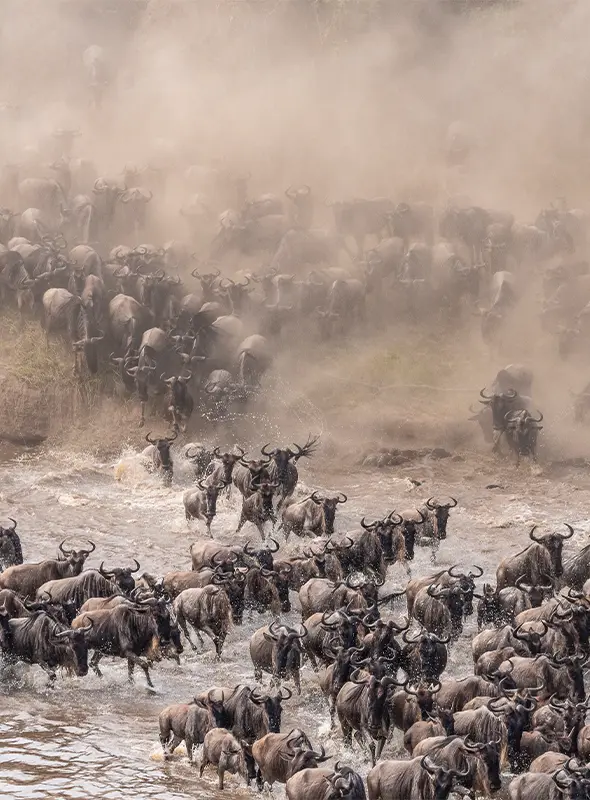
The Mara River crossings remain the most sought-after spectacle, with thousands of animals plunging into crocodile-infested water again and again, risking drowning and predation in scenes of extraordinary intensity. Roughly 250,000 wildebeest and 30,000 zebra die during the migration each year from predation, drowning and exhaustion. For a full breakdown of the migration's month-by-month movements, see our complete guide to the Great Wildebeest Migration.
Serengeti's regions explained
North Serengeti
The northern Serengeti stretches roughly 100km from Seronera to the Kenyan border, gently rolling country broken by small rivers, hills and dramatic kopjes. This is where the Mara River crossings take place from August to mid-October, drawing wildebeest and zebras across crocodile-infested waters in scenes of genuine chaos. The river itself usually delivers the most dramatic crossings in the entire migration, thanks to its greater width and depth compared with the Grumeti further south, while the Sand River nearby occasionally allows herds to cross without getting their feet wet at all.
The further north you travel, the fewer vehicles you encounter. The wild Lamai Wedge near the Kenyan border remains one of the quietest, most rewarding corners of the ecosystem and the only part of the national park where off-road driving is permitted. Elephants and giraffes are frequently spotted here, and rhino sightings, while genuinely rare across the wider park, are marginally more likely in this remote northern stretch than anywhere else in the Serengeti.
Central Serengeti
The central Serengeti, anchored by the Seronera Valley, is renowned for resident lion and leopard populations, making it excellent for feline sightings even outside migration months. Open plains, occasional kopjes and lines of hills add scenic interest, and resident wildlife here is phenomenal, sustained by permanent herbivore populations alongside passing migratory herds. The valley forms a natural boundary between the grassy plains to the south and the wooded hills to the north, drawing wildlife from both habitats and making it one of the richest year-round ecosystems anywhere in the park.
Its central position gives reasonable access to both the southern plains and the western corridor for much of the year, and the migration itself typically passes through here between November and June as the herds shift between calving grounds and the crossings further north. This accessibility comes at a cost, however, as Seronera attracts considerably more vehicles than quieter corners of the park, particularly during the busier months of the dry season.
Western Corridor
Stretching west almost to Lake Victoria, the Serengeti narrows into the Western Corridor, defined by the Grumeti and Mbalageti Rivers running roughly parallel, each supporting a band of evergreen riverine forest found nowhere else in the park. This sustains a strong permanent wildlife population, including plentiful zebra and wildebeest, all the resident predators, and forest specialists such as colobus monkeys that depend on this denser tree cover. Birdlife here is particularly varied, benefiting from the mix of forest and open savannah habitats found along the riverbanks.
The migration typically passes through between May and July, gathering momentum before pausing at the Grumeti River for crossings that, while less dramatic than those on the Mara further north, still deliver genuine drama against a backdrop of large Nile crocodiles and hippo pods. This corner of the ecosystem remains relatively underdeveloped compared with the north and centre, leaving considerably more room for solitude even as the herds pass through.
South Serengeti and Ndutu
The southern plains, including the Ndutu area bordering the Ngorongoro Conservation Area, form the Serengeti's calving grounds. Fertile, ash-enriched volcanic soils here support short, nutrient-dense grasses that draw huge concentrations of wildebeest and zebra between December and March, precisely when hundreds of thousands of calves are born and predators gather in force. The synchronised birthing overwhelms resident lion, cheetah and hyena populations with more prey than they can consume, which paradoxically improves each individual calf's odds of survival despite the heavy predation on display.
Open, flat terrain makes this some of the clearest wildlife viewing and photography country anywhere in the ecosystem, with visibility rarely interrupted by trees or thick vegetation. The dry season from June to October sees most animals move north in search of water, leaving the plains far quieter and the resident ostriches, secretary birds and smaller mammals considerably easier to spot without the crowds that calving season attracts.
Serengeti month-by-month guide
The Serengeti doesn't have an off-season — it has phases. Rainfall, not temperature, is the variable that shapes a safari here, and each month brings the migrating herds to a different part of the ecosystem.
January–February: The short dry spell, with calving season peaking in February on the southern plains around Ndutu, where hundreds of thousands of wildebeest calves are born within a two to three-week window.
March–May: The long rains arrive, pushing herds north through the central Serengeti and Grumeti Reserve as mating season gets underway; April is typically the wettest month of the year.
June–July: The dry season begins, and the western corridor's Grumeti River sees its first crossings of the annual cycle as the herds gather momentum heading north.
August–mid-October: Peak season, with the north's dramatic Mara River crossings drawing the largest predator activity and visitor numbers of the year.
November–December: The short rains trigger the herds' return journey south through the central Serengeti, arriving back on the southern plains ready to begin the cycle again.
For a full month-by-month breakdown of migration positions, rainfall, temperatures and what a safari looks like in each period, see our detailed Serengeti month-by-month guide.
Trusted by thousands of ecstatic travellers
✔️ 5-Star Trustpilot Rating ✔️ Condé Nast Travel Specialist Award Winner
✔️ Accredited by SATSA ✔️ 5,000+ Exceptional Safaris Since 1991
Why choose Africa Geographic to plan your safari?

I have been travelling with ... Africa Geographic for more than a decade ... and each trip has been unique, well-planned ... driving in the Serengeti for miles and miles among 1.5 million wildebeest, and 400,000 zebras enabled me to start to comprehend the magnitude of the "migration"; in addition, we saw a cheetah making a kill of a young Grant gazelle. Trust and enjoy.
After having done about 12-15 safaris in East Africa, I was hugely impressed by the very professional service and product offered by Africa Geographic Travel. Outstanding in every aspect, ranging from understanding what I was looking for, the presentation of how they received my request, to the actual trip, as such, with a unique product, high five in every aspect!
We booked our honeymoon safari with Africa Geographic, and it turned out to be one of the most memorable trips of our lives ... the flow of the trip was perfect: Kilimanjaro, Tarangire, Lake Manyara, Ngorongoro, Olduvai, Ndutu, and the Serengeti ... We would recommend Africa Geographic without hesitation to anyone looking for a safari that is personal, well‑designed, and truly special.
Wish you were here?
Frequently asked questions
With such extensive experiences available in this incredible part of the world, the ‘best time’ to visit the Serengeti National Park really hinges on what you want out of the experience – and this is where talking to our safari experts can be invaluable to guide you in this decision. They will also be in the know about seasonal fluctuations, so you don’t miss the greatest show on Earth.
The Great Wildebeest Migration follows rainfall patterns, making timing crucial for optimal sightings:
Calving season (December to March) | Ideal for: Newborn wildlife, predator action, fewer crowds
December–February: Southern Serengeti, Lake Ndutu area
March: Herds move more slowly with babies in tow
Weather: Short rains, warm days, cooler evenings
Migration movement (April to June) | Ideal for: Herd movements, fewer tourists, dramatic landscapes
April-May: Long rains, slippery conditions, spectacular photography
June: Herds spread out, front-runners reach Mbalageti River
Weather: Wettest months, afternoon thunderstorms
River crossings (July to mid-October) | Ideal for: Mara River drama, mating season, peak wildlife action
July: Grumeti Reserve crossings, mating season begins
August to mid-October: Mara River crossings, highest predator activity
Weather: Dry season, hot days, clear skies
Return journey (Late October–November) | Ideal for: Peaceful grazing, smaller crowds, cooler weather
October: Casual grazing in Maasai Mara
November: Short rains trigger southward movement
Weather: Cooler temperatures, unpredictable rainfall
Mara River crossings occur primarily from August to mid-October in the northern Serengeti's Kogatende area. Unlike the Grumeti River crossings in June and July, Mara crossings are more dramatic thanks to higher water volumes and steeper banks, drawing the largest predator activity of the year.
While river crossings during the Great Migration attract crowds, the Serengeti's vastness (14,750km²) means that you can escape the crowds and enjoy privacy away from the river crossings. Our positioning strategies and private conservancy access provide exclusive experiences away from the river, even during busy periods.
If your main aim is to view the Mara River crossings, then make peace with the fact that there will be crowds while you are at the river. If you are the type who skips the Eiffel Tower and seeks out that artisan cheese store in the back alleys of Paris, then perhaps give the Mara River crossings a miss, and opt to watch the vast herds away from the river or even avoid the river crossing season entirely.
The Serengeti Great Migration occurs throughout the year, as the herds move clockwise around the ecosystem. Our safari experts will help you decide on the best timing and itinerary to make the most of your tour of Serengeti National Park.
Tanzania (Serengeti National Park) | Kenya (Maasai Mara National Reserve) |
Ten times larger than the Maasai Mara | Dense wildlife in a smaller area |
Great Migration is present year-round, including river crossings in the north (August-mid-October) and peak calving on the southern plains (February–March) | Great Migration from August to mid-October, with Mara River crossings, which occur simultaneously in Tanzania's northern Serengeti during this period |
Vast, open landscapes result in more opportunities to avoid the crowds | Private conservancy system offers exclusive, crowd-free viewing. Note that river crossings occur in the main reserve and are subject to crowding |
Big 5 are present, but combine with an Ngorongoro Crater safari for higher chances of seeing rhinos | Very high likelihood of sighting the entire Big Five (especially with Laikipia and its rhino sanctuaries as an add-on) |
Best for: photographers, wilderness seekers, experienced safari-goers | Best for: first-timers, families, shorter trips |
The Serengeti is around ten times larger than the Maasai Mara, hosting the migration year-round, including river crossings from August to mid-October and calving on the southern plains from February to March. The Maasai Mara offers a smaller, denser wildlife area with crossings concentrated between August and mid-October. Serengeti suits photographers and wilderness seekers; the Mara suits first-timers and shorter trips.
Absolutely! Family-friendly programmes typically accommodate children aged six and above with educational activities, flexible schedules and safe accommodation. Cultural visits to Maasai communities also provide enriching, age-appropriate experiences for younger travellers.
Yes, Serengeti pairs very well with Zanzibar, as per this safari idea. Read more about Zanzibar, Pemba and Mafia Island and how to pair them with the Serengeti and other wildlife areas. Serengeti also combines well with beach holidays further afield, such as the Seychelles.
Yes, a Serengeti hot air balloon safari is certainly worth it. The hot air balloon safari is a sunrise flight over the plains, offering spectacular aerial wildlife views and a champagne bush breakfast afterwards. Flights typically last about 1 hour and cost around US$550–600 per person. Trips run year-round, though the dry season (June–October) offers the clearest views. Minimum age is usually 7 years, though some operators require children to be 12+
Yes, the Serengeti is an excellent location for photographers. This is particularly true in the dry season, when the light is clearer. Use kopjes for elevated vantage points and Mara River crossings during the Great Migration to capture dramatic action.
Serengeti National Park is a malaria area. Prophylaxis is strongly recommended; consult your GP or travel clinic before departure.
Yellow fever
Tanzania is not a yellow fever country, so a yellow fever vaccine is not mandatory. However, if you are entering Tanzania from a yellow fever country (such as Rwanda), you will need to present your vaccination certificate upon entry.
Malaria
Malaria is prevalent across Tanzania, and we advise you to consult your GP before you depart about taking prophylaxis. It’s also essential to cover up in the evenings when the malaria-carrying Anopheles mosquito usually feeds. The malaria incubation period is 1–3 weeks, so if you experience any flu-like symptoms, headaches, aching joints and back or nausea and diarrhoea, it is recommended that you get tested at the earliest opportunity and let the medical people know you’ve recently travelled to Africa.
Our safaris typically cost from US$700 per person, per night, depending on the accommodation comfort level, time of year and activities. This price usually includes accommodation, all meals, game drives, experienced guides, airport transfers, and 24/7 support from our team.
Neutral-coloured, light clothing (khaki, olive, beige) is recommended for game drives – avoid blue and white, which attract insects. Layering is important as mornings can be cold, particularly if there has been rain. Essential items include a good insect repellent (DEET-based for malaria areas), sunscreen, a sun hat, binoculars, and a camera. Soft-sided luggage is required if flying by charter aircraft.
See our comprehensive packing list.
Most travellers fly into Kilimanjaro International Airport, then take a charter flight of around 1.5 hours to an airstrip near their camp. Road transfers are also possible from Arusha, taking a full day and typically routing through the Ngorongoro Highlands.
Yes. The Serengeti holds substantial resident wildlife year-round, including strong lion, leopard and cheetah populations, particularly around the central Seronera Valley. Birdlife is especially rewarding during the wetter months, when migratory species join the roughly 750 species recorded across the park.
Click here to schedule a no-obligation call with one of our Safari Experts or fill in our 2-minute form with your questions. Our team of experts are here to help! Whether you’re curious about the best time to travel, want to hear first-hand about an experience or need help planning your safari.
Explore more African destinations
Start planning your dream safari
Our travel experts will craft a no-obligation itinerary just for you. We have crafted over 5,000 safaris since 1991. Your personal details are protected; we only use this information to contact you.
Why book your safari with us?

Deep Experience & Knowledge
Handcrafted experiential safaris since 1991.
Travel in Africa is about knowing when and where to go, and with whom. A few weeks too early/late or a few kilometres off course, and you could miss the greatest show on Earth. And wouldn’t that be a pity?

Trust & Safety

Make A Difference
We donate a portion of the revenue from every safari sold to carefully selected conservation projects that make a significant difference at ground level.
YOUR safari choice does make a difference - thank you!