

Tailor-made safaris. Since 1991



Walking safaris at a glance
Best time to travel | Dry season: May–October (Southern Africa); January–March and June–October (East Africa). Green-season walks offer newborns, birdlife and fewer people. |
Signature destinations | South Luangwa, Mana Pools and Chitake Springs, Okavango Delta, Greater Kruger, Serengeti, Tsavo, Laikipia, Lower Zambezi, Damaraland. |
Fitness and minimum age | 2–3 hours daily on relaxed itineraries; 5–8 hours on focused walking trails. Minimum age usually 12, sometimes 16. |
Guiding and safety | Certified trails guides; an armed guide or scout in dangerous-game areas. In Zambia, both a licensed walking guide and an armed scout accompany each group. |
Africa on foot: the original safari
A walking safari strips the African bush back to its essentials. There is no engine noise, no elevated vantage point, no metal between you and the wilderness; only the pace your own legs set and the judgement of a trails guide reading the ground ahead. It is the oldest way to travel in Africa, and it remains the most revealing.
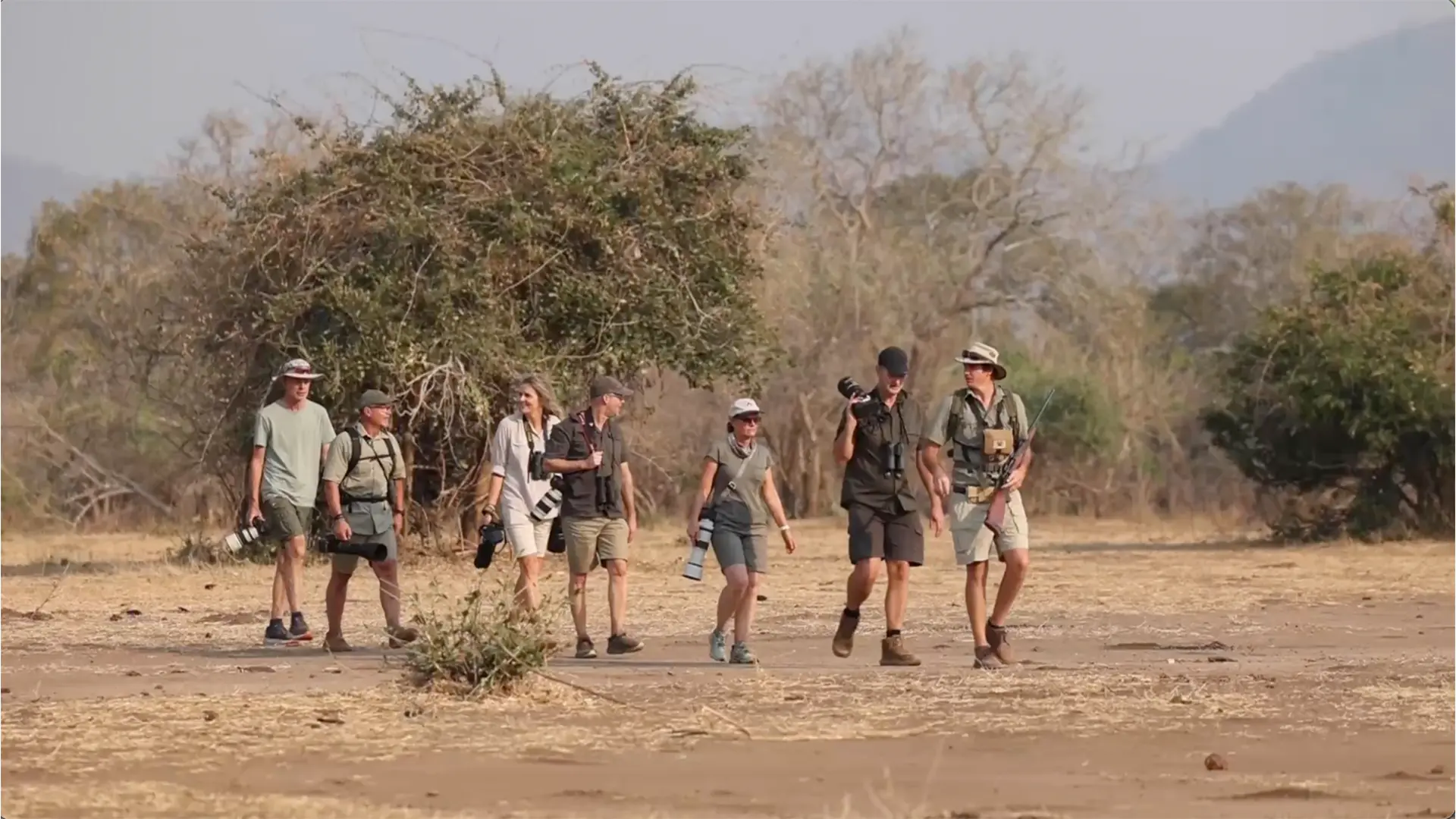
On foot, the continent reassembles itself around detail: the freshness of a lion track pressed into river sand, the alarm call of a tree squirrel betraying a leopard, the architecture of a weaver's nest, the pheromone-rich scent that lifts off the earth after rain. Groups move in single file, cover a few kilometres at a deliberately unhurried pace, and stop constantly, for a dew-strung spider web, a bleached skull, a kettle of distant vultures, or a breeding herd of elephants that must be given a wide berth.
Some travellers add a single morning walk to a lodge-based itinerary. Others commit entirely, walking camp to camp for days through country with no roads and no other vehicles, sleeping each night wherever the trail happens to end. Both are walking safaris. Both change how you see everything that follows.
Five reasons we love walking safaris in Africa
You notice the small stuff. Tracks, dung beetles, medicinal plants and weaver nests become the story - the granular detail that a game-drive vehicle simply moves too fast to register.
Encounters are earned. Approaching a bull elephant quietly on foot, then withdrawing before he knows you were there, carries a weight that no sighting from a vehicle quite matches.
The guiding is the product. Trails guides are assessed on animal behaviour, tracking, safety, firearms and first aid, and the best of them turn a termite mound into an hour of real teaching.
It treads lightly. Walking carries a far lower footprint than driving, reaches roadless wilderness that vehicles never see, and channels revenue into the reserves doing the protecting.
It resets your pace. Dawn starts, long shaded breakfasts and unhurried afternoons are the antidote to the ticklist safari - what our CEO Simon Espley calls the slow safari.
About the walking safari experience
Most walks begin in the grey cool before sunrise, after coffee and a light snack at the fire and a briefing on how to move and what to do if dangerous game is encountered. You walk in single file, roughly an arm's length apart, in neutral colours, carrying only water, sun protection and a light camera; kit bags travel ahead to the next camp if you are on an all-day walk.
The pace is slow and the terrain generally easy, but endurance matters. A focused walking itinerary can mean five to eight hours on your feet; a lodge-based programme with one walk and a game drive requires two to three hours. Mid-morning usually brings a long pause with a delicious breakfast laid out in the shade of a beneath a fig tree or on a rocky kopje, a book, a sleep before the final stretch into camp.
Blisters, heat, ticks and tsetse flies are part of the bargain, and you will be hot and uncomfortable at times. The silence more than repays it.
Key takeaways
A walking safari is a guided exploration of the African bush on foot, led by a certified trails guide trained in safety, wildlife behaviour, tracking, firearms handling and first aid.
Zambia's South Luangwa National Park is widely regarded as the birthplace of the modern photographic walking safari, a tradition traced to guide Norman Carr.
The most popular walking destinations are South Luangwa and Lower Zambezi (Zambia), Mana Pools and Chitake Springs (Zimbabwe), the Okavango Delta (Botswana), Greater Kruger (South Africa), the Serengeti (Tanzania), and Tsavo and Laikipia (Kenya).
Best conditions fall in the dry seasons: May to October in Southern Africa, and January to March plus June to October in East Africa.
A focused walking itinerary calls for five to eight hours on foot per day; a lodge-based walk-and-drive itinerary calls for two to three hours.
Minimum ages are typically 12, but 16 in some Big 5 areas. Requirements vary by lodge, country and terrain.
In areas with dangerous wildlife (lions, elephants, buffalo and hippos), an armed guide or scout accompanies every group. Firearms are often carried but seldom used.
Accommodation ranges from ultra-light trekking tents and mobile fly-camps to remote bushcamps and luxury tented lodges.
Africa Geographic safaris typically start from around US$700 per person per night, all-inclusive of accommodation, meals, guiding and transfers.
Most walking destinations are malaria areas. Seek medical advice well before travel.
Our favourite walking safaris
Why book with us?
Tailor-made experiential safaris - with love
"Travel in Africa is about knowing what, when and where to go - a few weeks too early/late or a few kilometres off course, and you could miss the Greatest Show on Earth. And wouldn’t that be a pity?
Our crew of passionate safari experts have lived and worked in Africa for most of their lives. Trust us to find you the rarest animals, the most spectacular wildlife events, the remotest landscapes and deeply meaningful cultural encounters!"
Simon Espley - CEO, Africa Geographic
All you need to know about walking safaris
Are walking safaris safe?
Yes, the guides on our walking safaris are certified as Trails Guides (qualifications vary by country), meaning they are trained to assess risk, interpret wildlife behaviour, handle firearms, and administer first aid. They are highly experienced and ensure the necessary safeguards are in place throughout your safari.
Your guides will be highly vigilant in adhering to established safety procedures and ensuring that you know what to do if dangerous animals are encountered.
The likelihood of encountering dangerous animals (which will be given a wide berth) is much lower than during a game drive.
Where to find the best walking safaris in Africa
Walking is possible across much of Africa, but these regions have built entire safari cultures around it.
South Luangwa & Lower Zambezi, Zambia: Known as the birthplace of walking safaris, South Luangwa and the Nsefu benefit from the rich Luangwa River floodplains, making it one of the best places to see leopards. Lower Zambezi offers excellent riverine forest and up-close encounters with relaxed male elephants.
Mana Pools & Chitake Springs, Zimbabwe: The Zambezi River is distinguished by regular close encounters with elephants, lions, and wild dogs. The park's southern Chitake Springs area has high concentrations of wildlife during the dry season and offers adventurous walking safaris.
Tsavo and Laikipia, Kenya: Tsavo East features big-tusked elephants, maneless lions and the critically endangered hirola antelope, the world's rarest antelope. Laikipia leads the way for conservation-led tracking on conservancies.
Greater Kruger, South Africa: These reserves are home to the Big Five, feature diverse ecosystems, and offer excellent walking safaris.
Okavango Delta, Botswana: hippo paths, dry-season floodplains and mokoro channels with the Delta's specialist guides
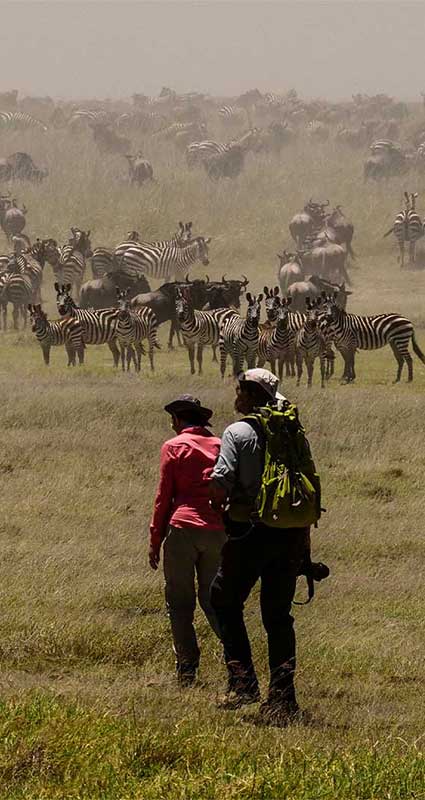
Serengeti National Park, Tanzania: Famous for its vast rolling savannah, the Serengeti offers remote wilderness and the drama and sheer scale of the wildebeest herds during the Great Migration season.
Trip reports from Africa Geographic walking safaris
We write about what we sell. Africa Geographic CEO Simon Espley's five-day Serengeti walking and fly-camping safari found roadless wilderness in the middle of peak migration season: He spent blissful days without seeing a vehicle, lionesses stalking buffalo bulls a few hundred metres away, and a jackal mugged by a Thomson's gazelle mother outside camp.
His Greater Kruger trail through the Maseke and Balule reserves opened with a bull elephant walking into camp and closed with a red-billed quelea colony so vast that raptors queued overhead.
In Tsavo, Iain Allan's account of the Galana River walk records eighteen species logged in a single day, elephant families crossing beside the group, and a lioness defending an oryx kill.
We also wrote this article about the best 11 walking safaris in Africa.
Walking safari accommodation types
Where you sleep shapes the safaris as much as where you walk. Many walking operations are deliberately low-impact, running on solar power, harvested rainwater and composting toilets; treading as lightly as the walking itself.
Mobile and fly-camps move with you: canvas dome or bell tents, comfortable mattresses, mosquito mesh, en-suite bucket showers heated over the fire, and a crew who strike camp and rebuild it ahead of you. Ultra-light nylon trekking tents strip this back further for the most committed trailists.
Remote bushcamps are the classic Luangwa model: small, seasonal, often unfenced camps linked by walking trails, with porters moving luggage between them.
Lodges and tented camps anchor walk-and-drive itineraries, offering a morning walk alongside game drives, with full comfort at the end of the day
Trusted by thousands of ecstatic travellers
✔️ 5-Star Trustpilot Rating ✔️ Condé Nast Travel Specialist Award Winner
✔️ Accredited by SATSA ✔️ 5,000+ Exceptional Safaris Since 1991
Why choose Africa Geographic to plan your safari?

This safari on foot through Tsavo National Park was the trip of a lifetime, expertly enabled ... from the initial enquiry through the whole administrative process to the final planning stage right up to departure. I cannot praise his efforts highly enough. The safari itself was an unforgettable experience.
Chitake Springs with Africa Geographic - just back from a truly memorable few days. Our Bush Camp ... bordered the sandy ‘highway” ... Elephants, leopards, hyenas, antelopes, baboons all used this route, and sometimes a few of the 21 local lions ... Fascinating and fun, every day!
The Africa on Foot Wilderness Trail - after 4 nights/ 3 days walking ... glamping ... in the beautiful Maseke Reserve, I had 4 nights / 5 days in the equally lovely Klaserie Reserve. Thank you, Christian and Africa Geographic, for soooooo giving me the ideal, tranquil, and heart-filling week ever!
Frequently asked questions
Yes, when properly guided. Guides on our walking safaris are certified as trails guides (qualifications vary by country) and are trained to assess risk, interpret wildlife behaviour, handle firearms and administer first aid. The likelihood of encountering dangerous animals is lower than on a game drive, because animals are deliberately given a wide berth. You reduce risk further by walking in single file, staying quiet, following your guide's instructions at all times - and never running if an animal is encountered.
Most guided walking safaris in Africa set a minimum age of 12, and some require 16. Big 5 areas tend to set higher minimums than areas with less dangerous wildlife, and the rules vary by lodge, country and the nature of the walk. Shorter, hands-on bush walks designed for younger children are available at many lodges, particularly in private conservancies. Tell us who is travelling, and we will find an itinerary that suits your family.
Yes, they do, in areas with dangerous wildlife, including much of Zambia, Zimbabwe, northern Botswana and the Greater Kruger. In Zambia, each group is accompanied by both a licensed walking guide and an armed scout. In Tanzania, walking guides are required by law to carry rifles. Firearms are a last-resort tool and are almost never fired; safety comes from situational awareness and animal knowledge.
It depends on the itinerary. A focused walking safari, with walks twice a day over several days, requires you to be fit enough to walk five to eight hours daily with regular breaks. A more relaxed itinerary, with one walk a day complemented by game drives, asks for two to three hours. The pace is slow, and the terrain is usually easy, but you need some endurance. The most underrated element of walking fitness is conditioning your feet to resist blisters.
This varies widely by camp and country. Many lodge-based walks run around two to three hours and are usually cover a small area near the lodge. Multi-day trails in Kenya's Laikipia can cover roughly 15km over up to five hours, tailored to the group's fitness. Distance is never the point; this is not a route march, and every excuse to stop is taken, from bird-watching to examining tracks or watching a herd from a safe distance.
Zambia's South Luangwa is the traditional answer; the birthplace of the walking safari, with camp-to-camp trails and generations of guides trained in that lineage. Zimbabwe's Mana Pools and Chitake Springs rival it for sheer drama, and Zimbabwe's guiding qualification is among the toughest on the continent. Beyond those, consider Greater Kruger, the Okavango Delta, the Serengeti, Tsavo, Laikipia, Lower Zambezi and Namibia's desert regions. The right answer depends on when you travel and what you want to see.
Encounters range from elephants, lions, leopards, wild dogs, buffalo, and hippos to the details that game drives miss: tracks, dung beetles, termite mounds, spider webs, bird nests, and medicinal plants. The goal is not to get as close as possible but to approach safely, observe natural behaviour, then withdraw quietly. What you see depends entirely on the destination and season, and a good guide can make a dung beetle as compelling as an elephant.
Yes, and most travellers do. Many lodges offer a short morning walk as an alternative to a game drive during a classic safari. Alternatively, you can build several nights of dedicated walking into a longer itinerary - walking between bushcamps in the Luangwa, for example, before moving on to a lodge elsewhere. Even on dedicated walking safaris, there is usually a game-drive vehicle based at camp.
Most walking safari destinations - including Zambia, Zimbabwe, Botswana, Tanzania and South Africa's Kruger - are malaria areas. Consult your doctor or a travel health clinic well in advance to discuss antimalarial medication. Practical precautions include wearing long sleeves and trousers at dusk, using a DEET-based repellent, and sleeping under a mosquito net. Malaria-free alternatives exist in South Africa, including Madikwe Game Reserve and reserves in the Western and Eastern Cape.
Carry as little as possible while walking: comfortable neutral-coloured clothing (brown, green, khaki or tan), a long-sleeved top and light raincoat for the conditions, closed-toe hiking boots or tough sandals, a sun hat and sunblock, thick plasters and blister ointment, a lightweight camera or phone, a water bottle that clips to your belt, snacks and a small backpack. Pack for camp as you would for any African safari.
The dry seasons offer the best conditions: May to October in Southern Africa, and January to March plus June to October in East Africa. Sparse vegetation and wildlife concentrating at water sources make for exceptional viewing. Late dry season delivers the most dramatic encounters, though October and November can be very hot. Green-season walks (roughly November to April) bring dramatic skies, newborn animals, spectacular birdlife, lower rates and fewer people.
Our safaris typically cost from US$700 per person, per night, depending on the accommodation comfort level and activities. This price usually includes accommodation, all meals, game drives, experienced guides, airport transfers, and 24/7 support from our team, but excludes a private vehicle and other exclusive services.
Click here to schedule a no-obligation call with one of our Safari Experts or fill in our 2-minute form with your questions. Our team of experts are here to help! Whether you’re curious about the best time to travel, want to hear first-hand about an experience or need help planning your safari.
Explore more African safari experiences
Start planning your dream safari
Our travel experts will craft a no-obligation itinerary just for you. We have crafted over 5,000 safaris since 1991. Your personal details are protected; we only use this information to contact you.
Why book your safari with us?

Deep Experience & Knowledge
Handcrafted experiential safaris since 1991.
Travel in Africa is about knowing when and where to go, and with whom. A few weeks too early/late or a few kilometres off course, and you could miss the greatest show on Earth. And wouldn’t that be a pity?

Trust & Safety

Make A Difference
We donate a portion of the revenue from every safari sold to carefully selected conservation projects that make a significant difference at ground level.
YOUR safari choice does make a difference - thank you!