
Tailor-made safaris. Since 1991



Lake Natron: Tanzania's Caustic Soda Lake
Lake Natron at a glance:
Location: Northern Tanzania, Ngorongoro District, near the Kenya border | Size: Up to 57km long and 22km wide, surface elevation 600m |
Best time to visit: Dry season, late May to early November | Known for: Millions of breeding lesser flamingos |
Nearby landmark: Active volcano Ol Doinyo Lengai, "Mountain of God" | Gateway village: Engaresero, base for lake and waterfall visits |
Getting there: Road transfer from Serengeti, Ngorongoro or Arusha | Terrain: Caustic soda lake, volcanic plains and Rift Valley escarpment |
Why Visit Lake Natron?
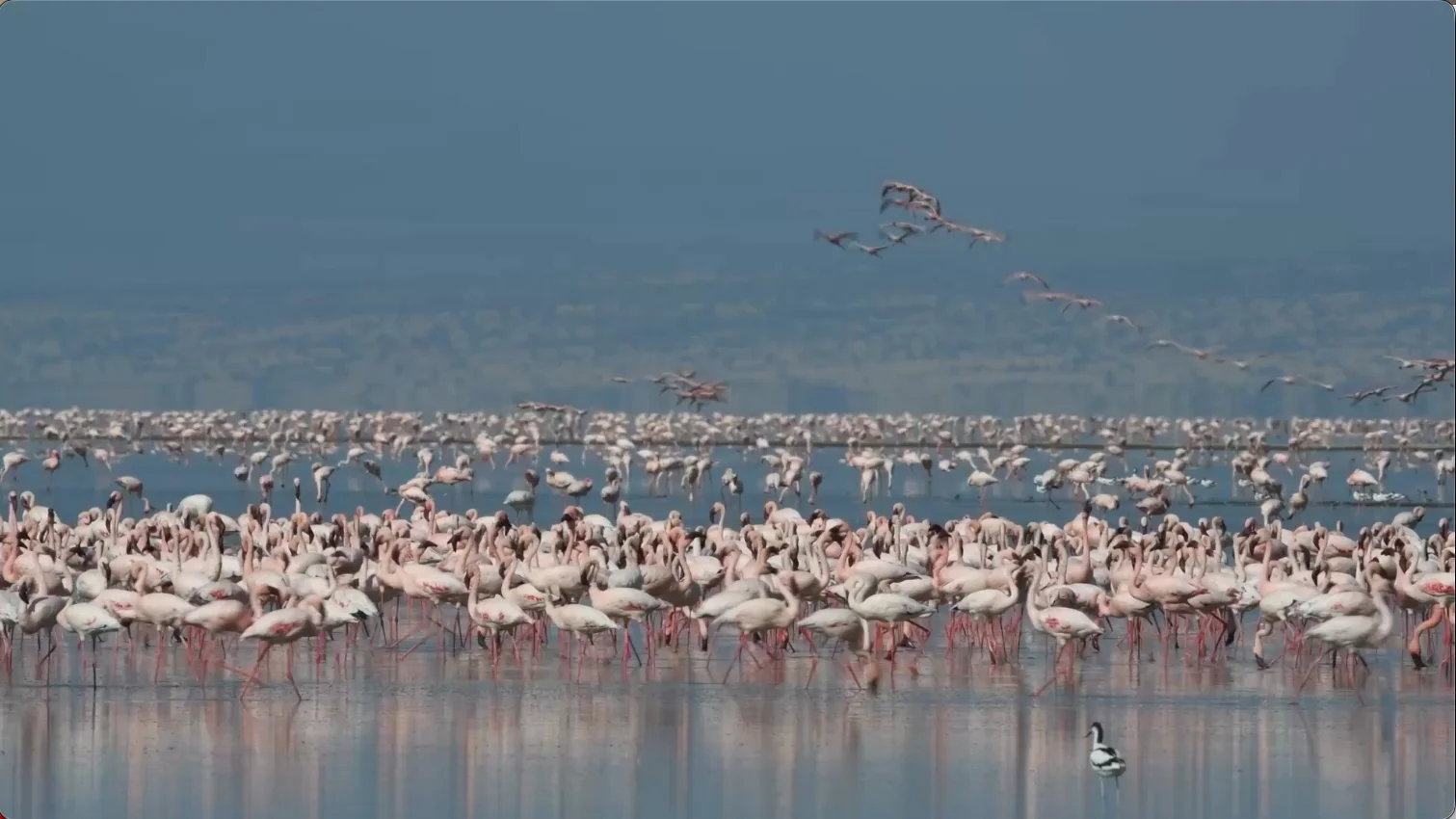
Few landscapes on earth feel as elemental as Lake Natron. Tucked into the floor of the Gregory Rift in northern Tanzania, this caustic soda lake sits below active volcano Ol Doinyo Lengai, the Maasai's sacred "Mountain of God." Its alkalinity can exceed pH 12, its shallows reach 60°C, and its shores are largely uninhabited — yet from this hostile chemistry emerges one of Africa's great wildlife spectacles: the only regular breeding ground in East Africa for lesser flamingos, whose pink-tinged colonies numbering in the millions rely entirely on this single, predator-free lake.
Beyond the flamingos, Natron rewards travellers willing to go properly off the beaten track. The drive in from the Serengeti or Ngorongoro Crater is part of the experience, tracing the Rift escarpment past extinct cones before Ol Doinyo Lengai's smoking summit appears. Along the way lie the enigmatic Engaruka ruins, a walk to Engare Sero's waterfall, and unscripted encounters with Maasai communities who still live on this land, rather than beside a fenced reserve. Because Natron sits on village land, not within a protected park, the bond between people, livestock and wildlife feels unusually close. For travellers seeking scenery, geology and culture over conventional wildlife density, Lake Natron is unmatched.
5 Reasons We Love Lake Natron
Millions of lesser flamingos: Natron is East Africa's only regular breeding site for these near-threatened birds, safe on caustic evaporite islands.
Ol Doinyo Lengai: climb the Maasai's active "Mountain of God" overnight for a sunrise summit view across the Rift Valley volcanoes.
Ancient Engaruka ruins: explore seven abandoned villages and a still-unexplained irrigation system that once supported 5,000 people.
Engare Sero waterfall: hike a shaded gorge to a natural swimming pool fed by cascading spring water beneath palm trees.
Genuine Maasai culture: this is village land, not a fenced reserve, offering authentic, unscripted encounters with local communities.
All You Need to Know About Lake Natron
About Lake Natron
Lake Natron lies in Tanzania's Ngorongoro District on the floor of the Gregory Rift, its northern tip crossing into Kenya. Fed by the Southern Ewaso Ng'iro River and mineral-rich hot springs, it stretches up to 57km long and 22km wide, yet is barely three metres deep. Relentless evaporation concentrates natron and trona, pushing alkalinity above pH 12 and temperatures to 60°C.
This caustic chemistry supports halophile cyanobacteria, whose red pigments turn open water deep red and the shallows pink and orange. Two endemic alkaline tilapia fish species survive near hot-spring inlets, while marshes and wetlands at the edges support birdlife and plants. The Lake Natron Basin is a Ramsar-listed wetland of international importance, recognising its role as East Africa's only regular breeding ground for lesser flamingos, whose caustic, predator-free islands protect nesting colonies each year.
Things to Do at Lake Natron
Lakeshore walk: Cross baked mud flats at dawn or dusk to watch flamingos feeding on algae along the water's edge.
Climb Ol Doinyo Lengai: Begin at midnight for a steep six-hour ascent, reaching the active volcano's summit for sunrise.
Hike to Engare Sero Waterfall: Wind through a shaded gorge, crossing the river, to a natural pool beneath palm-shaded cliffs.
Explore Engaruka ruins: Visit seven abandoned villages with a complex, still-unexplained irrigation system near Natron's route.
Visit Maasai villages: Spend time at a boma, learning warrior customs, sharing food, and sleeping under open sky.
See ancient footprints: View fossilised human footfalls from the late Pleistocene, most likely 10,000–19,000 years ago, preserved in volcanic ash terrain.
What Wildlife Can I See at Lake Natron?
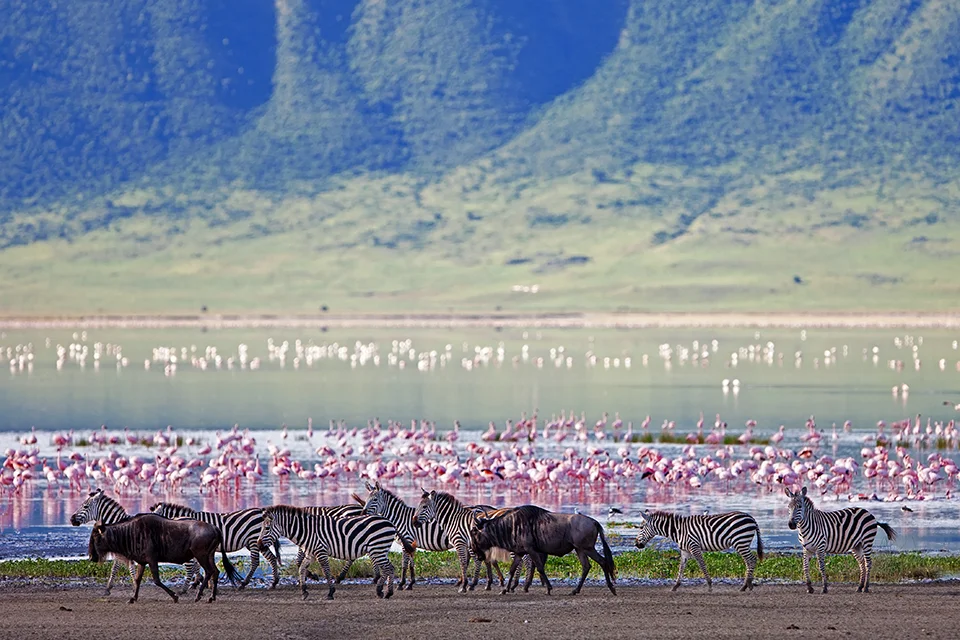
Lesser flamingos: Up to 2.5 million gather here, the only regular East African breeding colony for this near-threatened species.
Greater flamingos: Also breed on Natron's mud flats, feeding alongside lesser flamingos on the lake's algae blooms.
Alkaline tilapia: Two endemic fish species, Alcolapia latilabris and A. ndalalani, survive near hot-spring inlets at the margins.
Gerenuk and oryx: Dry-country antelope species favour the arid plains surrounding the lake's harsh volcanic terrain.
Zebra, giraffe and kudu: Occasionally spotted grazing the grassy flats or browsing acacia trees near camps, alongside ostriches on the open plains.
Golden jackal: A fortunate sighting for visitors exploring the margins of this predator-scarce ecosystem.
Where to Stay at Lake Natron
Accommodation at Lake Natron is limited, in keeping with the area's remote, off-grid character and its position on village rather than protected land. Most camps sit in the grassy flats or shaded acacia woodland near Engaresero village, the gateway settlement and base for exploring the lake.
Lake Natron Camp is a simple, unusual property with just ten spacious canvas tents, each with its own porch for watching the sunset. It has a natural swimming pool for cooling off after a hot day, and its modest scale guarantees a quiet, secluded stay. This is the more rustic, back-to-basics choice for travellers prioritising authenticity over polish.
Lengai Camp takes a more considered approach to comfort. Its eight tented suites each have an en-suite bathroom with indoor and outdoor showers, private verandas facing Lake Natron and Mount Lengai, and interiors furnished with local textiles and natural wood. A communal mess tent serves as lounge, dining room and bar, with solar power and a back-up generator supporting a genuine off-grid stay. The camp suits couples, honeymooners and photographers seeking solitude alongside a slightly more refined base for hiking, birdwatching and fly-camping excursions.
Beyond the lake: excursions and ecosystems
Ol Doinyo Lengai: the Mountain of God
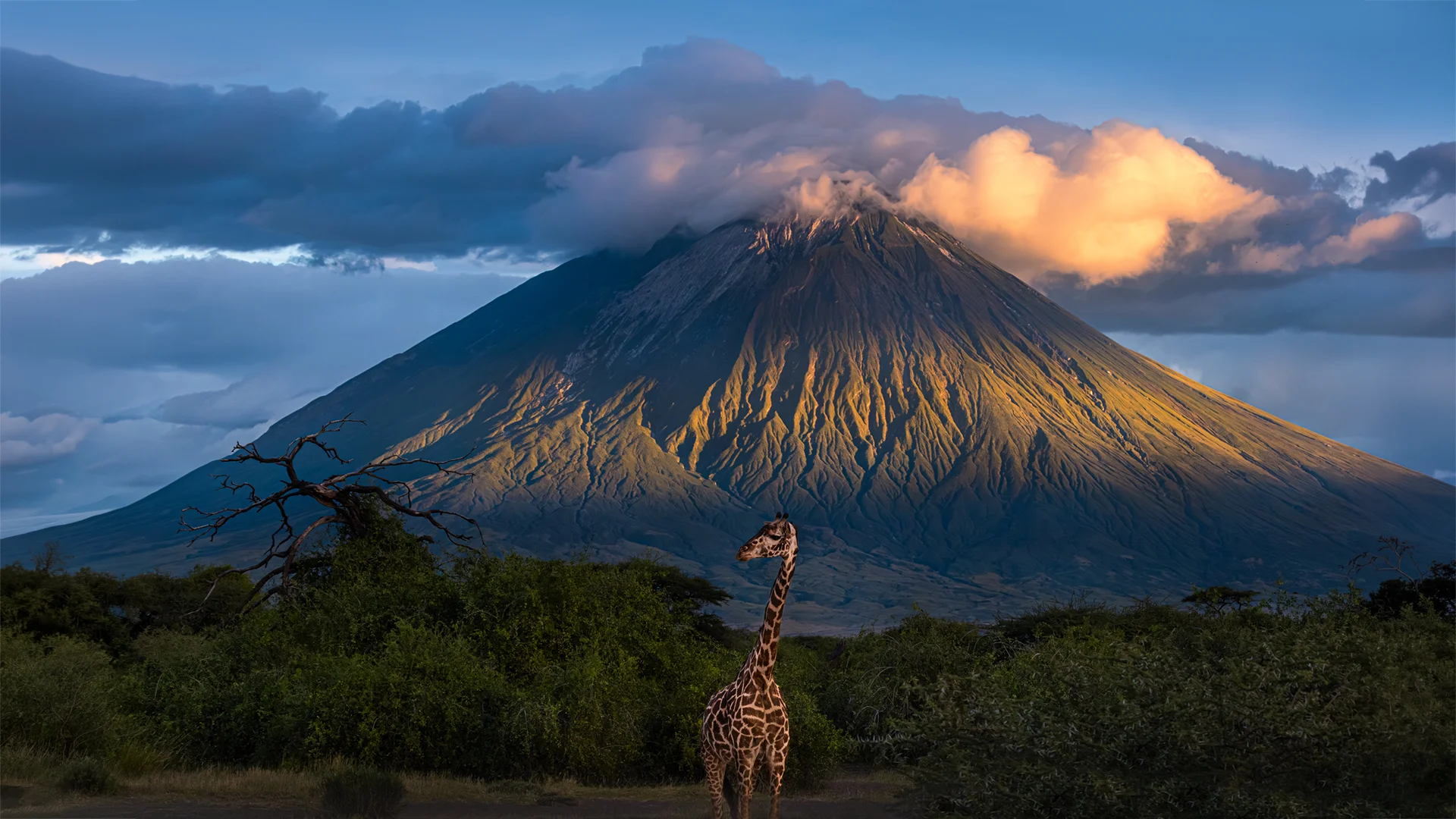
Ol Doinyo Lengai, meaning "Mountain of God" in the Maasai language, is the active volcano that dominates the landscape south of Lake Natron. Sacred to the Maasai, whose land stretches for hundreds of miles around its base, this carbonate volcano is a focal point for the entire region, its ash-grey slopes and smoking crown visible for miles as travellers approach the lake.
Climbing Ol Doinyo Lengai is one of the most demanding activities on offer at Natron, and not one to undertake lightly. The ascent is extremely steep and typically begins at midnight, allowing climbers roughly six hours to reach the summit in time for sunrise, avoiding the scorching daytime heat. From the top, on a clear day, views extend across Ngorongoro, Kilimanjaro and the surrounding volcanoes of the Rift Valley, with the pink expanse of Lake Natron visible far below. Given the high risks involved in climbing an active volcano, an experienced guide and a genuine level of mountaineering fitness are essential, and the climb should not be approached without careful preparation.
Engaruka Ruins: an unsolved mystery
Roughly halfway along the standard route to Lake Natron lie the Engaruka ruins, a mysterious complex of stone remains dating back several centuries. The site consists of seven abandoned villages built around an astonishingly complex irrigation system of canals, dams and stone-lined terraces that once supported an estimated 5,000 people farming this arid stretch of the Rift Valley floor.
Despite decades of study, archaeologists have never fully explained who built Engaruka, how its inhabitants engineered such an advanced agricultural system in this harsh landscape, or precisely why the settlement was eventually abandoned. Competing theories point to ancestors of the Iraqw people or the Bantu-speaking Sonjo, but no scholarly consensus has been reached, and the mystery remains part of the site's appeal. Visitors can still trace the outlines of stone-walled fields, house platforms and water channels set against the dramatic Rift Valley escarpment, making Engaruka a compelling, low-key stop for travellers with an interest in East Africa's pre-colonial history en route to the lake.
Into Kenya: Lake Magadi and Shompole Conservancy
Lake Natron's northern tip crosses the border into Kenya, connecting it to a wider chain of alkaline lakes within the same Rift Valley ecosystem. Both Lake Magadi and the Shompole Conservancy are located in Kenya, just north of Lake Natron: Magadi is a soda lake roughly 50 kilometres away, while Shompole is a Maasai-owned wildlife area sandwiched between Magadi and Natron along the Nguruman escarpment.
Shompole Conservancy provides an alternative access point into the Natron ecosystem from the Kenyan side, with the lake forming part of the conservancy's southern boundary. Nestled between the Nguruman and Loita escarpments, the conservancy is community-led and Maasai-owned. The Ewaso Ng'iro River, Natron's principal water source, rises in Kenya and flows south through Shompole's riverine forest before reaching the lake, linking the two landscapes hydrologically as well as geographically. Like Natron, Magadi is a highly alkaline, flamingo-attracting soda lake, part of the same interconnected system of caustic lakes and Maasai rangeland along the Gregory Rift.
Trusted by thousands of ecstatic travellers
✔️ 5-Star Trustpilot Rating ✔️ Condé Nast Travel Specialist Award Winner
✔️ Accredited by SATSA ✔️ 5,000+ Exceptional Safaris Since 1991
Why choose Africa Geographic to plan your safari?

"I had an absolutely incredible experience traveling through...Tanzania with Africa Geographic. From start to finish, everything was seamless and so thoughtfully planned. ...made sure every detail of the trip was perfect and exactly what I envisioned...I would absolutely recommend Africa Geographic and will definitely be using them again for future adventures!"
"I recently returned from a safari in Tanzania ,I am an 65 year female traveling solo and it was an unforgettable experience. I booked through...Africa Geographic, who took the time to understand my needs and expectations, then tailor-made the entire trip accordingly. Everything ran seamlessly. The guides were deeply in tune...I’ve already booked another trip..."
"I cannot imagine a better way to customize a trip to Africa than with Africa Geographic...listened to what we hoped to accomplish and patiently went back and forth with suggestions and itineraries until it was perfect. Our trip to Tanzania...exceeded all of our expectations. The transfers all went smoothly and our guides were exceptional. I wish I could give 10 stars."
Wish you were here?
Frequently asked questions
No. The water's high salt content burns and stings the skin, and temperatures can reach 60°C, making the lake unsafe for humans to enter.
Animals that die in direct contact with the water can become naturally mummified and calcified due to the lake's high alkalinity and salt content, drying out and preserving their form. This does not happen through mere proximity to the lake, only direct exposure to the water itself.
The colour comes from halophile cyanobacteria and Spirulina algae that thrive as salinity rises during the dry season. Their red pigments turn the deeper water red and the shallower salt crust pink and orange.
Lake Natron is East Africa's only regular breeding site for lesser flamingos, with populations estimated at up to 2.5 million birds. Roughly 75% of the world's lesser flamingo population is born here.
Flamingos gather at the lake between August and October to nest, with eggs typically hatching during the wet season around November to January.
Flamingos feed on Spirulina algae and cyanobacteria that flourish in the alkaline water, and the lake's caustic chemistry deters predators, making the evaporite islands a safe place to nest and raise chicks.
Ol Doinyo Lengai, meaning "Mountain of God" in Maasai, is an active carbonate volcano just south of Lake Natron. It can be climbed with an experienced guide, typically overnight, to reach the summit by sunrise.
Engaruka is an archaeological site roughly halfway to Lake Natron, consisting of seven abandoned villages built around a complex irrigation system that once supported around 5,000 people. Its origins remain unexplained.
Lake Natron is typically reached by road from the Serengeti, Ngorongoro Crater or Arusha, with the journey from Serengeti requiring an overnight stop en route due to the distance involved.
The dry season, from late May to early November, offers cooler, more comfortable conditions, with flamingo numbers building from August through October.
Lake Natron sits on Maasai village land rather than within a fenced national park, allowing closer interaction between local communities and surrounding wildlife.
Yes. The lake's northern tip crosses into Kenya, and the area can also be accessed via the Shompole Conservancy, near Kenya's Lake Magadi.
Beyond its famous flamingos, Lake Natron supports two endemic alkaline tilapia species, dry-country antelope such as gerenuk and oryx, plus occasional giraffe, zebra, kudu and golden jackal sightings.
Our safaris typically cost from US$700 per person, per night, depending on the accommodation comfort level, time of year and activities. This price usually includes accommodation, all meals, game drives, experienced guides, airport transfers, and 24/7 support from our team.
Click here to schedule a no-obligation call with one of our Safari Experts or fill in our 2-minute form with your questions. Our team of experts are here to help! Whether you’re curious about the best time to travel, want to hear first-hand about an experience or need help planning your safari.
Explore more African destinations
Start planning your dream safari
Our travel experts will craft a no-obligation itinerary just for you. We have crafted over 5,000 safaris since 1991. Your personal details are protected; we only use this information to contact you.
Why book your safari with us?

Deep Experience & Knowledge
Handcrafted experiential safaris since 1991.
Travel in Africa is about knowing when and where to go, and with whom. A few weeks too early/late or a few kilometres off course, and you could miss the greatest show on Earth. And wouldn’t that be a pity?

Trust & Safety

Make A Difference
We donate a portion of the revenue from every safari sold to carefully selected conservation projects that make a significant difference at ground level.
YOUR safari choice does make a difference - thank you!