
Tailor-made safaris. Since 1991

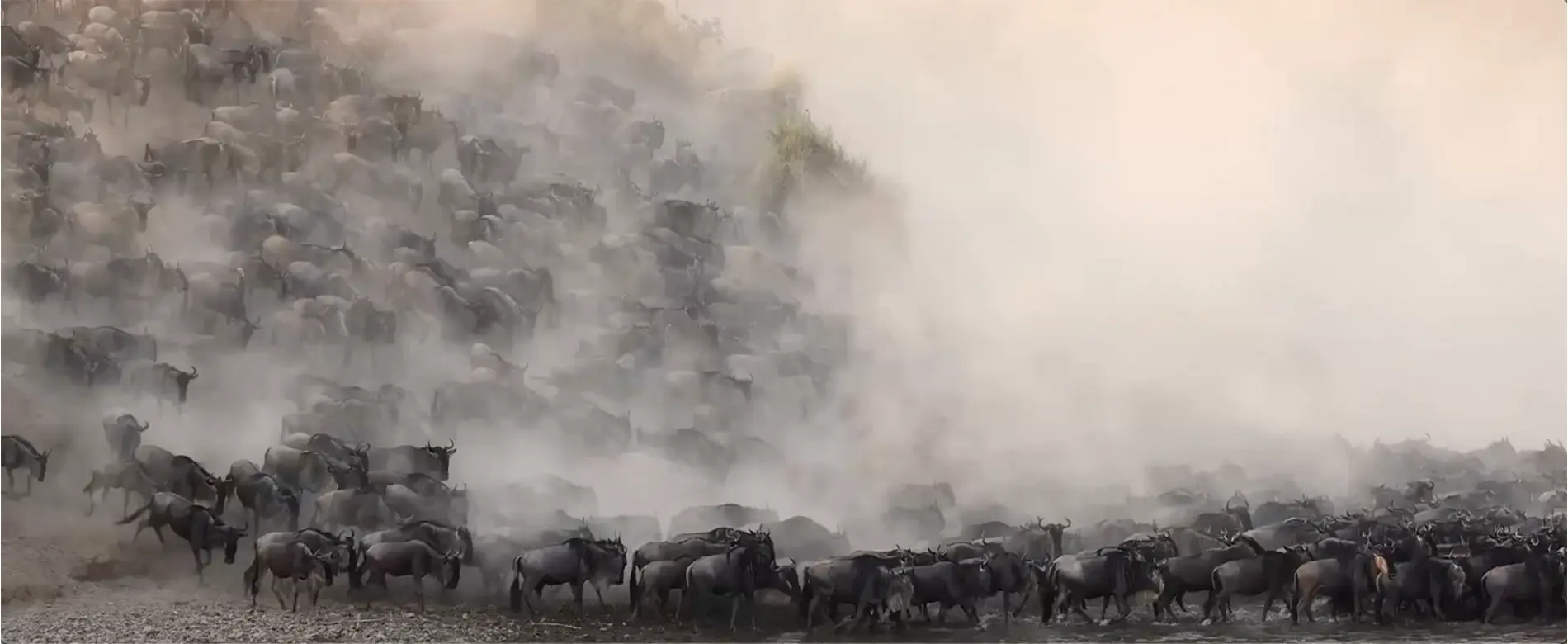


The Great Migration at a glance:
Questions | What to expect |
Where? | Serengeti (Tanzania) and Maasai Mara (Kenya), within one connected ecosystem; 800 km+ per circuit |
When? | Year-round; calving December–March, Mara River crossings roughly August–October, Grumeti River crossings May-June |
What? | An estimated 1.3–2.5 million wildebeest, alongside large numbers of zebra and gazelle, on a continuous circular migration following the rains and better grazing |
The Great Migration: Serengeti & Maasai Mara
When the rains beckon, the wildebeest go, and this never-ending circular journey makes for a compelling safari experience.
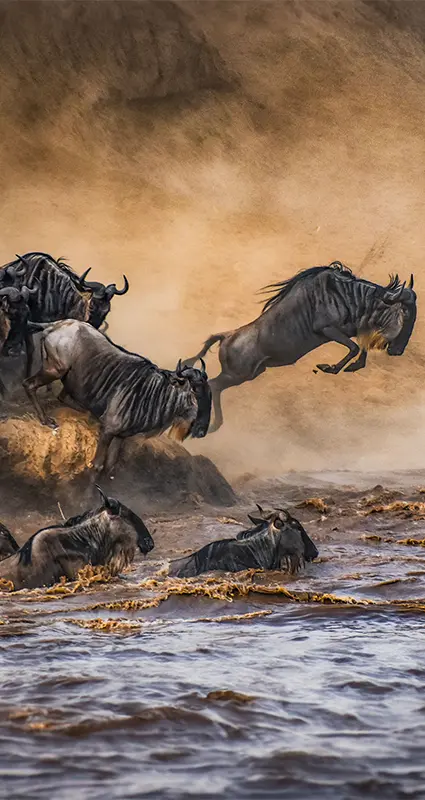
The Mara River crossings during August to October are fraught with danger, and one gets caught up in the drama of the moment, the chaos, the celebration of life. Death is ever-present, as massive crocs and tactical lions gorge on the reckless and the unlucky. During December to March, half a million wildebeest calves are born on the open plains. Big cats and hyenas cash in on the bonanza of easy pickings, the raw drama of life and survival on the African plains.
This is the Greatest Show on Earth.
Five reasons we love the Great Migration
Sheer scale: between 1.3 and 2.5 million wildebeest move across the plains, joined by zebra and gazelle; a density of life that few other places on Earth can rival.
Raw natural drama: from crocodile-filled river crossings to predators trailing the baby wildebeest, the migration plays out the full cycle of survival in real time, day after day.
Year-round reward: there is no single 'off' season: calving, rutting and river crossings each offer a different but equally compelling chapter of the same journey.
Two iconic landscapes: the vast, open Serengeti and the wildlife-rich Maasai Mara sit within one ecosystem, easily combined into a single, richly varied safari itinerary.
Conservation in action: visiting supports the parks, private conservancies and Maasai communities whose stewardship keeps this ancient migration route open and intact.
About the Great Migration experience
A Great Migration safari is built around movement. Rather than staying in one place, it follows the largest overland migration in the region as it loops clockwise through the Serengeti–Mara ecosystem.
Days are spent tracking the herds across open savannah, reading the landscape for predators, and waiting, sometimes for hours, where the wildebeest have gathered. The stakes are real: roughly 250,000 wildebeest and 30,000 zebra die during each cycle, yet that same abundance helps sustain a notably healthy lion population in the Serengeti, a bright spot for a species under pressure elsewhere in Africa.
The drama peaks at two moments. Between December and March, the short-grass plains of the southern Serengeti become a vast calving ground, where hundreds of thousands of young are born within weeks, and predators gather to take advantage. Then, in May to June, the herds cross the Grumeti River, and from there, from roughly August to October, they mass along the Mara River, plunging through crocodile-filled waters in crossings as chaotic as they are unforgettable. Witnessing it well is a matter of timing and place: a few weeks early or late, or a few kilometres off course, and the spectacle can pass you by. A migration safari rewards patience, local knowledge and a willingness to follow the herds rather than expecting them to follow you.
Beyond the migrating herds, the vast Mara-Serengeti ecosystem offers some of Africa's finest general wildlife viewing, with lions, hyenas, leopards, cheetahs, elephants, zebras, giraffes and other species present year-round.
The experience suits first-timers and seasoned travellers alike, pairing true wilderness with the guiding culture of Kenya and Tanzania.
Our favourite Great Migration safari ideas
Why book with us?
Tailor-made experiential safaris - with love
"Travel in Africa is about knowing what, when and where to go - a few weeks too early/late or a few kilometres off course, and you could miss the Greatest Show on Earth. And wouldn’t that be a pity?
Our crew of passionate safari experts have lived and worked in Africa for most of their lives. Trust us to find you the rarest animals, the most spectacular wildlife events, the remotest landscapes and deeply meaningful cultural encounters!"
Simon Espley - CEO, Africa Geographic
All you need to know about the Great Migration
The Great Migration explained
The Great Migration is a year-round circular movement of roughly 1.3 to 2.5 million wildebeest, zebra and gazelle, across the Serengeti (Tanzania) and the Maasai Mara (Kenya), a return journey of 800 km or more. Most of the migration takes place in the Serengeti, which is considerably larger than the Maasai Mara.
The clockwise circular movement is driven by seasonal rains and the search for fresh grazing; the exact timing varies each year and cannot be precisely predicted.
The herds move from Tanzania's southern Serengeti, through the Ngorongoro Conservation Area, the Loliondo Game Controlled Area, and the Grumeti Reserve. They then leave Tanzania briefly to spend time in the Maasai Mara in Kenya, which borders Serengeti National Park to the north, before heading back south to resume the journey.
The calving season runs roughly from December to March in the southern Serengeti; the Grumeti River crossings occur in June, and the Mara River crossings generally occur from about August to October.
The Great Migration is best experienced over a longer itinerary, with timing and location chosen around the events you most want to see.
Great Migration timing
The Great Migration is an ongoing, circular migration across the Serengeti (Tanzania) and Maasai Mara (Kenya) savannahs, as wildebeest and zebra herds follow the rains and green grass. You can follow the herds throughout the year, but the most rewarding migration months are the following:
May to June - Grumeti River crossings: The Serengeti’s Western Corridor hosts the migration’s best-kept secret: the Grumeti River crossings. Not as dramatic as the Mara River crossings, this experience emphasises exclusivity and intimacy.
August to October - Mara River crossings: Hordes of wildebeest and zebras cross the Mara River repeatedly as the herds criss-cross the northern Serengeti and southern Maasai Mara in search of better grazing.
December to March - babies & predators: The Southern Serengeti transforms into nature's most remarkable maternity ward. February sees the highest birthing rate of the year, with half a million wildebeest born across the season and as many as 8,000 calves arriving daily during peak periods.
Where to find Great Migration safaris
The Great Migration unfolds across two countries and several protected areas, all part of one connected ecosystem. Most of the journey takes place in Tanzania's Serengeti, which is far larger than its Kenyan counterpart, before the herds cross north into the Maasai Mara. Key areas to base yourself include:
Southern Serengeti and the Ndutu area, the heart of the calving season from December to March.
Central and western Serengeti, plus the Maswa and Grumeti reserves, are good for the herds on the move and Grumeti River crossings.
Northern Serengeti and the Lamai region, the Tanzanian side of the Mara River crossings, where many herds linger along the bank or cross repeatedly.
Maasai Mara National Reserve and its private conservancies, the Kenyan stage, with exclusive game viewing in the conservancies. The Mara River crossings occur only in the national reserve.
Because the herds are constantly moving, choosing the right region for your dates matters more than your choice of lodge.
Great Migration accommodation types
The variety of luxury accommodation available for your Great Migration safaris ranges from permanent lodges constructed of stone, wood, canvas, and thatch, to seasonal tented camps that are open only when the herds are in the area. Each has its merits, lodges for comfort and consistency, mobile camps for proximity and a more immersive feel, and many travellers combine both.
All of the lodges and camps that we include in our handcrafted safaris meet our exacting quality standards and our requirement to be responsible to the Serengeti | Maasai Mara ecosystem, wildlife, and local people.
Check out our Great Migration safari ideas above to see some of the lodges and camps with proven track records that we regularly send our guests to.
Trusted by thousands of ecstatic travellers
✔️ 5-Star Trustpilot Rating ✔️ Condé Nast Travel Specialist Award Winner
✔️ Accredited by SATSA ✔️ 5,000+ Exceptional Safaris Since 1991
Why choose Africa Geographic to plan your safari?

My husband and I have always dreamt about witnessing the migration in Africa, and we finally achieved our wish ... it was an experience that will remain with us forever! ...
I have been travelling with Africa Geographic for more than a decade ... the migration in the Serengeti, driving for miles among 1.5 million wildebeest, and 400,000 zebras ...
Booking a safari holiday to the Maasai Mara through Africa Geographic was an absolute game-changer for my travel experience. From start to finish, their service exceeded all expectations ...
Frequently asked questions
It depends on what you most want to witness. For the dramatic Mara River crossings, aim for roughly August to mid-October, which is also the busiest, priciest period. For newborn calves and intense predator activity, the December-to-March calving season in the southern Serengeti is hard to beat. The quieter months in between can offer good value and fewer vehicles. More about when to see the Great Migration.
Across the Serengeti–Mara ecosystem, spanning Tanzania's Serengeti and Kenya's Maasai Mara. The herds move clockwise from the southern Serengeti, through the Ngorongoro and Grumeti areas, up into the northern Serengeti, briefly into the Maasai Mara, and back south again. Most of the journey unfolds in the much larger Serengeti.
Both excel differently. Kenya's private conservancies offer exclusivity and reliable big-cat viewing; Tanzania's Serengeti offers unmatched scale and variety. Your choice comes down to priorities: exclusivity and predictability in Kenya, or vast wilderness in Tanzania. Many travellers combine the two. Read more about Kenya versus Tanzania.
Yes, especially in August–October when herds move between Kenya's Maasai Mara and Tanzania's Serengeti. Flying between countries is faster and more practical than driving. Many travellers combine Kenya’s private Maasai Mara conservancies for exclusive viewing with northern Tanzania’s Serengeti for river crossing action.
They peak in August and usually taper off by late September or mid-October, as the herds move across the Mara River between the northern Serengeti and the Maasai Mara. Many herds linger along the bank rather than fully crossing. Crossings cannot be scheduled; the herds may plunge in soon after arriving, wait for days, or turn back, which is exactly why a longer stay improves your chances.
No. Not even the wildebeest seem to know when they will cross. Some arrive and swim straight over; others graze nearby for days or retreat the way they came. Because the rains that drive the migration are themselves variable, no one can pinpoint a crossing in advance, so allow as much time on safari as possible.
Yes. Whatever the month, you will see vast herds and have excellent chances with lion, leopard, cheetah, hyena, elephant, zebra, giraffe and more. Kenya and Tanzania also have well-developed tourism infrastructure and a long-standing culture of excellent guiding, which makes for a smooth first experience. Read more about this topic: Our ultimate first-timers guide to the Great Migration.
River crossings occur in public areas of both reserves, so they attract many vehicles, including day visitors and self-drivers. Travelling in early October rather than peak August–September, visiting in the quieter green season (roughly late March to May) to watch the herds on the open western Serengeti, focusing on the calving season, or basing yourself in the Maasai Mara's private conservancies (where night drives, walking and off-road viewing are allowed) all help you sidestep the busiest scenes.
Estimates put the herds at between 1.3 and 2.5 million wildebeest, accompanied by large numbers of zebra and Thompson's and Grant's gazelles. Their movement in turn draws the ecosystem's predators, lion, leopard, cheetah, hyena and, at the rivers, large crocodiles, making the herds the centre of a much wider wildlife drama.
Pack for early-morning and late-afternoon game drives, when temperatures are coolest. Useful items include a warm fleece or jacket, neutral-coloured layers, a waterproof for the rains, closed shoes that cope with mud, sun protection and binoculars. Keen photographers should prepare for harsh midday light, as crossings can happen at any hour. Read more about safari packing.
Great Migration safaris typically cost from US$700 per person, per night, depending on the accommodation comfort level and activities. This price usually includes accommodation, all meals, game drives, experienced guides, airport transfers, and 24/7 support from our team.
You only make your first payment when you book your holiday. Your second (last) payment is about 105 days before you travel.
Peak season bookings require 12–18 months of advance planning. Trips outside of peak season can be arranged 6–9 months ahead, with better rates and availability.
Click here to schedule a no-obligation call with one of our Safari Experts or fill in our 2-minute form with your questions. Our team of experts are here to help! Whether you’re curious about the best time to travel, want to hear first-hand about an experience or need help planning your safari.
Explore more African safari experiences
Start planning your dream safari
Our travel experts will craft a no-obligation itinerary just for you. We have crafted over 5,000 safaris since 1991. Your personal details are protected; we only use this information to contact you.
Why book your safari with us?

Deep Experience & Knowledge
Handcrafted experiential safaris since 1991.
Travel in Africa is about knowing when and where to go, and with whom. A few weeks too early/late or a few kilometres off course, and you could miss the greatest show on Earth. And wouldn’t that be a pity?

Trust & Safety

Make A Difference
We donate a portion of the revenue from every safari sold to carefully selected conservation projects that make a significant difference at ground level.
YOUR safari choice does make a difference - thank you!