

Tailor-made safaris. Since 1991



Ngorongoro Crater: Africa's Garden of Eden
Ngorongoro Crater & Conservation Area at a glance:
Location: Northern Tanzania, part of the greater Serengeti ecosystem | Size: Conservation Area ~8,292 km²; Crater ~264 km² |
UNESCO status: World Heritage Site since 1979 (cultural significance added 2010) | Best time to visit: Year-round; June–October dry season; January–March calving season |
Crater formation: Volcanic caldera collapse roughly 2–3 million years ago | Iconic wildlife: Big Five within the crater, including black rhinos and big-tusked elephants |
Crater walls: Rise 400–600m above the crater floor | No crater accommodation: Lodges sit on the rim or Rift Valley escarpment |
Why visit Ngorongoro Crater & Conservation Area?
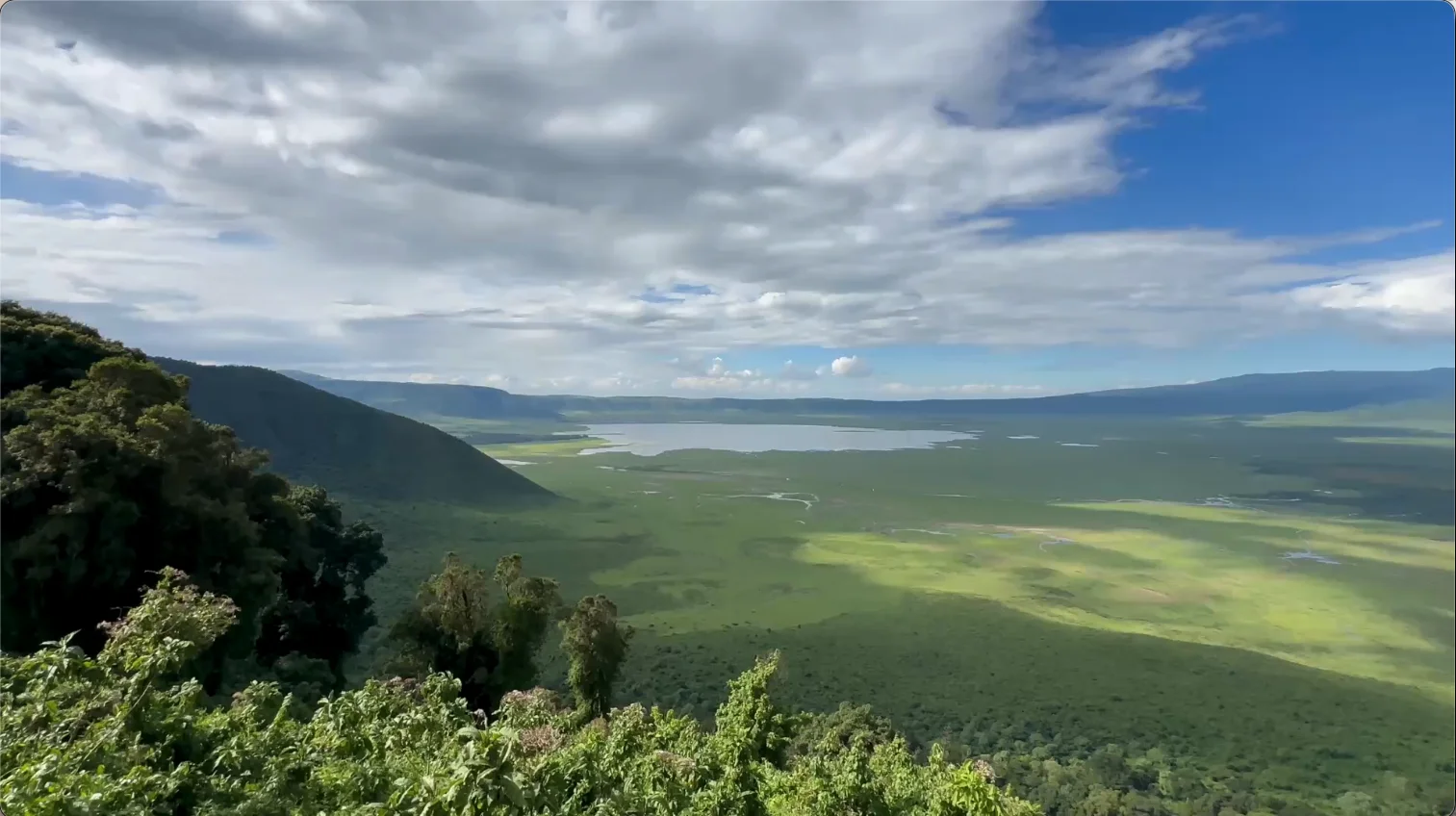
Descending into Ngorongoro Crater for the first time is a slow-motion revelation. The crater floor unfurls below the rim in bands of green and gold, and within minutes the abstraction resolves into wildlife: a lion pride dozing in open grass, a huge bull elephant moving through yellow fever trees, a black rhino picking its way across the plains. Few places deliver concentration like this. Enclosed by walls rising over 600 metres, the crater has effectively formed its own ecosystem, and Africa's most recognisable species share a single, compact basin, offering some of the most reliable Big Five sightings on the continent.
The wider Ngorongoro Conservation Area extends far beyond the crater rim, folding in the archaeological riches of Oldupai Gorge, the volcanic solitude of Olmoti and Empakai craters, and the short-grass plains around Lake Ndutu, where the Great Migration halts each year to calve. Here, wildlife and Maasai pastoralists share the same land under one of Africa's oldest multiple-land-use conservation models.
This landscape rewards unhurried exploration. A morning descent into the crater can be followed by a highland walk, a visit to a Maasai community, or a quiet afternoon at the Oldupai Gorge Museum, tracing the earliest chapters of human history.
5 Reasons We Love Ngorongoro
Concentrated Big Five viewing: Some of Africa's most reliable Big Five sightings, concentrated within one compact, self-contained volcanic basin found nowhere else on the continent.
Black rhino and giant tuskers: Exceptional chances of spotting critically endangered black rhino, alongside ancient big-tusked elephant bulls rarely seen elsewhere in Africa.
The cradle of humankind: Ancient human history unfolds at Oldupai Gorge, where fossils trace our species' evolution from Homo habilis through to Homo sapiens.
Great Migration on the doorstep: Outstanding year-round wildlife viewing, plus proximity to Ndutu's wildebeest calving season, one of Africa's greatest predator-prey spectacles.
Highland walking safaris: Guided walks into Olmoti and Empakai craters reveal volcanic landscapes, forested trails and views most crater-only visitors never experience.
Our favourite Ngorongoro safari ideas
All You Need to Know About Ngorongoro
About Ngorongoro Conservation Area
The Ngorongoro Conservation Area covers roughly 8,292 square kilometres of northern Tanzania, forming part of the greater Serengeti ecosystem. Designated a UNESCO World Heritage Site since 1979, it holds dual recognition for exceptional natural heritage and outstanding cultural significance, reflecting a rare combination of wildlife conservation, living Maasai culture and important archaeological discovery. Unlike a national park, it is instead managed under a multiple-land-use model that allows wildlife and Maasai pastoralists to coexist across the wider landscape.
At its heart lies Ngorongoro Crater, the world's largest unflooded and intact volcanic caldera, formed when an ancient volcano collapsed roughly two to three million years ago. Beyond it, the area also includes Oldupai Gorge, the Empakai and Olmoti craters, and forests and plains near Lake Ndutu.
Things to Do in Ngorongoro
Crater safari: Descend into the crater for a full-day safari across grasslands, swamps and forest, tracking lion, elephant and rhino below the rim.
Olmoti Crater walk: Take a guided walk with an armed ranger through Olmoti Crater, following ancient Maasai cattle trails to a dramatic waterfall.
Empakai Crater hike: Hike into Empakai Crater to view its soda lake, often tinged pink with flamingos, framed by views toward Ol Doinyo Lengai.
Oldupai Gorge Museum: Visit the museum to see fossil casts and the Laetoli hominid footprints, among humanity's most significant discoveries.
Ngoitokitok Spring picnic: Enjoy a picnic lunch while hippos wallow noisily below, a favourite midday stop during a crater safari.
Maasai cultural visit: Join a highland visit to learn about pastoralist traditions that continue alongside the wildlife here.
What Wildlife Can I See in Ngorongoro?
Big Five sightings: The crater offers Africa's most reliable Big Five sightings, with lion, elephant, buffalo, leopard and critically endangered black rhino all present.
Lion prides: Lion density is exceptionally high, and prides show little regard for vehicles, often resting or hunting within metres of safari traffic.
Spotted hyena clans: Large hyena clans patrol the plains in numbers, frequently competing directly with lions for territory and prey.
Big-tusked elephant bulls: Ancient bulls roam the crater floor, though breeding herds with calves remain in the forested highlands above.
Flamingos at Lake Magadi: Lesser flamingos gather during the October to December breeding season, alongside grey crowned cranes and secretary birds.
Prolific birdlife: More than 500 bird species have been recorded across the conservation area, from highland forest specials to alkaline lake waders.
Where to Stay in Ngorongoro
There is no accommodation inside Ngorongoro Crater itself; day visits to the crater floor are time-limited to protect the environment, so every lodge sits either on the crater rim, further afield on the Rift Valley escarpment, or near Oldupai Gorge.
On the Crater rim: Rim lodges offer the best access to the crater floor, allowing guests to descend early before day-trippers arrive and linger after most vehicles have left. Ngorongoro Crater Lodge is renowned for opulent, theatrical interiors and sweeping views straight into the caldera. Entamanu Ngorongoro is smaller and more understated, with views stretching toward the Serengeti plains beyond. Crater's Edge is an intimate luxury lodge on the north-eastern rim, while Ngorongoro Tented Camp and Ngorongoro Crater Camp both sit close to descent gates, pairing quick crater access with classic safari-tented styling.
Outside the Crater: Further from the rim, a different pace takes over. The Highlands sits near Olmoti Crater, offering walking safaris, drives and cultural visits from a remote, atmospheric setting away from the crowds. Gibb's Farm, set among working coffee plantations, is known for home-grown food, gardens and strong community ties. Plantation Lodge and Lemala Osonjoi both provide relaxed, well-appointed bases between Ngorongoro and Lake Manyara, while The Manor at Ngorongoro offers a smart, Cape-Dutch-style retreat well suited to families and longer stays.
Olduvai: For travellers exploring Oldupai Gorge, Olduvai Camp and the smaller Olduvai Ndogo provide simple, well-placed bases near the museum and archaeological sites.
Beyond the Crater: Ngorongoro's Highlands and Plains
Oldupai Gorge
Oldupai Gorge, often spelled Olduvai, is a steep-sided ravine whose name comes from the Maasai word for the wild sisal plant that dominates its slopes. Archaeological research here, alongside nearby Lake Ndutu and surrounding sites, has produced one of the most complete records of human evolution found anywhere on Earth. Bone fragments of Homo habilis, Paranthropus boisei, Homo erectus and eventually Homo sapiens have all been recovered from the gorge, tracing a progression from early scavenging and stone-tool use through to more complex, communal societies.
Forty-five kilometres south, at Laetoli, the discovery of hominid footprints preserved in volcanic ash for close to four million years helped settle a long-standing debate over whether bipedalism or large brain size evolved first in early hominids. The footprints themselves have since been covered to prevent erosion damage, but the Oldupai Gorge Museum, founded by Mary Leakey in the 1970s, displays casts of the footprints alongside genuine fossils, offering visitors deep insight into these globally significant discoveries.
Olmoti Crater
Olmoti Crater lies north of Ngorongoro, reached by following an ancient Maasai cattle trail through open grassland and patches of montane forest. Unlike the main crater, Olmoti can be explored entirely on foot, accompanied by an experienced guide and an armed park ranger, offering a completely different pace and perspective on this volcanic highland landscape.
The walk climbs gently to the crater rim, where views stretch out across the surrounding highlands, before continuing partway toward a grassy floor and a dramatic waterfall tumbling from the crater wall below. Birding along the route is consistently rewarding, and the surrounding ferns and dense montane vegetation make it as much a botanical experience as a scenic one. Olmoti sees far fewer visitors than the main crater floor, making it an excellent half-day addition for travellers spending two or more nights in the wider conservation area who wish to combine walking with a more conventional vehicle-based safari itinerary.
Empakai Crater
Empakai Crater, roughly ninety minutes' drive from Ngorongoro Crater, is considerably smaller than its famous neighbour but no less striking. A deep soda lake covers about half of its six-kilometre-wide caldera floor, often turning shallow and pink with thousands of gathered flamingos along its shallows. Visitors can drive to the outer rim before taking a guided, forty-five-minute walk down forested slopes to reach the crater floor, accompanied by an experienced guide and an armed park ranger throughout.
The views from Empakai's rim rank among the most spectacular in the wider region, extending toward Ol Doinyo Lengai, East Africa's only active carbonatite volcano, and on exceptionally clear days reaching as far as Kilimanjaro and Lake Natron beyond. Empakai makes an excellent full-day excursion for travellers spending more than two nights in the Ngorongoro area, offering volcanic scenery, birdlife and solitude entirely distinct from the main crater floor below.
Lake Ndutu
Lake Ndutu lies on the short-grass plains of southern Ngorongoro, along the boundary shared with the greater Serengeti ecosystem. Between January and March, hundreds of thousands of wildebeest, accompanied by large numbers of zebra and gazelle, gather here to calve during a brief, intense window that ranks among Africa's greatest wildlife spectacles. With thousands of calves born daily across the plains, predators and scavengers of every description descend on the area, taking full advantage of the seasonal abundance while inexperienced young animals sharpen their hunting skills close by.
For travellers visiting during calving season, seasonal tented camps around Ndutu provide front-row access to this drama before continuing onward into the Serengeti proper. The nutrient-rich volcanic soil that draws the migration here each year is part of the same geology that shapes Ngorongoro Crater itself, tying the region's ancient eruptions directly to the rhythms of today's Great Migration.
Lake Masek
A short distance from Lake Ndutu, on the western edge of the Ngorongoro Conservation Area bordering the Serengeti, lies Lake Masek, a shallow, alkaline soda lake fringed by acacia woodland and open grassland. Like its larger neighbour, Lake Masek is seasonal, shrinking during the dry months and swelling with the rains, and it forms an important water source for resident and migratory wildlife alike, its saline waters too concentrated for human consumption but well suited to the hardy species that depend on it.
Between December and May, the surrounding plains fall within the heart of the Great Migration's calving grounds, drawing large concentrations of wildebeest and zebra to drink at the lake's edge, along with the predators that follow them closely. Seasonal camps set on the low rises above the lake take advantage of sweeping views across the water and grasslands beyond, offering a quieter, more intimate alternative to the crater floor for travellers timing their visit to the migration season.
Understanding Ngorongoro Crater
How the crater was formed
Ngorongoro Crater began as a volcano roughly the size of Kilimanjaro. Around two to three million years ago, following a massive eruption, the volcanic cone collapsed in on itself, leaving behind the vast, unbroken caldera visible today. Its walls rise between 400 and 600 metres above the crater floor, enclosing a basin some 16 to 19 kilometres in diameter. Ngorongoro is widely described as the largest unflooded, intact caldera on Earth: unlike many calderas elsewhere, its walls remain whole, and its floor has never filled with water to form a lake.
A self-contained ecosystem
The crater's enclosed nature has effectively created its own ecosystem, and the concentration of wildlife within it is extraordinary. An estimated 25,000 to 30,000 large mammals move across the crater floor, drawn by permanent water sources and mineral-rich, nutrient-dense grazing. Sightings begin almost as soon as visitors descend: wildebeest, zebra and buffalo graze in the open, often within view of resting predators. Lion prides show little regard for vehicles, occasionally resting in their shade, while spotted hyena clans patrol wide stretches of the plains. The crater also holds one of Tanzania's most closely monitored populations of eastern black rhino, individually tracked and protected after decades of recovery from historic poaching.
Three species that many visitors expect to see are conspicuously absent: giraffe, impala and topi. The steep descent and lack of suitable browsing vegetation are thought to explain the absence of giraffe and impala, and in their place, wildebeest, zebra and Thomson's gazelle dominate the open plains instead. Elephant herds, meanwhile, behave differently here than elsewhere: breeding groups with calves largely remain in the forested rim above, while the crater floor itself is best known for ancient, solitary bulls carrying some of the largest ivory left in Africa today, making it one of the finest places on the continent to see both big-tusked elephants and black rhino.
Habitats within the crater
Despite its modest size, the crater floor holds a remarkable variety of habitats within a single game drive. In the southwest, Lerai Forest is dominated by yellow-barked fever trees and is the crater's primary refuge for leopards, along with baboons and elephants seeking shade. To its north lies the shallow, alkaline Lake Magadi, its waters regularly tinged pink by lesser flamingos gathering to feed and breed, particularly between October and December. To the east, the Ngoitokitok Springs and Gorigor and Mandusi Swamps provide permanent water for hippo pods, elephants, and lions, and make for a popular picnic stop during a full-day safari. The Short Grass Plains dominate the crater's centre, supporting the bulk of its grazing herds, while the drier Rumbe Hills to the east favour larger buffalo herds moving across more undulating terrain.
Together, these habitats compress an astonishing range of East African wilderness into one of the most rewarding half-day or full-day safaris on the continent.
Trusted by thousands of ecstatic travellers
✔️ 5-Star Trustpilot Rating ✔️ Condé Nast Travel Specialist Award Winner
✔️ Accredited by SATSA ✔️ 5,000+ Exceptional Safaris Since 1991
Why choose Africa Geographic to plan your safari?

"AG organized an outstanding East African experience for me, my wife, and two friends. They set us up with great guides, lovely accommodations, and most importantly, incredible natural history experiences. Seamless travel. And when we wanted to make a last minute change, they were right there to timely accommodate us. 6/5 rating!"
"We recently returned from a wonderful adventure through the East African countries...watching the migration of wildebeests in Tanzania...The drivers and guides were very personable and knowledgable; they did a wonderful job engaging with all of us, and, most importantly, took the time to engage with each of the children."
"The 2 drivers were with us every day and were knowledgeable and good communicators. Their many years of experience and also skill in driving thru challenging rough terrain allowed us to get to great viewing spots at the right times. The food was abundant and very good quality...The hospitality was excellent everywhere we went."
Wish you were here?
Frequently asked questions
No. Ngorongoro Crater is a single volcanic caldera covering roughly 264 square kilometres, while the Ngorongoro Conservation Area is the much larger, 8,292-square-kilometre protected region surrounding it. The conservation area includes the crater itself, plus Oldupai Gorge, Empakai and Olmoti craters, highland forests and the plains bordering Lake Ndutu.
Ngorongoro is most accurately described as the world's largest unflooded, intact volcanic caldera, meaning its walls remain unbroken and its floor has never filled with water to form a lake. Larger calderas do exist elsewhere, but few match Ngorongoro's combination of scale, intact walls and dense resident wildlife.
Yes, but the distinction matters. The Big Five, lion, leopard, elephant, buffalo and rhino, can be reliably found within the crater itself, one of the few places in Africa offering such consistent sightings in a single, compact area. Beyond the crater rim, across the wider conservation area, sightings become far less predictable.
No. Giraffe and impala are both notably absent from the crater floor, most likely due to the steep descent and a lack of suitable browsing trees. Both species are common in the surrounding highlands and wider conservation area, just not within the caldera itself.
Wildebeest calving typically occurs between January and March on the short-grass plains around Lake Ndutu and southern Ngorongoro. Over this period, huge numbers of calves are born within a short window, drawing intense predator activity across the plains.
Ngorongoro delivers strong wildlife viewing year-round, since the crater supports a large resident population regardless of season. The dry season from June to October offers cooler temperatures and clearer visibility, while January to March suits travellers combining the crater with the Ndutu calving season.
No. There is no accommodation inside the crater itself, in order to protect its environment. Lodges and camps are instead located along the crater rim or further afield on the Rift Valley escarpment, with rim properties offering the shortest access to the crater floor.
Ngorongoro is most commonly reached from Arusha, either by a drive of approximately three to four hours or via a light aircraft flight to a nearby airstrip. Kilimanjaro International Airport serves as the main international gateway for northern Tanzania.
Oldupai, also spelled Olduvai, is one of the world's most important paleoanthropological sites. Fossil discoveries here, including remains of Homo habilis, Paranthropus boisei and Homo erectus, have been fundamental to understanding human evolution, alongside the nearby Laetoli hominid footprints.
Walking is not permitted on the main crater floor, but guided walks accompanied by an armed ranger are available in Olmoti and Empakai craters, offering a completely different, more immersive way to experience the wider highlands on foot.
Lake Magadi is a shallow, alkaline soda lake at the centre of Ngorongoro Crater, fed by the Ngoitokitok Spring and Munge River. It regularly attracts large flocks of lesser flamingos, particularly during their breeding season between October and December.
Most travellers combine a morning or full-day crater safari with time exploring the wider conservation area, such as Oldupai Gorge or the Olmoti and Empakai craters. Two to three nights allows for a crater descent alongside these additional highland experiences.
Yes. Ngorongoro forms the centrepiece of Tanzania's Northern Safari Circuit, typically combined with Tarangire National Park, Lake Manyara National Park and the Serengeti, creating a varied itinerary spanning volcanic highlands, forests and open plains.
Our safaris typically cost from US$700 per person, per night, depending on the accommodation comfort level, time of year and activities. This price usually includes accommodation, all meals, game drives, experienced guides, airport transfers, and 24/7 support from our team.
Click here to schedule a no-obligation call with one of our Safari Experts or fill in our 2-minute form with your questions. Our team of experts are here to help! Whether you’re curious about the best time to travel, want to hear first-hand about an experience or need help planning your safari.
Explore more African destinations
Start planning your dream safari
Our travel experts will craft a no-obligation itinerary just for you. We have crafted over 5,000 safaris since 1991. Your personal details are protected; we only use this information to contact you.
Why book your safari with us?

Deep Experience & Knowledge
Handcrafted experiential safaris since 1991.
Travel in Africa is about knowing when and where to go, and with whom. A few weeks too early/late or a few kilometres off course, and you could miss the greatest show on Earth. And wouldn’t that be a pity?

Trust & Safety

Make A Difference
We donate a portion of the revenue from every safari sold to carefully selected conservation projects that make a significant difference at ground level.
YOUR safari choice does make a difference - thank you!