

Tailor-made safaris. Since 1991



Southern Kenya: Giant Elephants, Kilimanjaro Views and Varied Landscapes
Southern Kenya at a glance:
Location: Southeastern Kenya, near the Tanzanian border; Kajiado County and the Tsavo hinterland | Parks: Amboseli NP (39,206 ha) · Chyulu Hills NP (74,100 ha) · Tsavo East NP (1,370,000 ha) · Tsavo West NP (900,000 ha) |
Combined ecosystem: 23,000+ km², one of the world's largest wildlife sanctuaries | Best time to visit: June–October (primary dry season); January–March (second dry season) |
Access: Light aircraft from Wilson Airport, Nairobi (~45 min to Amboseli); road from Nairobi (~4–5 hrs) or Mombasa (~2 hrs to Tsavo) | Wildlife highlights: Super tusker elephants, maneless lions, hirola (world's rarest antelope), striped hyenas, African wild dogs, black rhino, cheetah, leopard, 300–550+ bird species per park |
Key features: Mount Kilimanjaro backdrop; Mzima Springs; Yatta Plateau (longest lava flow in the world); Amboseli Elephant Research Project (50+ years) | Accommodation: 13 properties across four parks, from community conservancy camps to architecturally striking luxury lodges |
Why visit Southern Kenya?
Few safari circuits in Africa ask as much of a landscape as Southern Kenya delivers. Four national parks, connected by ancient wildlife corridors across a combined protected area of more than 23,000 km², form one of the world's largest wildlife sanctuaries, sheltering the most significant concentration of super tusker elephants remaining on Earth, all set against the snow-capped summit of Mount Kilimanjaro.
Each park brings a distinct character to the journey. Amboseli is intimate, marsh-fed and shaped by more than five decades of elephant research that changed what the world understands about these animals. Tsavo East opens into one of Africa's last great arid wildernesses: vast, red-soiled and uncrowded, sheltering super tuskers, the world's rarest antelope, alongside distinctive maneless lions. Tsavo West answers with volcanic drama, dense habitat and Mzima Springs, where crystal-clear water emerges from the earth, and hippos can be watched from below the surface. The Chyulu Hills rise green and volcanic between the two ecosystems, their porous rock channelling rainfall underground to feed springs that sustain wildlife across the broader landscape.
Conservation and community are woven into the fabric of this circuit. The Amboseli Ecosystem Trust maintains the wildlife corridors that allow species to move freely across the landscape. The Kuku Group Ranch co-manages the Chyulu Hills with resident Maasai communities. Tourism here does not sit alongside conservation. It funds it. This is not a circuit you pass through. It is one you come to understand.
5 reasons we love Southern Kenya
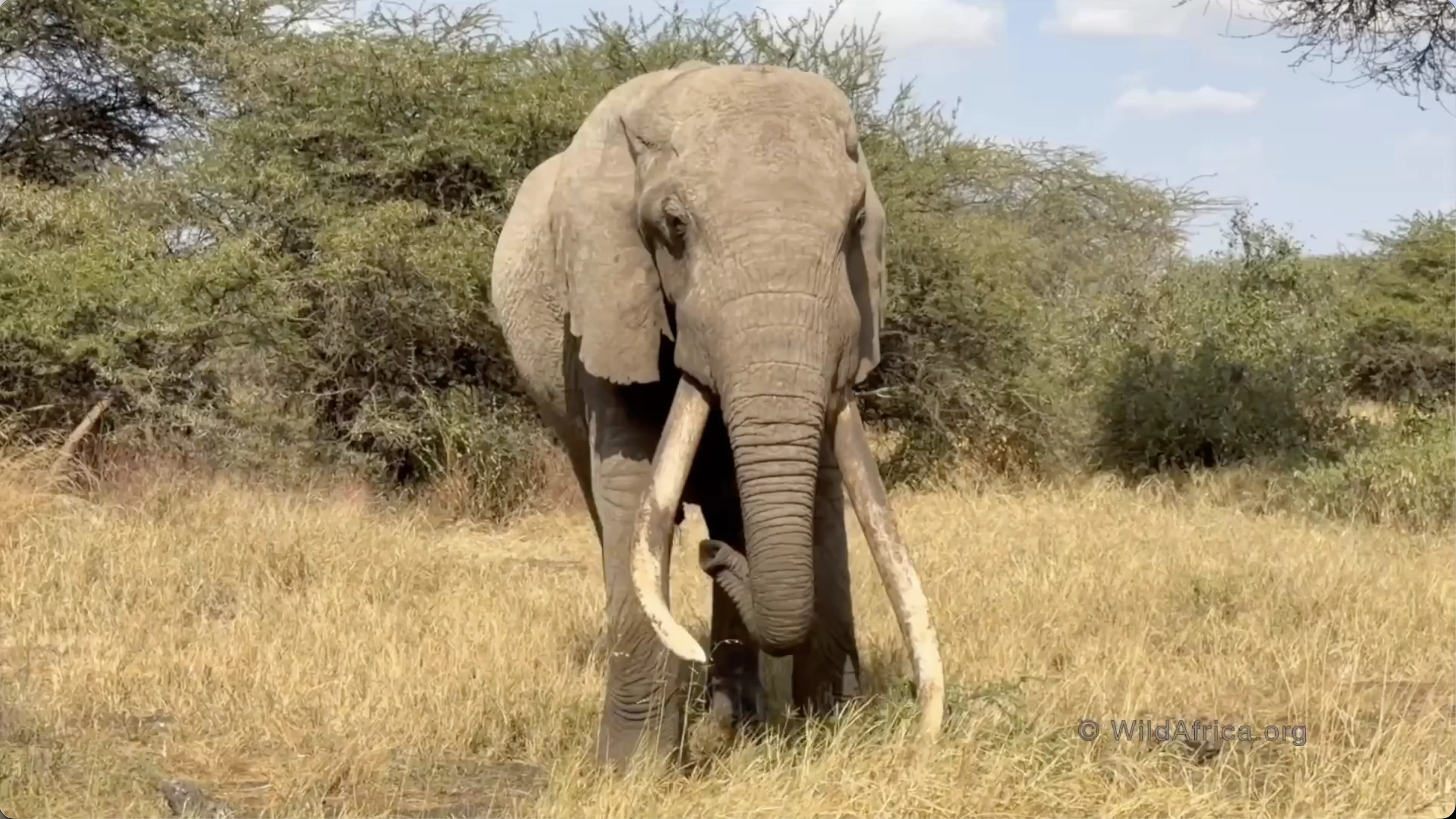
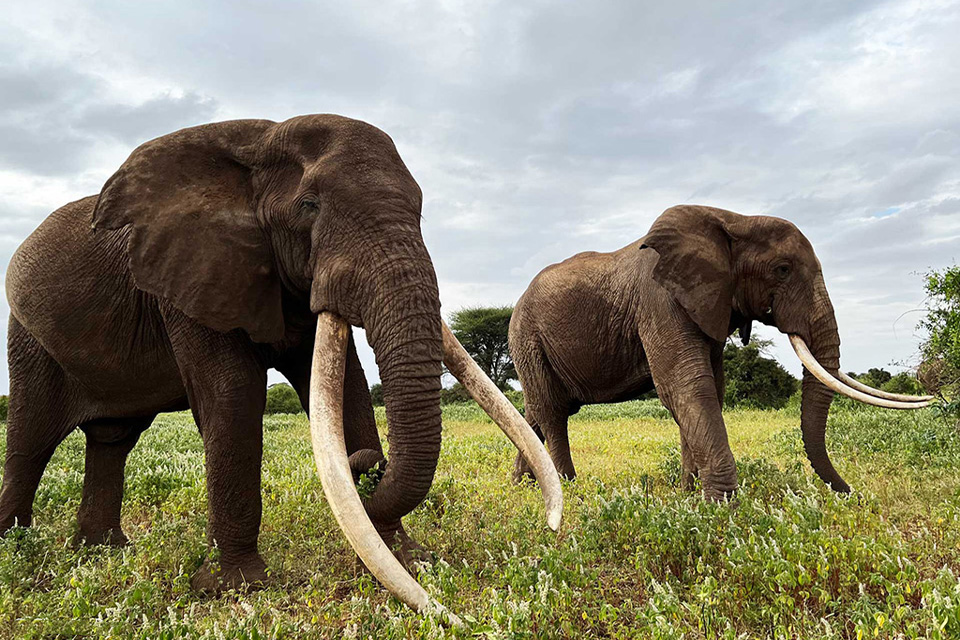
The last of the super tuskers: Southern Kenya holds one of the world's last significant concentrations of extraordinarily large-tusked bull elephants, a privilege that may not exist for future generations.
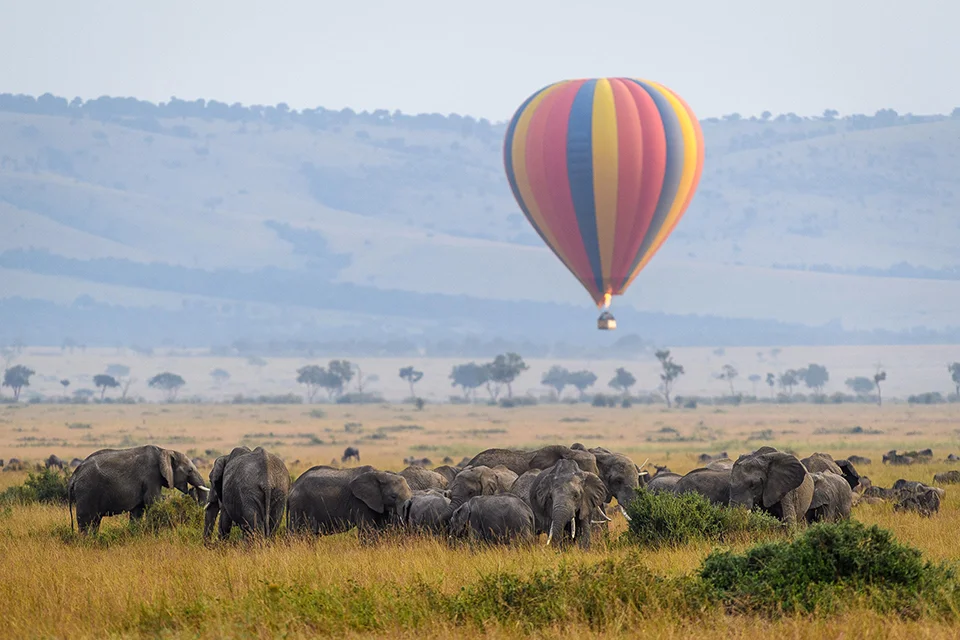
The world's most iconic wildlife photograph: Elephants crossing dusty plains with Kilimanjaro's 5,895-metre summit floating above them. No other safari destination on Earth delivers this precise combination of subjects.
Mzima Springs, below the surface: A crystal-clear volcanic pool at Tsavo West where an underground glass chamber places you at eye level with resident hippos, Nile crocodiles and shoals of fish.
The world's rarest antelope and Kenya's most distinctive lions: Tsavo East shelters the critically endangered hirola, found nowhere else in Kenya, alongside maneless lions whose ancestors made this one of Africa's most infamous wildlife stories.
Four landscapes, one journey: Amboseli's elephant marshes, the mist-wrapped Green Hills of Africa, Tsavo's red open plains and Tsavo West's volcanic highlands make this Kenya's most varied and least-crowded safari circuit.
All you need to know about Southern Kenya
Things to do in Southern Kenya
Game drives across four distinct landscapes: From Amboseli's elephant-rich swamp margins and Tsavo East's vast open red plains to Tsavo West's volcanic highlands and Chyulu's green rolling hills, each park offers a different driving experience with its own wildlife character.
Walking safaris and night drives in community conservancies: Porini Amboseli's Selengei Conservancy, adjacent to the national park, permits walking safaris and night drives unavailable inside the park boundary; guided ridge walks and cloud-forest hikes are equally defining in the Chyulu Hills.
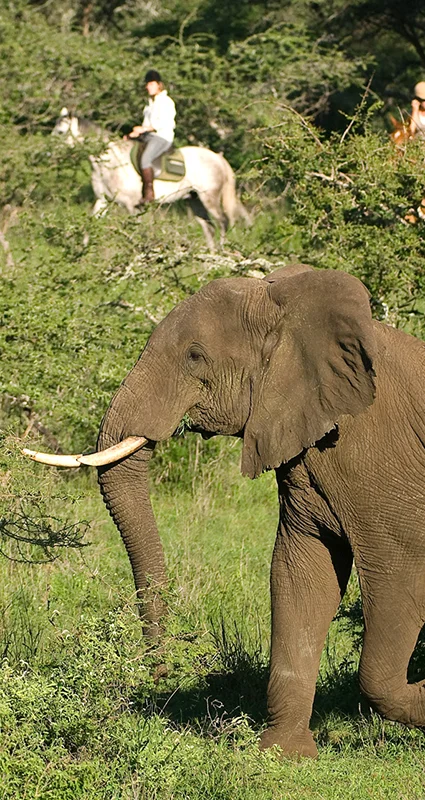
Lava-tube caving and horse riding in the Chyulu Hills: Descend into one of Africa's longest cave systems, including the vast Leviathan, or ride across volcanic plains and approach wildlife quietly from the saddle.
Mzima Springs: Enter the underground glass viewing chamber at Tsavo West's most iconic attraction and watch hippos, crocodiles and fish moving through crystal-clear spring water at eye level.
Photography: elephants beneath Kilimanjaro: Amboseli remains the world's foremost location for this singular image; Tsavo East's low visitor density and red-stained elephant herds offer equally rare conditions for wildlife photography.
Maasai and Kamba cultural encounters: Lodge-arranged visits to communities across Amboseli and the Chyulu Hills offer a direct, living encounter with the people who are the custodians and co-managers of this landscape.
What wildlife can I see in Southern Kenya?
Super tusker elephants: Present across all four parks; Amboseli's herds are the world's most studied, while Tsavo's populations carry the distinctive red stain of laterite soil, a colouring unlike anywhere else in Africa.
Maneless lions, leopards and cheetahs: Tsavo's distinctive maneless lions, leopards, and cheetahs range across the circuit. Amboseli carries a high predator density for its size, and African wild dogs (also known as painted wolves) have returned to Tsavo East's reopened northern areas.
Hirola, gerenuk, lesser kudu and dry-country specialists: Tsavo East shelters hirolas, the world's rarest antelope, alongside gerenuk, lesser kudu, fringe-eared oryx and striped hyena.
Hippos, Nile crocodiles and marsh wildlife: Hippos are abundant year-round in Amboseli's marshes; Mzima Springs in Tsavo West offers an underwater view of hippos and crocodiles in a setting found nowhere else on the circuit.
Black rhino: A small protected population inhabits the Chyulu Hills' lava fields under the watch of dedicated rangers; rare sightings are also recorded within the Tsavo West Rhino Sanctuary (approximately 320,000 hectares).
Birds, 300 to 550+ species per park: Amboseli's Malagasy pond heron and steel-blue whydah; Tsavo East's vulturine guineafowl and golden-breasted starling; Chyulu Hills' Abbott's starling and narina trogon; Tsavo West's taita falcon and Fischer's starling.
Where to stay in Southern Kenya
Accommodation across Southern Kenya ranges from intimate bush camps to luxury lodges, exclusive villas, and panoramic tented lodges.
The range of options across the region is vast, and we showcase many of them on the regional pages linked below.
Explore the Southern Kenya parks
Amboseli National Park
Amboseli National Park covers 39,206 hectares in Kajiado County, with Mount Kilimanjaro rising 50 kilometres to the southeast across the Tanzanian border. The park's name derives from the Maa word Empusel, meaning "salty, dusty place", and the landscape reflects it: arid, low in rainfall and fed not by rain but by glacial meltwater filtering through Kilimanjaro's porous soils before surfacing as freshwater springs. These springs feed the three great marshes, Enkongo Narok, Ol Tukai and Olokeya, that sustain one of Africa's highest elephant concentrations. More than 550 bird species are recorded across the marshes and open plains. Observation Hill, a pyramid-shaped volcanic formation at the park's heart, offers a 360-degree view across the entire ecosystem.
What sets Amboseli apart is the depth of knowledge surrounding its elephants. The Amboseli Elephant Research Project, initiated by Cynthia Moss and Harvey Croze and operated by the Amboseli Trust for Elephants, has documented individual herds across more than five decades, transforming the global understanding of elephant social bonds and emotional lives. The matriarch Echo, who led her family for over forty years before her death in 2008, became internationally known. Super tuskers Tim and Craig have since passed away, but a small number remain in the broader ecosystem. The Amboseli Ecosystem Trust maintains the wildlife corridors that allow these animals to move freely across the landscape, while conservancies such as Selengei offer experiences, including night drives and walking safaris, unavailable inside the national park.
Chyulu Hills National Park
Rising abruptly green from the arid plains between Amboseli and Tsavo West, the Chyulu Hills are among the youngest volcanic ranges on Earth: a chain of grassy cones, lava flows and underground cave systems running for almost 100 kilometres across southeastern Kenya. Ernest Hemingway immortalised these slopes as the Green Hills of Africa, and the description holds. Nightly mist keeps the higher crests wrapped in cloud forest while the lower slopes open into thorn tree grassland and bare lava fields. Gazetted in 1983, the park covers approximately 74,100 hectares and forms part of the larger Tsavo-Chyulu protected area.
The hills perform a quiet but essential ecological function. Porous volcanic rock absorbs rainfall and channels it underground to feed Mzima Springs in Tsavo West, sustaining wildlife across the broader ecosystem. The Leviathan lava-tube system, one of the longest in Africa, threads beneath the hills. A small, carefully protected population of black rhino inhabits the lava fields, monitored by dedicated rangers. Around 300 bird species are recorded, including the rare Abbott's starling, and the endemic Chyulu Hills blade-horned chameleon can be found during nature walks. The surrounding land belongs largely to the Kuku Group Ranch, co-managed with resident Maasai communities in a model where conservation, culture and community livelihood are inseparable.
Tsavo East National Park
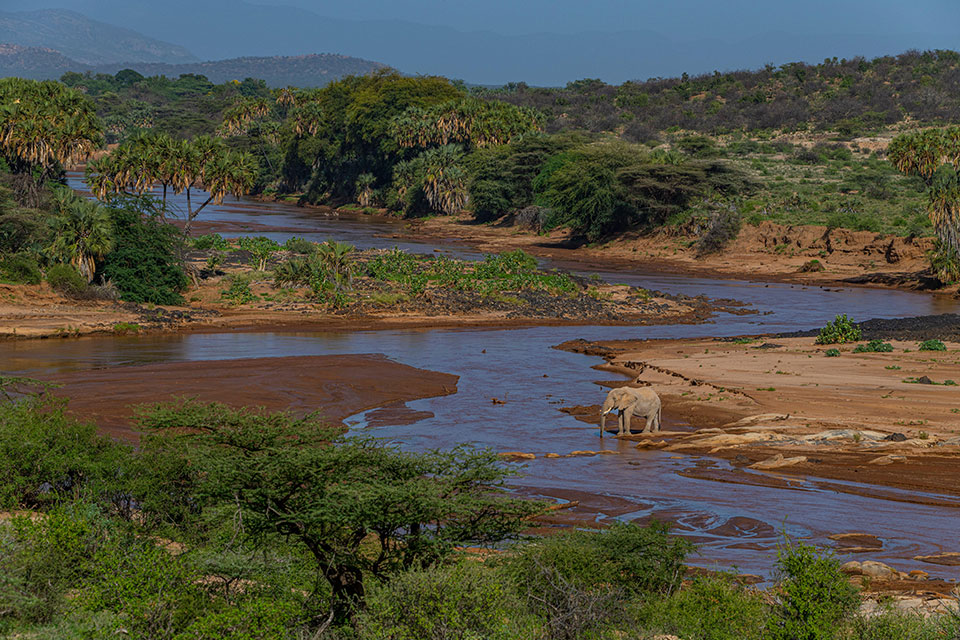
Tsavo East is the largest park in the Southern Kenya circuit and one of the most distinctive wildlife landscapes on the continent. Its 1,370,000 hectares of arid grassland savanna and red semi-desert stretch between Nairobi and Mombasa, defined above all by space. It is easily possible to spend a full day exploring without encountering another vehicle. The park's red laterite soil stains its elephant herds a deep ochre, a colouring unique to this population; a herd crossing the Galana River, caked in red dust, is one of Africa's most striking safari images.
Two geological features define Tsavo East's physical character. The Yatta Plateau runs for more than 300 kilometres along the western boundary, the longest lava flow in the world. Mudanda Rock, a large inselberg within the park, acts as a natural water catchment, drawing elephant herds to drink at the pool below and offering an elevated vantage point above them.
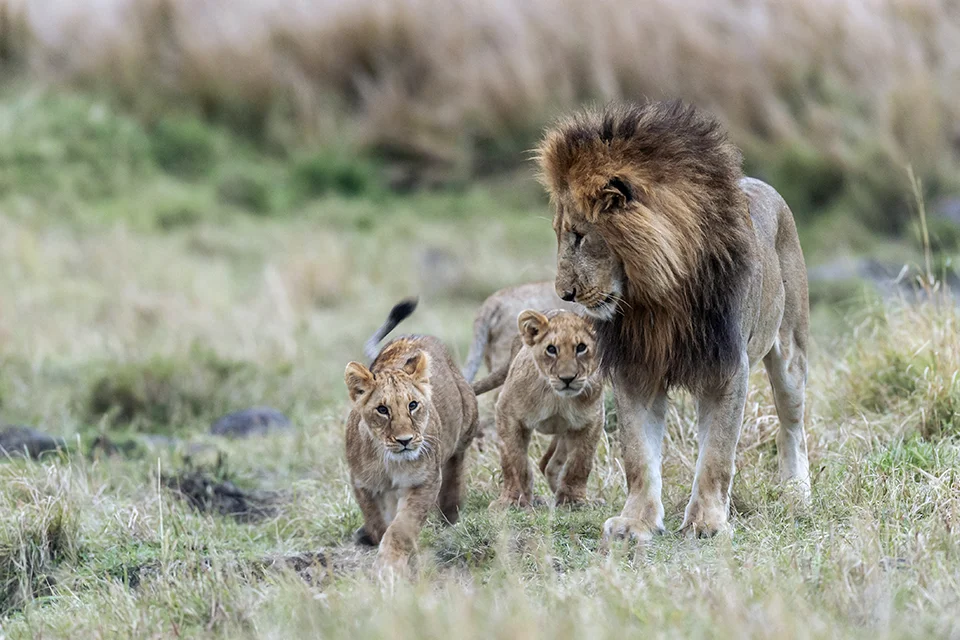
The park's wildlife profile is unlike anywhere else in Kenya. The hirola, the world's rarest antelope and critically endangered, is found in Kenya only in Tsavo East. The park's lions carry reduced or absent manes, a characteristic documented since 1898 when two such lions reportedly killed construction workers building the railway bridge over the Tsavo River, a story dramatised in The Ghost and the Darkness. The reopening of the former "forbidden zone" in the park's north has brought African wild dogs, or painted wolves, back to Tsavo East.
Tsavo West National Park
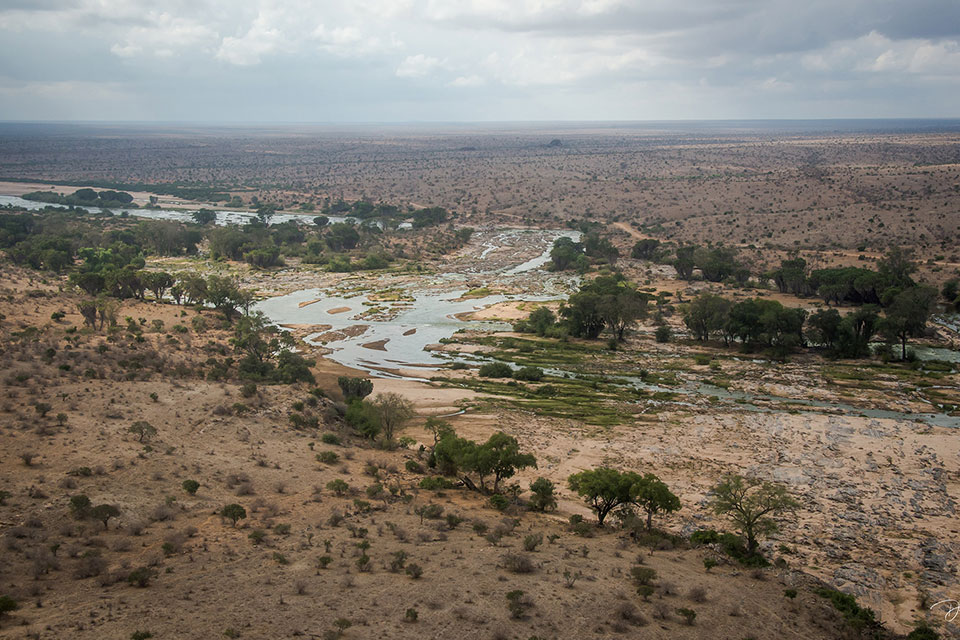
Where Tsavo East unfolds across open red plains, Tsavo West answers with volcanic drama. Its 900,000 hectares are shaped by ancient tectonic shifts and eruptions that produced dramatic mountains, sheer inselbergs and cliff faces unlike anything in the broader circuit. The vegetation is denser here: higher rainfall and fertile volcanic soils support thicker bush, which makes wildlife viewing occasionally more challenging but the landscape considerably more spectacular. The Tsavo River runs through the park before joining the Athi to form the Galana River, and on clear mornings the summit of Kilimanjaro is visible across the Tanzanian border to the west.
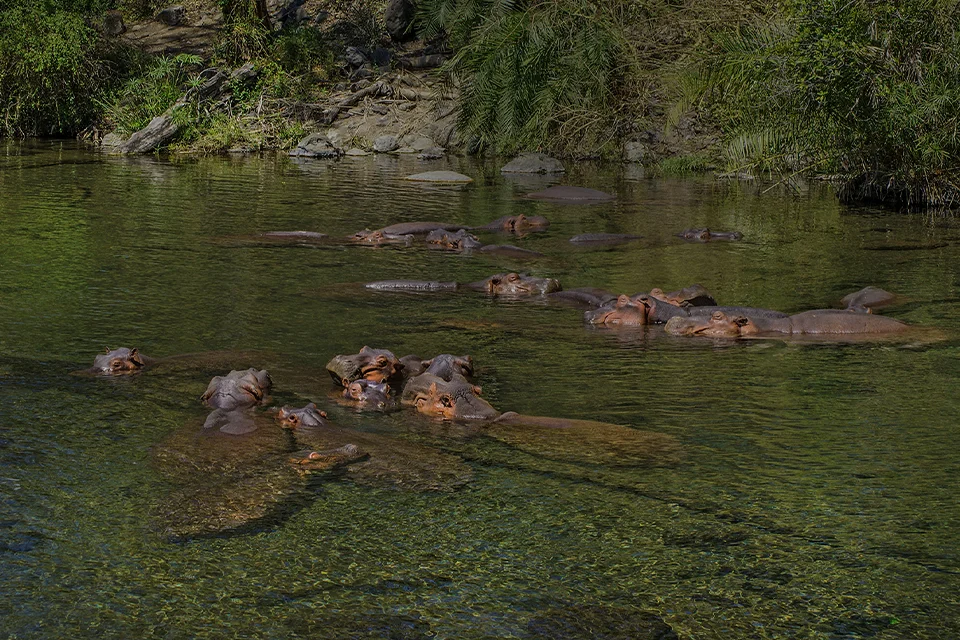
Mzima Springs is the park's signature attraction and one of the most unusual wildlife experiences in Kenya. Underground water, filtered through the porous volcanic rock of the Chyulu Hills, emerges here as crystal-clear pools inhabited by hippos, Nile crocodiles and shoals of fish. An underground glass viewing chamber allows visitors to watch this life from below the waterline, surrounded by dense date and raffia palms. More than 530 bird species are recorded, including the taita falcon, narina trogon and Somali ostrich. The Tsavo West Rhino Sanctuary (approximately 320,000 hectares) offers a chance to encounter rare black rhinos with the assistance of a local guide, and the sharp granite cliffs of Kitchwa Tembo in the park's west provide a recognised rock-climbing destination with views toward Kilimanjaro. The park's most atmospheric lodge takes its name from Denys Finch Hatton, the British adventurer immortalised in Out of Africa, who loved this landscape above all others.
Trusted by thousands of ecstatic travellers
✔️ 5-Star Trustpilot Rating ✔️ Condé Nast Travel Specialist Award Winner
✔️ Accredited by SATSA ✔️ 5,000+ Exceptional Safaris Since 1991
Why choose Africa Geographic to plan your safari?

"This safari on foot through Tsavo National Park was the trip of a lifetime... AG, who assisted me assiduously from the initial enquiry through the whole administrative process to the final planning stage right up to departure. The safari itself was an unforgettable experience. I'm immensely grateful to AG...for making this wonderful safari possible."

"Yet another fabulous trip arranged...this time to Kenya...The experience with one of the super tuskers was breathtaking; it came within touching distance! In addition, so many other amazing encounters with numerous animals and birds. The final day in Amboseli provided iconic shots of elephants with Kilimanjaro in the background...I can't wait for the next trip in September!!"

"Yet another fabulous trip arranged...this time to Kenya, Tsavo East, Amboseli and...The aim was to search for super tuskers and the endangered hirola in Tsavo...The experience with one of the super tuskers was breathtaking; it came within touching distance! In addition, so many other amazing encounters with numerous animals and birds...I can't wait for the next trip in September!!"
Wish you were here?
Frequently asked questions
Southern Kenya's safari circuit comprises four national parks: Amboseli, Chyulu Hills, Tsavo East and Tsavo West. Together they form part of a connected protected landscape exceeding 23,000 km², one of the world's largest wildlife sanctuaries, linked by migratory corridors used by elephants, lions and other wide-ranging species.
The primary dry season, June to October, is the most reliable window: sparse vegetation, concentrated wildlife and clear Kilimanjaro views. January to March provides a second dry period. The long rains (March to May) and short rains (November to December) bring fewer visitors, good availability and green, photogenic scenery.
Super tuskers are bull elephants with at least one tusk weighing 100 pounds and are so massive that they touch the ground, an increasingly rare trait. The Amboseli–Tsavo ecosystem holds one of the last meaningful concentrations in Africa, and a small number still roam the broader Southern Kenya circuit.
Initiated by Cynthia Moss and Harvey Croze and operated by the Amboseli Trust for Elephants, the Amboseli Elephant Research Project is the longest-running study of wild elephant behaviour, documenting individual herds across more than five decades. Its findings transformed the world's understanding of elephant family bonds and emotional lives.
Yes. On clear mornings, Kilimanjaro's snow-capped summit dominates the skyline from Amboseli, just 50 kilometres to the southeast, and is visible from the western sections of Tsavo West on clear days. Cloud typically builds by mid-morning, making early game drives the best window for unobstructed views.
The hirola is the world's rarest antelope, critically endangered and found in Kenya only in Tsavo East and along the Kenyan-Somali border. Introduced into the park to protect the species beyond its limited natural range, a hirola sighting in Tsavo East is one of Kenya's rarest large mammal encounters.
In 1898, two maneless male lions reportedly killed construction workers during the building of the railway bridge over the Tsavo River, before being shot by Lt Colonel JH Patterson. Their story was dramatised in The Ghost and the Darkness, and Tsavo's lions still carry the distinctive maneless trait.
Mzima Springs is Tsavo West's signature attraction: crystal-clear pools fed by rainfall filtering through the Chyulu Hills' porous volcanic rock. Resident hippos, Nile crocodiles and fish inhabit the water, and an underground glass viewing chamber allows visitors to watch them from below the surface.
Most visitors fly by light aircraft from Wilson Airport, Nairobi, to individual park airstrips, approximately 45 minutes to Amboseli. Road transfer from Nairobi takes four to five hours to Amboseli and around four hours to the Tsavo parks; Mombasa is approximately two hours from both Tsavo parks by road.
Yes. Tsavo East and Tsavo West are both approximately two hours by road from Mombasa, making a bush-and-beach combination one of Southern Kenya's most practical and rewarding itinerary options. Several camps in both parks arrange onward road or light aircraft transfers to the Kenyan coast.
Amboseli is compact, marsh-fed and built around its extraordinary elephant experience. The Chyulu Hills are volcanic, green and uncrowded. Tsavo East is vast, arid and defined by red elephants, rare species and minimal visitor traffic. Tsavo West is more dramatic and densely vegetated, with Mzima Springs as its centrepiece.
The circuit offers walking safaris and night drives in community conservancies around Amboseli; guided lava-tube caving, horse riding and mountain biking in the Chyulu Hills; the Mzima Springs underground glass viewing chamber in Tsavo West; and Maasai and Kamba cultural visits across both Amboseli and the Chyulu Hills.
A portion of every safari sold through Africa Geographic supports conservation projects at ground level, alongside the organisation's conservation publishing work. Several Southern Kenya properties operate within community conservancy frameworks, including Porini Amboseli in the Selengei Conservancy and Chyulu Lodge within its Maasai conservancy. The Amboseli Ecosystem Trust works specifically to maintain the wildlife corridors that connect these parks and reduce human-wildlife conflict across the landscape.
Our safaris typically cost from US$700 per person, per night, depending on the accommodation comfort level, time of year and activities. This price usually includes accommodation, all meals, game drives, experienced guides, airport transfers, and 24/7 support from our team.
Click here to schedule a no-obligation call with one of our Safari Experts or fill in our 2-minute form with your questions. Our team of experts are here to help! Whether you’re curious about the best time to travel, want to hear first-hand about an experience or need help planning your safari.
Explore more African destinations
Start planning your dream safari
Our travel experts will craft a no-obligation itinerary just for you. We have crafted over 5,000 safaris since 1991. Your personal details are protected; we only use this information to contact you.
Why book your safari with us?

Deep Experience & Knowledge
Handcrafted experiential safaris since 1991.
Travel in Africa is about knowing when and where to go, and with whom. A few weeks too early/late or a few kilometres off course, and you could miss the greatest show on Earth. And wouldn’t that be a pity?

Trust & Safety

Make A Difference
We donate a portion of the revenue from every safari sold to carefully selected conservation projects that make a significant difference at ground level.
YOUR safari choice does make a difference - thank you!