

Tailor-made safaris. Since 1991



Lake Turkana: Africa's Jade Sea revealed
Lake Turkana at a glance:
Location: Northern Kenya, Great Rift Valley | Access: Charter or scheduled flight to Loiyangalani or South Horr airstrips |
Size: 249 km north to south; 44 km at widest point | Best time to visit: January–March; July–October (dry seasons) |
UNESCO status: World Heritage Site (Lake Turkana National Parks) | Minimum recommended stay: 4–5 nights |
Currency: Kenyan Shilling (KES) | Malaria risk: Yes, prophylaxis recommended |
Why visit Lake Turkana?
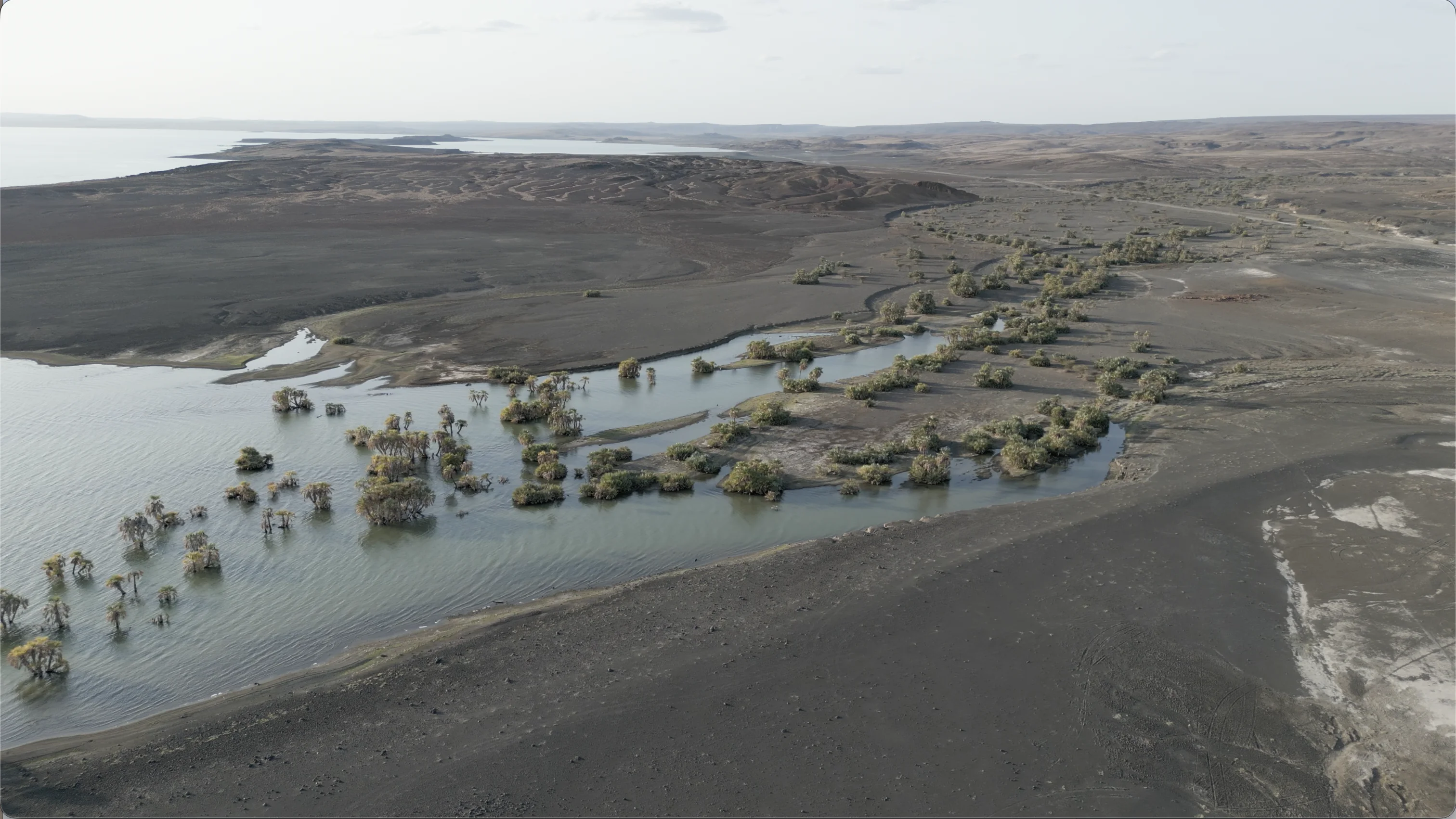
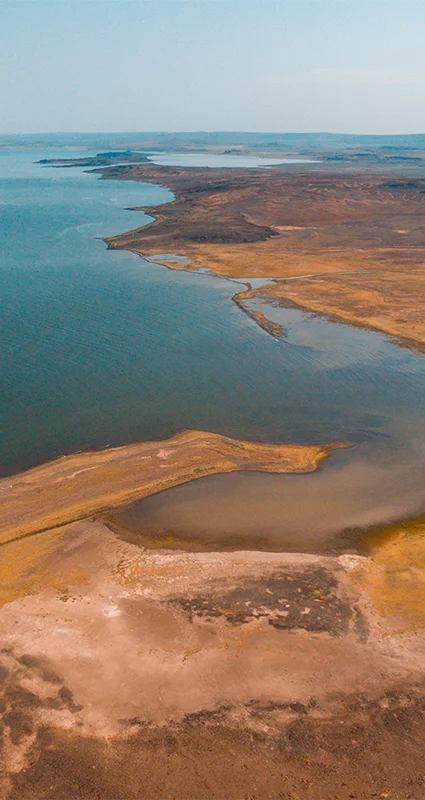
There are places in Africa where the landscape feels genuinely prehistoric, where you sense that the land itself has not changed since the first people walked across it. Lake Turkana is one of them. Stretching 249 kilometres from north to south along Kenya's Great Rift Valley, this is the world's largest desert lake, its jade-green waters shimmering against blackened lava fields, ancient calderas and the bone-dry plains of the Suguta Valley. The Rift Valley dropped here across millions of years, and the lake filled the void.
The lake is Africa's fourth largest, and its remoteness is its defining quality. To arrive at its shores, whether by charter flight over volcanic ridgelines or overland through the Chalbi Desert, is to enter a landscape that belongs to a different order of time entirely. At Koobi Fora, in Sibiloi National Park on the northeastern shore, paleontological deposits have yielded some of the most significant pre-human and early human fossil remains ever found. There is evidence of five hominid species, contributing more to the understanding of human ancestry than almost any other site on Earth. The lake and its three national parks, Sibiloi, Central Island, and South Island, together comprise a UNESCO World Heritage Site.
5 reasons we love Lake Turkana
The Jade Sea: Lake Turkana's vivid green waters stretch endlessly across volcanic plains; a surreal, otherworldly palette unlike any other lake in Africa.
Koobi Fora and Sibiloi: Fossils of five hominid species have been found here, making Sibiloi National Park one of Earth's most significant windows into human evolutionary history.
Central Island's volcanoes: Three active volcanic craters rise from the lake's surface on Central Island, forming one of the world's largest Nile crocodile breeding grounds.
Lake Logipi and the flamingos: In the adjacent Suguta Valley, Lake Logipi hosts an estimated 737,000 lesser flamingos, up to half of East Africa's entire population.
The people of the lake: The Turkana, Samburu, Rendille, and El Molo have called this shoreline home for centuries, each bringing a distinct cultural heritage.
All you need to know about Lake Turkana
About Lake Turkana
Lake Turkana sits at the northern tip of Kenya's Great Rift Valley, along the Ethiopian border. The lake drops 249 kilometres from north to south and reaches 44 kilometres at its widest point, with a depth of 30 metres. It is the most saline lake in East Africa and the largest desert lake in the world, its characteristic jade-green colouring giving rise to the name the Jade Sea.
The lake basin encompasses three protected areas inscribed as a UNESCO World Heritage Site: Sibiloi National Park, gazetted in 1973, and the island parks - Central Island and South Island, gazetted in 1985 and 1983 respectively. Together they cover a total area of 161,485 hectares. The wider catchment includes the Mount Kulal Biosphere Reserve to the east, which serves as a watershed for the lake basin and a dispersal area for wildlife. The Suguta Valley lies to the south, an arid, intensely remote corridor that has recently emerged as one of East Africa's most significant flamingo refuges, centred on the alkaline waters of Lake Logipi.
Things to do at Lake Turkana
Boat expeditions on the Jade Sea: Cruise Lake Turkana's jade waters past ancient volcanic islands, Nile crocodile-inhabited shores, and aquatic birdlife.
Visit Central Island National Park: Explore three active volcanic craters rising from the lake, home to one of the world's largest breeding Nile crocodile populations.
Explore Sibiloi and Koobi Fora: Walk the fossil grounds where paleontological finds have reshaped understanding of human evolution; among the most significant sites on earth.
Helicopter safari from Laikipia or the lake: Several Laikipia lodges offer day trips to Lake Turkana by helicopter, a dramatic way to experience the Jade Sea, Suguta Valley and Lake Logipi's flamingo flocks without basing yourself in the north. For those already at the lake, aerial safaris departing directly from your lodge offer an entirely different perspective on this vast volcanic landscape. Ask your Africa Geographic consultant about which Laikipia properties currently offer this excursion.
Cultural encounters along the shore: Meet the Turkana, Samburu, Rendille and El Molo communities whose nomadic traditions and living heritage have shaped this shoreline for centuries.
Mount Kulal expedition: Journey from the arid lowlands to Kulal's 2,300m alpine forest, where temperatures drop sharply, and panoramic views over the Jade Sea reward the climb.
What wildlife will I see in Lake Turkana?
Nile crocodile: Central Island is one of the world's largest Nile crocodile breeding grounds; large populations are visible across the lake's islands and shores.
Hippopotamus: The three national parks provide critical habitat for hippos, which breed and shelter in the lake's shallower bays and island margins.
Waterbirds and Palearctic migrants: Lake Turkana's parks sit along a major bird migration flyway, with over 350 recorded aquatic and terrestrial species concentrated across the basin.
Lesser flamingos at Lake Logipi: The alkaline Lake Logipi in the Suguta Valley hosts up to half of East Africa's lesser flamingo population, a major conservation revelation.
Reticulated giraffe, lion and Grevy's zebra: The parks provide in situ protection for these threatened species across the lake's grassy plains and surrounding arid terrain.
Venomous snakes: The island parks support numerous snake species, such as saw-scaled viper, puffadder, red spitting cobra and Egyptian cobra.
Where to stay at Lake Turkana
Accommodation at Lake Turkana is deliberately scarce, and that scarcity is part of what makes arriving here feel like an achievement.
Koros Camp sits deep in the belly of the Great Rift Valley, in the scrub of South Horr, within reach of the Jade Sea's southern shores. With five rooms and a deliberate commitment to wild immersion, Koros is built for those who want the full weight of the landscape on their doorstep. Three tribes - Samburu, Rendille and Turkana - converge at Koros Camp's doorstep, and cultural encounters are woven naturally into the experience.
Desert Rose Lodge takes a different approach entirely. Perched some 1,700 metres above sea level on the slopes of Mount Nyiro, the lodge sits above the semi-arid plains in the dense wooded valleys of northern Kenya. It is a remote hideaway that places the extraordinary vertical landscape of northern Kenya, from mountain forest to desert floor, within a single stay.
Laikipia day trips: Not all Lake Turkana experiences require a multi-night stay in the north. A number of Africa Geographic's partner lodges in Laikipia offer day excursions to Lake Turkana by helicopter, allowing guests to witness the Jade Sea, Suguta Valley and Lake Logipi's flamingo flocks as part of a broader Kenya itinerary. Speak to your Africa Geographic consultant about which Laikipia properties currently offer this excursion and how it can be woven into your safari.
Trusted by thousands of ecstatic travellers
✔️ 5-Star Trustpilot Rating ✔️ Condé Nast Travel Specialist Award Winner
✔️ Accredited by SATSA ✔️ 5,000+ Exceptional Safaris Since 1991
Why choose Africa Geographic to plan your safari?

"...I went online and found Africa Geographic...Our guides were so friendly and knowledgeable. Our accommodations and the food were excellent. Our transportation within Africa was very well organized. Everything went so smoothly and my whole family kept commenting on what a great job Africa Geographic did...I will definitely use Africa Geographic again when I book another trip to Africa!..."

"A top company to help organise and arrange your perfect safari trip...extremely helpful in tailoring our experience exactly how we wanted it, from the initial conversations, to suggested changes, to the organisation whilst on the trip...if you want peace of mine for your perfect once in a lifetime trip then this is the company for you. Will definitely be recommending them and using them again if and when we visit Africa!"

"My team at Africa Geographic was amazing. They took the time to listen to what I wanted to experience on my trip and designed the perfect itinerary for me. They were always available when I had a question and made sure I was well prepared from the time I booked all the way through my trip. They even checked on me after I returned home. Thank you...for making my dream vacation an amazing and unforgettable experience."
Wish you were here?
Frequently asked questions
Lake Turkana is the world's largest desert lake, located in Kenya's Great Rift Valley. Stretching 249 kilometres from north to south, it is the most saline lake in East Africa and is commonly called the Jade Sea for its vivid green colour.
Yes. Lake Turkana National Parks, comprising Sibiloi National Park, Central Island National Park and South Island National Park, are inscribed as a UNESCO World Heritage Site, covering a total area of 161,485 hectares.
The three national parks are Sibiloi National Park, gazetted in 1973 and located on the northeastern shore; Central Island National Park, gazetted in 1985 and rising from the lake itself as a cluster of volcanic craters; and South Island National Park, gazetted in 1983, which is also designated as an Important Bird Area by BirdLife International.
Koobi Fora, within Sibiloi National Park, is one of the most important paleontological sites in the world. Fossil deposits here have yielded the remains of five hominid species, including Homo habilis and Homo erectus, and have contributed more to the understanding of human evolution and paleo-environment than any other site on the continent.
The parks support over 350 recorded bird species and are one of the world's most important Nile crocodile breeding grounds. Hippos, reticulated giraffe, lion, Grevy's zebra and several venomous snake species are also present. Nearby Lake Logipi in the Suguta Valley hosts up to half of East Africa's lesser flamingo population.
The dry seasons, January to March and July to October, offer the most reliable access and best conditions for wildlife viewing and exploration. The wet months (April–May and November–December) bring rain and can make roads and airstrips difficult to reach.
Access is primarily by charter or scheduled light aircraft to airstrips near the lake, including those serving Loiyangalani and South Horr. The terrain and distances make flying the most practical option for most visitors.
The Suguta Valley is an arid and intensely remote corridor south of Lake Turkana within Kenya's Rift Valley. It is home to Lake Logipi, an alkaline lake that has emerged as a critical refuge for lesser flamingos. Aerial surveys in late 2024 recorded an estimated 737,000 lesser flamingos at Lake Logipi — among the largest concentrations ever documented in East Africa.
The Turkana are a Nilotic pastoralist community regarded as the third largest pastoralist group in Kenya. Nomadic by nature, they do not maintain permanent settlements, moving with their livestock - camels, goats, zebu and donkeys - as water and grazing resources shift. Their society is organised around a social unit called an awi, and their traditional faith centres on a god of the heavens called Akuj.
Loiyangalani is a settlement on the southeastern shore of Lake Turkana and a gateway for visitors exploring the lake's eastern coastline. It serves as a base for reaching Central Island, Sibiloi National Park and Koobi Fora, and is home to several of the lake-region's cultural communities.
Central Island National Park rises from the surface of Lake Turkana as a cluster of three active volcanic craters. It is one of the world's largest Nile crocodile breeding grounds and is accessible by boat from the lake's shores.
Lake Turkana's remote northern territory has historically been challenging to access, and visitors should travel with experienced operators familiar with current conditions. Properly arranged expeditions with established camps ensure appropriate logistics and local knowledge.
Lake Turkana works well as the centrepiece of a northern Kenya itinerary, potentially combined with other wilderness destinations in the region. Its remoteness means it is most rewarding as a dedicated stay of at least four to five nights, allowing time to explore the lake, national parks and surrounding landscapes in full.
Our safaris typically cost from US$700 per person, per night, depending on the accommodation comfort level, time of year and activities. This price usually includes accommodation, all meals, game drives, experienced guides, airport transfers, and 24/7 support from our team.
Click here to schedule a no-obligation call with one of our Safari Experts or fill in our 2-minute form with your questions. Our team of experts are here to help! Whether you’re curious about the best time to travel, want to hear first-hand about an experience or need help planning your safari.
Explore more African destinations
Start planning your dream safari
Our travel experts will craft a no-obligation itinerary just for you. We have crafted over 5,000 safaris since 1991. Your personal details are protected; we only use this information to contact you.
Why book your safari with us?

Deep Experience & Knowledge
Handcrafted experiential safaris since 1991.
Travel in Africa is about knowing when and where to go, and with whom. A few weeks too early/late or a few kilometres off course, and you could miss the greatest show on Earth. And wouldn’t that be a pity?

Trust & Safety

Make A Difference
We donate a portion of the revenue from every safari sold to carefully selected conservation projects that make a significant difference at ground level.
YOUR safari choice does make a difference - thank you!