

Tailor-made safaris. Since 1991





Marakele National Park: Waterberg's Big Five Sanctuary
Marakele National Park at a glance:
Location: Waterberg mountain range, Limpopo Province, 12km outside Thabazimbi | Drive from Johannesburg: ~250km north; 3–4 hours' drive via N1 to Bela-Bela, then R516 to Thabazimbi |
Size: 300,000 hectares (Kransberg block) | Best time to visit: May–September (dry season); October–April for lush scenery and migratory birds |
Nearest city: Thabazimbi (12km); Johannesburg (~250 km) | Minimum recommended stay: 3 nights |
Currency: South African Rand (ZAR) | Malaria risk: None - Marakele is entirely malaria-free |
Why visit Marakele National Park?
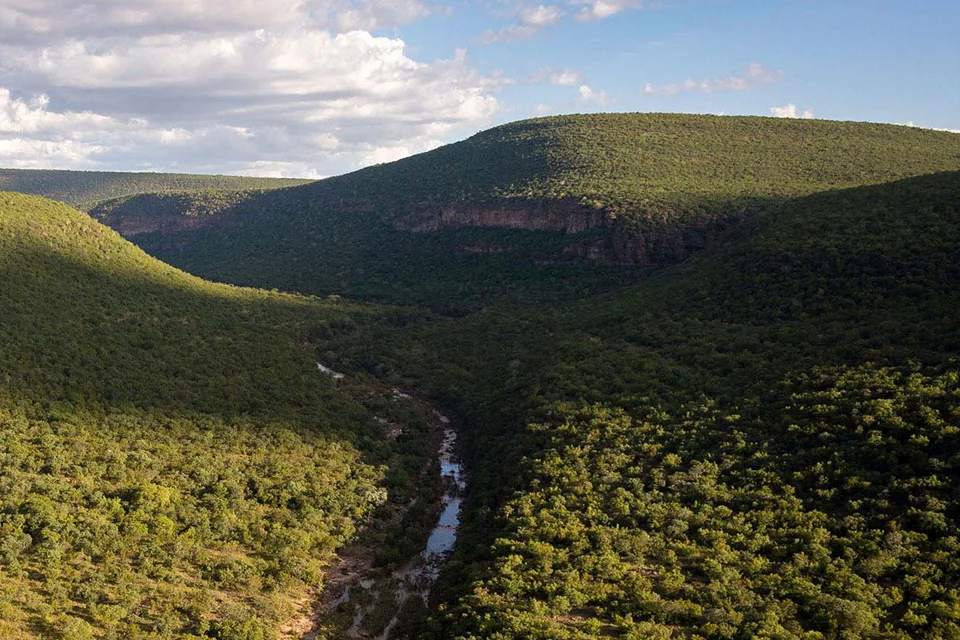
Marakele National Park operates on its own unhurried logic, shaped by the ancient geology of the Waterberg and the dramatic meeting of ecosystems that converge nowhere else in South Africa. Standing at the Lenong viewpoint on the Kransberg summit, watching Cape vultures ride thermals above sandstone cliffs that plunge into bushveld and mountain fynbos, you begin to understand what makes this park extraordinary. The altitude shifts from 1,050 metres above sea level on the valley plains to 2,088 metres at the Kransberg peak, and every metre of that climb tells a new ecological story. Below, the transitional zone between South Africa's dry western and moist eastern regions creates a biodiversity hotspot where closely related bird species from opposite sides of the country coexist at the same waterhole.
Marakele sits 12km outside Thabazimbi in Limpopo Province, approximately 250km north of Johannesburg - the nearest national park to the country's largest city. It is entirely malaria-free, making it an ideal choice for families and those new to African safari travel. The park forms part of the UNESCO-designated Waterberg Biosphere Reserve, and its northern Marataba concession is a model private-public conservation partnership offering exclusive guided experiences. This park rewards patience, altitude, and curiosity in equal measure.
5 Reasons We Love Marakele National Park
The Cape vulture colony: Around 800 breeding pairs nest on Kransberg cliffs - one of the world's largest, best viewed from Lenong viewpoint.
Malaria-free Big Five safaris: Lion, leopard, elephant, rhino and buffalo roam a 300,000-hectare park set within a UNESCO Biosphere Reserve in Limpopo Province.
An ecological crossroads where montane fynbos meets Waterberg bushveld - 765 plant species, 272 recorded birds, and 91 mammal species in one dramatic landscape.
The Marataba concession: 21,000 hectares under private management with two distinct luxury lodges offering exclusive guided safaris and water safaris.
Wild dogs and cheetahs: The Marataba section offers the chance to encounter Africa's most endangered carnivores alongside the complete Big Five suite.
All you need to know about Marakele
About Marakele National Park
Proclaimed as Kransberg National Park in 1994, Marakele forms a cornerstone of the Waterberg Biosphere Reserve in Limpopo. Its Tswana name means "place of sanctuary." Three river systems run through the park: the Matlabas and Mamba northwest, the Sterkstroom northeast, and the Sundays River south. Around 55% of the park is Waterberg Moist Bushveld, 42% Mixed Bushveld, with Sweet Bushveld lining the Matlabas banks. Some 765 plant species are recorded, including the endemic Waterberg cycad (Encephalartos eugene-maraisii), named after Eugene Marais, the naturalist who wrote Soul of the White Ant during 16 years in this landscape. Altitudes range from 1,050 to 2,088 metres, creating different climates and habitats within a single park. The Big Five occupy the larger eastern section, separated from the west by a regional road connected via a short electrified tunnel. Marakele is entirely malaria-free.
Things to do in Marakele National Park
Game drives: through diverse bushveld and mountain terrain, with Big Five sightings concentrated in the park's eastern section - self-drive or guided.
Guided interpretive bush walks: at dawn or sunset with an experienced ranger - tracking signs, reading the landscape, and experiencing the Waterberg.
The Marakele 4×4 Eco Trail: a three-day guided wilderness route through remote areas inaccessible to standard day visitors in a sedan vehicle.
Birding from the Bollonoto Dam hide and along the Matlabas River, scanning for half-collared kingfisher and African finfoot among 272 recorded species.
The Lenong viewpoint drive: a spectacular mountain pass with klipspringer on the rocks and Cape vultures soaring above the Kransberg cliff faces.
Batswana Iron Age heritage sites: including MNP 66 Zandfontein, where ancient furnaces, ceramics, and a glass bead reveal centuries of regional trade.
What wildlife can I see in Marakele?
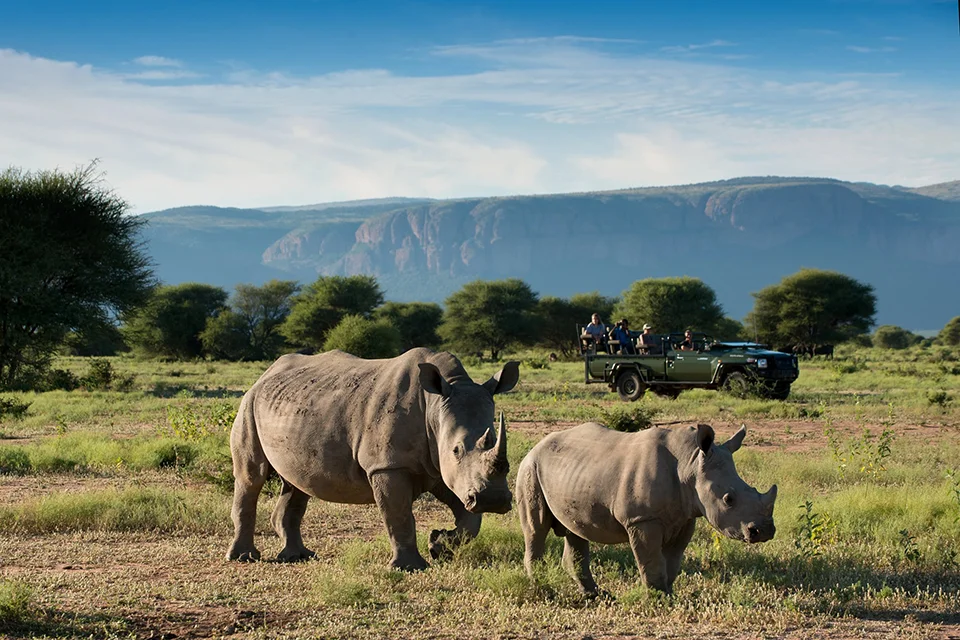
The Big Five: lion, leopard, elephant, white & black rhino, and buffalo are all present in Marakele's larger eastern section.
Cape vultures: around 800 breeding pairs nest on the Kransberg cliffs, making this one of the world's largest recorded Cape vulture colonies.
Cheetah and wild dog (painted wolf): occur in the Marataba section; wild dogs are a conservation priority and among the park's most rewarding and elusive sightings.
Exceptional antelope diversity: sable, kudu, eland, tsessebe, waterbuck, impala, and klipspringer are present throughout the park's varied habitats.
Nocturnal mammals: including bat-eared fox, Cape fox, lesser bushbaby, porcupine, genet, and various bat species reward patient twilight observers.
272 recorded bird species, including Cape vulture, Gurney’s sugarbird, Verreaux’s and martial eagles, African finfoot, half-collared kingfisher, white-backed night heron, black stork, Denham’s bustard and white-bellied korhaan.
Where to stay in Marakele National Park
The most exclusive safari experience in Marakele is found in the 21,000-hectare Marataba concession - a privately managed section in the park's northern reaches, operated as a contractual national park under a public-private partnership. Both lodges offer exclusive access to the Marataba reserve's Big Five wildlife, with guided drives by professional field guides and no other vehicles on sightings.
Marataba Safari Lodge sits on a plain at the foot of the Waterberg mountains and is the concession's family-focused flagship. Fifteen luxury tented suites are built from canvas and stone, each with a private viewing deck and outdoor shower. The design references ancient African architectural forms - dry-stone walling and conical towers - paired with elegant interiors. A boma for bush dinners, a library in a stone tower, and a swimming pool complete the lodge. Meals draw on African-inspired cuisine, from four-course dinners to informal braais under open skies.
Marataba Mountain Lodge is an adults-only retreat perched on a hillside above Waterfall Valley. Five solar-powered eco-suites look out over the valley, each with a king-sized bed, fireplace, en-suite rain shower, and shaded viewing deck. The Scandinavian-influenced design centres on space, silence, and immersion in the mountain landscape. A fire deck and infinity rock pool extend the experience.
Trusted by thousands of ecstatic travellers
✔️ 5-Star Trustpilot Rating ✔️ Condé Nast Travel Specialist Award Winner
✔️ Accredited by SATSA ✔️ 5,000+ Exceptional Safaris Since 1991
Why choose Africa Geographic to plan your safari?

"Africa Geographic was super prompt and professional at each stage of the booking process. The agent was very knowledgeable about alternative destinations and explained the pros and cons of each...Once I had decided to proceed he was well-informed about the specific options like airport pickup...the options and credit were handled flawlessly. All that was handled very professionally and in a most helpful manner."

"My family and I just returned from a "trip of a lifetime"...Our accommodations and the food were excellent. Our transportation within Africa was very well organized. Everything went so smoothly and my whole family kept commenting on what a great job Africa Geographic did... I will definitely use Africa Geographic again when I book another trip to Africa! I highly recommend using Africa Geographic!!!"

"Africa Geographic was amazing to work with. They tailored a trip specifically for us based on our wants and needs. They take the time to listen to you and understand what you are looking for from this sometimes once in a lifetime experience. They are professional, courteous, friendly and with you every step of the way. Their job does not end until you are home. If I could give them more than 5 stars I would!"
Wish you were here?
Frequently asked questions
Yes. Marakele National Park and the Marataba concession within it are in a malaria-free zone of Limpopo Province. No antimalarial medication is required, making it an excellent choice for families with young children, pregnant travellers, and those who prefer to avoid prophylaxis.
All five - lion, leopard, elephant, white rhino, and black rhino- as well as buffalo, are present. The Big Five are concentrated on the park's larger eastern side. Sightings require patience and a few days; no encounters are guaranteed, but the Marataba concession is known for consistently excellent wildlife viewing.
The park is approximately 250km north of Johannesburg, around 12km from Thabazimbi in Limpopo Province. Two road routes connect from Gauteng: via the N1 to Bela-Bela (Warmbaths), then the R516 through Leeupoort to Thabazimbi; or via Brits and the R511 through Beestekraal. Driving time is approximately 3 hours from Tshwane and 4 hours from Johannesburg. Marataba can also be reached by private air charter in approximately 45 minutes.
Marataba is a 21,000-hectare privately managed section in the northern reaches of Marakele National Park, operated under a contractual national park model - a public-private conservation partnership. It is home to two luxury lodges and provides exclusive game-drive experiences on a fully malaria-free Big Five reserve.
Marataba Safari Lodge is family-friendly, positioned on a plain at the foot of the Waterberg mountains, and has 15 canvas-and-stone tented suites - ideal for guests travelling with children. Marataba Mountain Lodge is an adults-only retreat of just five solar-powered eco-suites on a hillside above Waterfall Valley, designed for solitude and intimate landscape immersion. Both are fully all-inclusive with professional field guides.
The dry season from May to September offers cooler temperatures, sparse vegetation, and excellent wildlife visibility - the peak season for sightings. October to April brings summer rainfall, lush green landscapes, migratory birds, and vivid post-rain scenery. The park is open year-round, and every season has its rewards.
Marakele has 272 recorded bird species, including Verreaux’s and martial eagles, Cape vulture, Gurney’s sugarbird, African finfoot, white-backed night heron, black stork, Denham’s bustard and white-bellied korhaan.
Wild dogs (painted wolves) are present in the park, particularly in the northern Marataba section, and Marakele is considered an important site for the conservation of these endangered carnivores. They move over large territories and are not reliably encountered, but a sighting is considered a genuine highlight of any visit.
A minimum of 3 nights allows meaningful exploration of the park's contrasting zones — the mountain drive to Lenong viewpoint, the Big Five bushveld of the eastern section, and birding at the Bollonoto Dam hide. A stay of 4–5 nights at the Marataba lodges provides the full experience: guided drives, bush walks, water safaris, and the unhurried pace the Waterberg rewards.
Marakele is ecologically remarkable within its park boundaries. The lower plains support Waterberg Moist Bushveld (approximately 55%) and Mixed Bushveld (approximately 42%). On the Kransberg summit, vegetation transitions into montane fynbos - proteas, ericoid shrubs, and yellowwoods - a landscape more typical of high-altitude systems than the surrounding savanna. This transformation is visible on the drive to Lenong viewpoint.
Marakele contains around 130 identified potential heritage sites. Among those currently accessible are Batswana Iron Age stone enclosures - including sites MNP 03, 04, 05, and 06 - that reflect agropastoral settlement patterns in the Matlabas Valley. MNP 66 Zandfontein contains ancient furnaces, ceramics, and a glass bead. The Coetzee Cemetery (MNP 22) holds mixed-race family graves that challenge historical segregation narratives.
Yes. Marakele is entirely malaria-free, making it a practical and reassuring choice for families. Marataba Safari Lodge specifically welcomes families and has a family suite. The park has self-drive access, a moderate climate, and a range of activities suited to guests of varying ages and fitness levels. The Marataba concession is approximately 3.5 hours from Johannesburg by road.
Marakele safaris in the Marataba concession typically cost from R18,270 per person, per night, depending on the accommodation comfort level, time of year and activities. This price usually includes accommodation, all meals, game drives, experienced guides, and 24/7 support from our team.
Click here to schedule a no-obligation call with one of our Safari Experts or fill in our 2-minute form with your questions. Our team of experts are here to help! Whether you’re curious about the best time to travel, want to hear first-hand about an experience or need help planning your safari.
Explore more African destinations
Start planning your dream safari
Our travel experts will craft a no-obligation itinerary just for you. We have crafted over 5,000 safaris since 1991. Your personal details are protected; we only use this information to contact you.
Why book your safari with us?

Deep Experience & Knowledge
Handcrafted experiential safaris since 1991.
Travel in Africa is about knowing when and where to go, and with whom. A few weeks too early/late or a few kilometres off course, and you could miss the greatest show on Earth. And wouldn’t that be a pity?

Trust & Safety

Make A Difference
We donate a portion of the revenue from every safari sold to carefully selected conservation projects that make a significant difference at ground level.
YOUR safari choice does make a difference - thank you!