

Tailor-made safaris. Since 1991



Garden Route: Where forests meet the Indian Ocean
The Garden Route at a glance:
Location: Western Cape and Eastern Cape, South Africa | Access: Fly into George Airport (GRJ), then self-drive east along the N2 |
Length: Approximately 200km of coastline, from Mossel Bay to Stormsrivier | Best time to visit: Year-round; whales July–November; wildflowers August–September |
Nearest airport: George Airport (GRJ); also Cape Town International (CPT) | Minimum recommended stay: 5–7 nights |
Currency: South African Rand (ZAR) | Malaria risk: None – the Garden Route is entirely malaria-free |
Why visit the Garden Route?
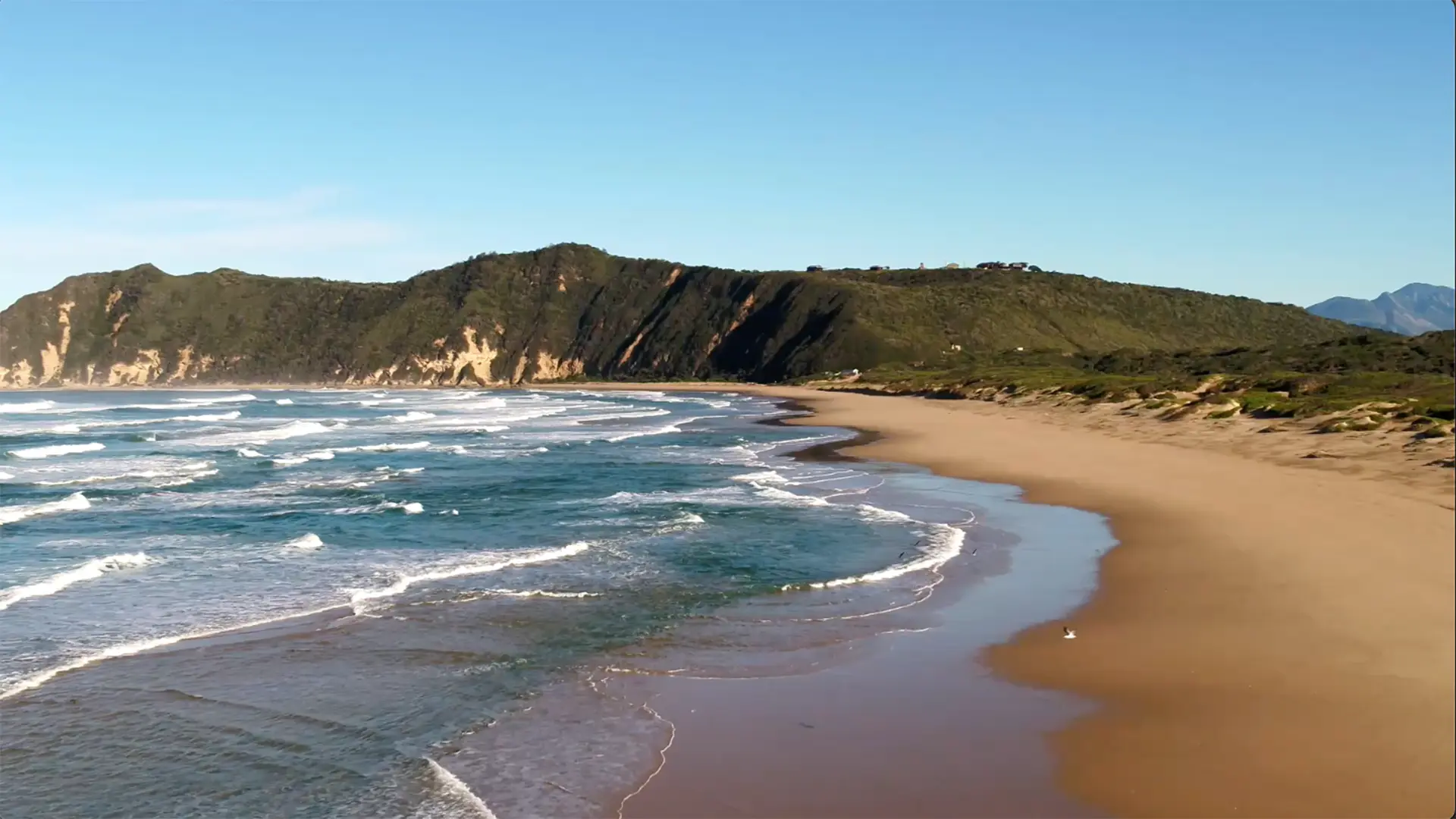
The Garden Route extends about 200 kilometres along the southern edge of South Africa, from Mossel Bay in the Western Cape to Stormsrivier in the Eastern Cape. But calling it merely a route misses the point. This region is a series of layered worlds, each folding into the next. The Outeniqua and Tsitsikamma mountain ranges push sharply from the coastal plain, cloaked in ancient forest where giant Outeniqua yellowwoods, South Africa's national tree, grow alongside stinkwoods, Cape chestnuts and tree ferns, and hidden tracks reveal elephant footprints. Between the mountains and the Indian Ocean lies a mosaic of freshwater lagoons, clear rivers, fynbos-covered dunes, sheltered coves and long sandy beaches.
The Garden Route is as much about its towns as its landscapes. Knysna wraps around a protected lagoon; Plettenberg Bay opens onto sweeping white-sand beaches; Wilderness sits at the gateway to five interconnected lakes; Nature's Valley tucks itself at the foot of the Tsitsikamma gorges; and Sedgefield offers a quieter pause in between. Cross the Outeniqua Mountains northward, and the landscape shifts entirely, the fynbos giving way to the semi-arid Klein Karoo and the ostrich country of Oudtshoorn. The entire region is malaria-free, making it one of Africa's most accessible and versatile destinations, rewarding for families, honeymooners, wildlife enthusiasts, and outdoor adventurers alike.
5 Reasons We Love the Garden Route
Ancient forests and dramatic gorges: towering Outeniqua yellowwoods, deep ravines and the plunging Tsitsikamma cliffs define this coastline.
Year-round whale watching: southern right whales arrive from July to November; humpback and Bryde's whales appear throughout the year.
The Garden Route National Park: spans Tsitsikamma, Wilderness, and Knysna and protects forests, lakes, estuaries and a world-class marine reserve.
Malaria-free wildlife experiences: reserves and national parks reward visitors without the need for prophylaxis, ideal for families and first-timers.
Exceptional food and drink: Knysna oysters, wine farms, farmers' markets and fine coastal restaurants all reward lingering.
Our favourite Garden Route safari ideas
All you need to know about the Garden Route
About the Garden Route
The Garden Route is defined by three geographical features: 200km of coastline, the Outeniqua Mountains that bar the way to the dry interior and the Garden Route National Park.
The Garden Route National Park, formed in 2009 from Tsitsikamma, Wilderness and the Knysna National Lake Area, covers approximately 1,210 km² of protected coast. It safeguards ancient indigenous forest, RAMSAR-listed wetlands, five linked lakes, estuaries, beaches and Africa's first marine national park, proclaimed in 1964.
Tsitsikamma, Khoisan for 'place of much water', runs 70 kilometres of cliff, gorge and ancient woodland east from Nature's Valley. Wilderness protects the Touw River lakes system, forested hills and wetlands teeming with kingfishers and Knysna turacos. The Knysna section guards the famous lagoon and the forests sheltering Africa's southernmost surviving elephant: a shy solitary cow named Oupoot, known mostly from tracks and camera images. Private farms and forest patches connect the three sections, forming a green corridor that shapes the landscape and the character of each town along the route.
Things to do on the Garden Route
Kayak and canoe the lakes and rivers: paddle the linked lakes at Wilderness, explore the Touw River estuary or canoe along the Tsitsikamma rivers.
Walk the Otter Trail: South Africa's most celebrated coastal hike, covering 41 kilometres over five days from Storms River Mouth to Nature's Valley. The return route, known as the Tsitsikamma Trail, ventures further into the mountains and is also popular.
Bungee jump at Bloukrans Bridge: leap from one of the world's highest commercial bungee jumps, 216 metres above the base of the Bloukrans gorge.
Whale and dolphin watching: scan the waters from Plettenberg Bay for southern right, humpback and Bryde's whales, plus resident dolphins year-round.
Explore the Cango Caves near Oudtshoorn: enormous limestone caverns with towering stalagmite formations deep in the Swartberg foothills.
Hike and mountain bike in Garden Route National Park: marked trails through yellowwood forests, along rivers and across coastal fynbos.
Storms River suspension bridge: Cross this dramatic bridge, gateway to caves once sheltering ancient San and Khoikhoi communities along the coast.
Ancient yellowwoods: Stand beneath 800-year-old giants in Knysna's indigenous forests, including the famous Big Tree, witnesses to centuries past.
What wildlife can I see in the Garden Route?
Forest & fynbos mammals: Bushbuck, bushpig, Cape grysbok, klipspringer, honey badger and caracal roam the park's forest and fynbos habitats.
Predators & primates: Leopard, serval, large spotted genet, vervet monkeys and chacma baboon are among 77 recorded mammal species across the park.
Marine mammals: Southern right whale, humpback whale, bottlenose dolphin, Cape fur seal and African clawless otter frequent the coastline.
Wilderness wetland birds: Great crested grebe, red-knobbed coot, African fish eagle and the threatened African black oystercatcher favour the lagoons.
Forest birds: Knysna turaco, Narina trogon, Knysna warbler and African crowned eagle inhabit the indigenous forests of Tsitsikamma and Knysna.
Fynbos endemics: Cape sugarbird, orange-breasted sunbird and the elusive Victorin's warbler favour the mountain fynbos above the coast.
Heritage & natural landmarks
San rock art: Ancient paintings near Keurbooms and in the Goudveld forest depict symbolic figures that record San spiritual beliefs and cosmology.
Ancient middens: Sites at Klipriver and caves near Storms River Mouth preserve shell, bone and stone tools left by hunter-gatherer communities.
The Big Tree: This 800-year-old Outeniqua yellowwood in Knysna's forest stands as one of the region's most striking natural landmarks.
The Spoortjie railway: This historic line near Diepwalle once carried timber from dense forests to sawmills, recalling Knysna's logging past.
Ox-Wagon Wheel Ruts (Outeniqua Pass / Montagu Pass, near George): These protected heritage sites feature visible grooves cut into the solid sandstone bedrock by the iron wheels of Voortrekker and settler ox-wagons climbing over the Outeniqua Mountains in the 1800s.
Bartolomeu Dias Museum & Post Office Tree (Mossel Bay): The main maritime history monument on the Garden Route, located about 60 km west of Wilderness.
Dining along the Garden Route
Knysna oysters are the Garden Route's most iconic dish; best eaten fresh on the waterfront, paired with cold South African white wine. The Knysna Oyster Festival, held every July since 1983, draws visitors from across the country for ten days of feasting, wine and live music.
Wild Oats Community Farmers' Market in Sedgefield runs every Saturday, with locally grown produce, cooked breakfasts and artisan food stalls.
Seafood is the region's heartland: fresh kingklip, mussels and langoustines feature on menus from Mossel Bay to Plettenberg Bay and beyond.
Wine farms along Route 62 and in the emerging Plettenberg Bay wine region offer tastings paired with Klein Karoo scenery and mountain views.
Restaurants range from award-winning country-house dining near Nature's Valley to relaxed waterfront cafés in Knysna, Wilderness, and Plettenberg Bay.
Where to stay on the Garden Route
Garden Route accommodation options range from beach guesthouses to boutique hotels and working farm stays.
In Knysna, on the edge of the ancient forest and lagoon, The Turbine Boutique Hotel occupies a converted power station with striking industrial-luxe interiors. The Mount Knysna offers refined countryside calm above the lagoon. The Lofts Boutique Hotel provides a chic, contemporary stay close to the waterfront and its famous oyster culture.
Plettenberg Bay suits travellers drawn to beaches and forest in equal measure. Christiana Lodge offers a personal, boutique setting close to town. Tsala Treetop Lodge is built into the indigenous forest canopy, pairing luxury with an immersive setting among the trees this region is known for.
Deeper into Tsitsikamma, where the Otter and Dolphin Trails begin, The Fernery Lodge & Spa and Misty Mountain Reserve both feature as staging points on the guided Dolphin Trail, offering forest and mountain settings with access to dramatic coastal scenery.
In Wilderness, where lagoons and lakes define the landscape, Views Boutique Hotel & Spa makes the most of its coastal outlook. Cinnamon Boutique Hotel offers an intimate, design-led stay near the beach and Kaaimans River.
In Oudtshoorn, De Zeekoe Guest Farm is a working ostrich and lucerne farm built around a 150-year-old colonial homestead.
The Garden Route National Park
The Garden Route National Park is an amalgamation of three former protected areas:
Tsitsikamma National Park, which includes coastline, indigenous forests, and Africa's oldest Marine Protected Area;
Wilderness National Park, encompassing lakes, wetlands, and coastal forests;
Knysna National Lake Area, which features the protected Knysna Estuary and surrounding ancient forests.
This merger, carried out in 2009, united years of split conservation work under one team along some 200km of coast. At its declaration, the national park covered about 121,000 ha: roughly 68,500 ha from Wilderness and Tsitsikamma, plus 52,500 ha of new land from the Knysna area.
The national park is not fenced; it wraps around and between major tourism hubs like Wilderness, Knysna, and Plettenberg Bay. For example, the Knysna Lakes Section includes the Knysna Estuary, which forms the waterfront in central Knysna. Most major tourist attractions, such as the Bloukrans Bungee Jump, Monkeyland, local restaurants, and private resorts, sit directly adjacent to, or within gaps between, the park's protected forest corridors.
Exploring the Garden Route's towns
Mossel Bay marks the western gateway to the Garden Route and carries one of the region's oldest histories. Portuguese explorer Bartolomeu Dias stopped here in 1488, making it the spot where the first European set foot in South Africa. Caves beneath Pinnacle Point contain evidence of human habitation believed to be approximately 164,000 years old. Visitors today walk the cave networks, view a full-sized replica of Dias' ship in the museum complex and explore the rocky coastline's sheltered coves. The quaint St Blaize Lighthouse serves as a landmark and the starting point for popular hiking routes. A smaller colony of Cape fur seals gathers on a nearby Seal Island.
George, nestled in the Outeniqua Mountains eight kilometres from the ocean, is among the Garden Route's largest towns and often the arrival point for visitors flying in. It holds several historical landmarks, including the King Edward VII Library, the Outeniqua Transport Museum and the Garden Route Botanical Gardens, which showcase the exceptional fynbos flora of the southern Cape region.
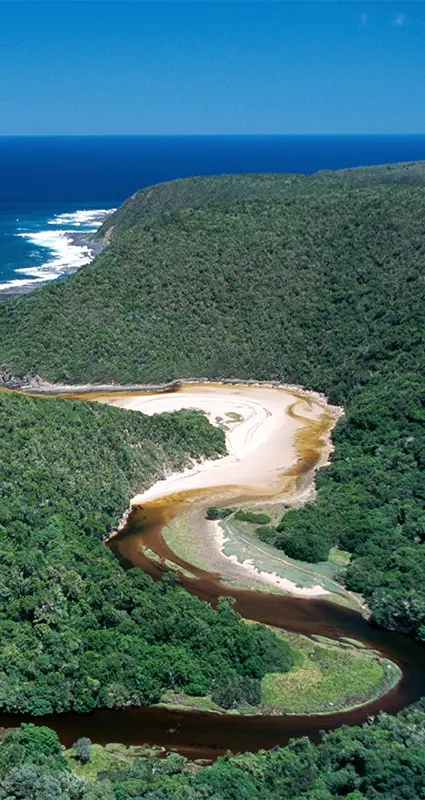
Wilderness sits on the Touw River Lagoon, surrounded by the Wilderness section of the Garden Route National Park: over 2,500 hectares encompassing five rivers, five interconnected lakes, two estuaries and a stretch of Indian Ocean coastline. The linked lakes are listed by the Ramsar Convention as internationally significant bird habitat. The 'Map of Africa' viewpoint, where the Kaaimans River loops around a forested hill, and Dolphin Point are popular stops; resident Knysna turacos and half-collared kingfishers reward birdwatchers throughout the area.
Sedgefield offers a quieter interlude between Wilderness and Knysna and holds the distinction of being Africa's first Cittaslow town, part of a worldwide movement that advocates slowing the pace of life. The Wild Oats Community Farmers' Market, held every Saturday, is a beloved local institution that draws residents and visitors alike.
Knysna wraps around a tidal lagoon fed by the Knysna River, with the twin sandstone headlands known as The Heads creating a narrow and sometimes treacherous channel to the open sea. The surrounding Knysna forests, the largest closed-canopy forest in southern Africa, shelter the last surviving elephant in Africa's southernmost elephant population. The town is celebrated for its oysters, and the annual July Knysna Oyster Festival, running since 1983, has grown into one of the largest events on the Garden Route calendar.
Plettenberg Bay, universally known as "Plett" and called Bahia Formosa ("beautiful bay") by the Portuguese, is the Garden Route's most fashionable coastal town, with long stretches of white-sand beach, the Robberg Nature Reserve and exceptional marine wildlife. Southern right, Bryde's and humpback whales visit seasonally; dolphins are permanent residents.
Nature's Valley sits at the western end of the Tsitsikamma section of the Garden Route National Park, where the Otter Trail ends at the Salt River estuary. The village is small, quiet and surrounded by forest, lagoon and beach: the Garden Route at its most raw and undisturbed.
Oudtshoorn, across the Outeniqua Mountains in the Klein Karoo, is included on most Garden Route itineraries for its world-famous Cango Caves and its status as the global centre of the ostrich farming industry. This industry dates to the Feather Boom of the late 19th century, when ostrich feathers ranked among South Africa's most valuable exports.
Trusted by thousands of ecstatic travellers
✔️ 5-Star Trustpilot Rating ✔️ Condé Nast Travel Specialist Award Winner
✔️ Accredited by SATSA ✔️ 5,000+ Exceptional Safaris Since 1991
Why choose Africa Geographic to plan your safari?

"...outstanding job organizing an unforgettable trip for my family and me to South Africa... perfect balance between family-friendly...we spent four nights in Cape Town, soaking in the city’s beauty and culture, before embarking on a breathtaking tour of the Garden Route...we had an extraordinary experience."

"...AG made this trip to Southern Africa seamless and fantastic. this was my wife's turn at a trip of a Lifetime and you delivered. all the transfers and hotels were fantastic and allowed us the freedom on Garden Route to get to the places we wanted to go to...."

"We have been using Africa Geographic a few times in the past and they have never let us down...provides expert advice on any question one might have. Our recent trip to South Africa was a small group...I would always trust AG... and I look forward to dealing with AG...again for our next trip"
Wish you were here?
Frequently asked questions
The Garden Route is a roughly 200-kilometre stretch of South Africa's southern coastline, extending from Mossel Bay in the Western Cape to Stormsrivier in the Eastern Cape. It includes rugged coastal areas, pristine beaches, forests, mountains, gorges, lakes, and rivers, along with the towns of Mossel Bay, George, Wilderness, Sedgefield, Knysna, Plettenberg Bay, Nature's Valley. Oudtshoorn, in the Little Karoo to the north, is often included on Garden Route itineraries.
You can visit the Garden Route year-round. The weather is temperate throughout: temperatures seldom drop below 10°C or rise above 30°C on the coast. Rain can fall year-round; the Garden Route receives some of South Africa's highest rainfall, which explains the lush vegetation. Rainfall peaks slightly from June to August. The best whale-watching months are July to November, and wildflowers celebrate the arrival of spring in August and September.
Yes. The entire Garden Route is malaria-free, requiring no prophylaxis. This makes it an ideal destination for families with young children and travellers who prefer to avoid antimalarial medication.
The main gateway is George Airport (GRJ), served by regular flights from Cape Town and Johannesburg. From George, visitors typically self-drive east along the N2 national road. Cape Town International Airport (CPT) is also a common arrival point, with George approximately a four-hour drive east along the N2.
A minimum of five nights allows meaningful time in two or three areas. Seven nights gives space to explore the national park sections, enjoy day trips between towns and experience activities at a comfortable pace. Travellers who rush the route often feel they have seen it too quickly.
The Garden Route National Park was formed in 2009 by amalgamating three former national parks - Tsitsikamma, Wilderness, and the Knysna National Lake Area- along with other sections of government-owned land. It covers approximately 1,210 km² and protects ancient indigenous forest, linked lake systems, estuaries, pristine beaches, and Africa's first marine national park.
The Otter Trail is widely considered South Africa's most celebrated multi-day hike. It follows the rugged coastline from Storms River Mouth to Nature's Valley over four nights and five days, covering 41 kilometres of cliffs, river crossings and dense coastal forest. Permits must be booked well in advance through South African National Parks.
The Bloukrans Bridge bungee jump is one of the highest commercial bungee jumps in the world, at 216 metres above the base of the Bloukrans Gorge in the Tsitsikamma section of the Garden Route. It is situated on the N2 national road between Plettenberg Bay and Nature's Valley and attracts visitors from across the world.
Marine wildlife is the highlight: southern right whales (July to November), humpback and Bryde's whales, bottlenose and humpback dolphins, and Cape fur seals. The forest sections of the national park shelter bushbuck, blue duiker, grysbok, baboons and vervet monkeys. Birdlife is exceptional, with almost 450 species across diverse habitats, including sought-after species such as the Knysna warbler, orange-breasted sunbird, Knysna turaco, African black oystercatcher, half-collared kingfishers, and fynbos buttonquail.
The Cango Caves are a network of enormous limestone caverns near Oudtshoorn, featuring massive stalagmite formations. The caves contain some of the world's oldest known limestone formations. They are accessed via guided tours and are among the Garden Route region's most visited attractions.
Knysna is known for its spectacular lagoon, the iconic sandstone Heads, its temperate indigenous forests and its oyster industry. The annual Knysna Oyster Festival is held each July. The surrounding forests are home to the last surviving elephant of the southernmost population in Africa.
There is no single best base; it depends on your interests. Knysna and Plettenberg Bay are the most popular anchor points, both within easy reach of the national park sections, marine wildlife, hiking, and many restaurants. Wilderness is ideal for birdwatchers and lake-based activities. Oudtshoorn suits those wishing to explore the Little Karoo independently of the coastal strip.
Our safaris typically cost from US$700 per person, per night, depending on the accommodation comfort level, time of year and activities. This price usually includes accommodation, all meals, game drives, experienced guides, airport transfers, and 24/7 support from our team.
Click here to schedule a no-obligation call with one of our Safari Experts or fill in our 2-minute form with your questions. Our team of experts are here to help! Whether you’re curious about the best time to travel, want to hear first-hand about an experience or need help planning your safari.
Explore more African destinations
Start planning your dream safari
Our travel experts will craft a no-obligation itinerary just for you. We have crafted over 5,000 safaris since 1991. Your personal details are protected; we only use this information to contact you.
Why book your safari with us?

Deep Experience & Knowledge
Handcrafted experiential safaris since 1991.
Travel in Africa is about knowing when and where to go, and with whom. A few weeks too early/late or a few kilometres off course, and you could miss the greatest show on Earth. And wouldn’t that be a pity?

Trust & Safety

Make A Difference
We donate a portion of the revenue from every safari sold to carefully selected conservation projects that make a significant difference at ground level.
YOUR safari choice does make a difference - thank you!