

Tailor-made safaris. Since 1991



Madikwe Game Reserve: Where Rewilding Rewrote the Rules
Madikwe Game Reserve at a glance:
Location: North West Province, South Africa, bordering Botswana | Access from Johannesburg: ~4–5 hours by road; ~1 hour by light aircraft |
Size: 750 km² (75,000 hectares) - fifth-largest reserve in South Africa | Best time to visit: May–September (dry season); summer for birding |
Nearest major airport: OR Tambo International Airport, Johannesburg | Minimum recommended stay: 3 nights |
Currency: South African Rand (ZAR) | Malaria risk: None - Madikwe is malaria-free |
Why visit Madikwe Game Reserve?
Thirty years ago, this corner of South Africa's North West Province was degraded cattle farmland; soils exhausted, wildlife absent. A government study concluded that wildlife-based ecotourism would deliver far greater value to local communities than farming ever could. That decision, made in 1991, produced one of Africa's most remarkable conservation stories: Madikwe Game Reserve.
Today, 75,000 hectares of rewilded bush harbour the Big 5, thriving populations of African wild dogs (painted wolves), cheetahs, brown hyenas, and more than 350 recorded bird species. The reserve is entirely malaria-free, making it one of the few Big 5 destinations genuinely suitable for families with young children.
Unlike South Africa's national parks - where self-drive visitors and high vehicle counts at sightings are part of the deal - Madikwe admits no day visitors or self-drivers. Every vehicle belongs to a lodge; every drive is guided. Encounters are unhurried, and vehicle limits at any sighting are strictly enforced.
And it is community-owned. Tourism revenues flow directly to local communities, funding employment, business and enterprise. A safari here directly contributes to one of the continent's most principled conservation models.
5 Reasons We Love Madikwe Game Reserve
Malaria-free Big 5 safari: All five iconic species - lion, leopard, elephant, buffalo and rhino - roam freely, with zero malaria risk for travellers of all ages.
The painted wolf factor: Madikwe is one of the finest reserves in southern Africa to observe packs of the rare and endangered African wild dog in action.
No crowds: Day-trippers and self-drive tourists are not permitted, keeping vehicle numbers low and wildlife encounters genuinely exclusive and unhurried.
A conservation phoenix: Born from barren farmland in 1991, Operation Phoenix relocated nearly 10,000 animals here - one of the largest wildlife translocations in history.
Community-first ownership: The reserve is built on a model where local communities own the land and share directly in tourism profits, making every safari visit meaningful.
Our favourite Madikwe Game Reserve safari ideas
All you need to know about Madikwe
About Madikwe Game Reserve
Madikwe Game Reserve lies just south of the Botswana border in South Africa's North West Province, only 40 km from Gaborone. At 750 km² (75,000 hectares), it is the country's fifth-largest reserve, occupying the transition zone between the Kalahari Desert and the Lowveld bushveld. This crossover produces striking habitat diversity: arid acacia woodland in the west, open bushveld plateaus, seasonal wetlands and wide savanna plains. Volcanic inselbergs punctuate the terrain, the Groot Marico River runs along the eastern boundary, and the Dwarsberg Mountains anchor the south.
Proclaimed in 1991 after a government study determined that ecotourism would better serve local communities than degraded farmland, the reserve was rewilded through Operation Phoenix: the translocation of nearly 10,000 animals from 28 species, one of the largest wildlife relocations in history.
Things to do in Madikwe Game Reserve
Morning and evening game drives: Expert rangers lead open-vehicle drives at dawn and dusk, when wildlife is most active and the light most rewarding for photography.
Guided bushwalks: On foot with a trained guide, the reserve reveals tracks, insects, plant life and geology. The bush becomes intimate in ways that vehicles cannot reveal.
Night drives: After-dark drives with spotlights reveal the reserve's nocturnal residents: brown hyena, aardwolf, bat-eared fox and African wildcat.
Waterhole hides: Several lodges offer underground, or eye-level hides at active waterholes - immersive, photogenic wildlife observation unique to Madikwe.
Birding: With over 350 recorded species, including seasonal migrants and Kalahari endemics, Madikwe rewards dedicated birders across every season.
Community visits: At select lodges with community partnerships, guests visit neighbouring villages to engage with local culture, heritage and enterprise.
What wildlife can I see in Madikwe Game Reserve?
The Big 5: lion, leopard, elephant, buffalo, and both black and white rhinos are resident in Madikwe and reliably encountered on game drives year-round.
African wild dogs (painted wolves): Madikwe is one of the best reserves in southern Africa for sightings of these endangered, energetic predators, with established packs.
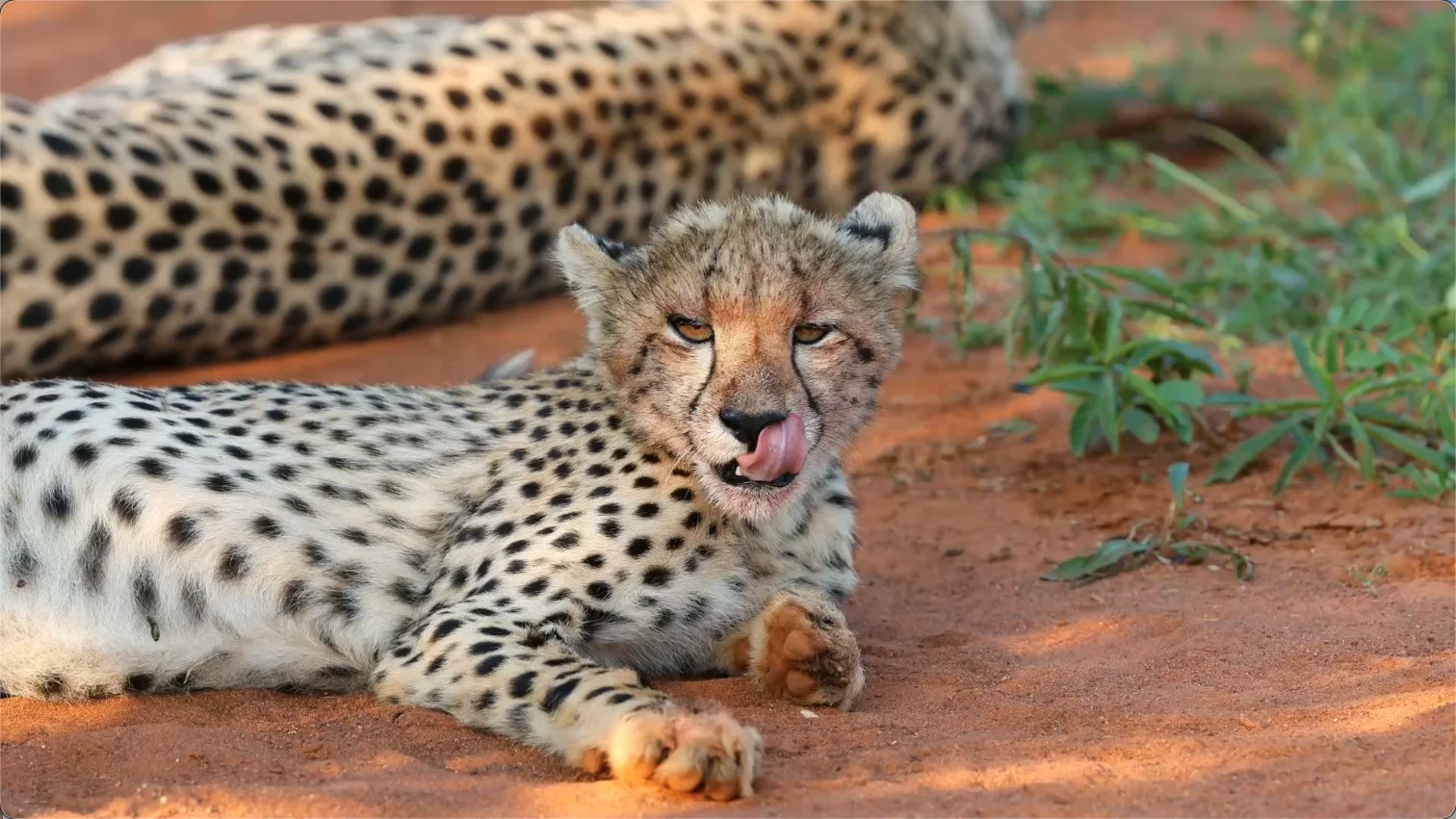
Cheetah and brown hyena: Two of Africa's more elusive predators are regularly seen in Madikwe - a combination that is genuinely rare among South African reserves.
Plains species: Giraffe, zebra, blue wildebeest, tsessebe, sable, red hartebeest, kudu, eland and impala are all present across Madikwe's varied habitats.
Smaller mammals: Bat-eared fox, aardwolf, caracal, honey badger, aardvark and Cape pangolin inhabit the reserve; Kalahari species rarely seen in lowveld.
Birdlife: Over 350 species recorded include yellow-throated sandgrouse, southern pied babbler, kori bustard, crimson-breasted shrike, ashy tit and barred wren-warbler; summer sees a migrant flush.
Where to stay in Madikwe Game Reserve
Madikwe Hills Private Game Lodge sits on a rocky outcrop in the central region of the reserve, set ingeniously among ancient boulders and Tamboti trees. Ten glass-fronted luxury suites are scattered across the hillside, each with a private plunge pool, fireplace, outdoor shower, and floor-to-ceiling bush views. The elevated main lodge opens onto a deck overlooking an active waterhole. A separate private villa, Little Madikwe, provides exclusive-use accommodation for families or small groups.
Tuningi Safari Lodge, in the western section, was built explicitly with families in mind. A maximum of 16 guests are accommodated across four luxury suites and two dedicated family suites, each with wraparound timber decks, private plunge pools, gas fireplaces and outdoor rock showers. A sunken underground hide brings guests to eye level with drinking wildlife. Tuningi has adopted a neighbouring pre-school, and guest contributions directly support that community partnership.
Buffalo Ridge Safari Lodge occupies a spectacular elevated position on the Tweedepoort Ridge in the west, accessed via a wooden bridge crossing a ravine. This is the first wholly community-owned commercial safari lodge in South Africa, owned by the Balete Ba Lekgophung community. Staff are drawn from the local community, and a palpable pride runs through every interaction. Eight thatched suites offer private decks and expansive views. Guests may visit the neighbouring village of Lekgophung to engage with the community whose conservation model underpins everything here.
Trusted by thousands of ecstatic travellers
✔️ 5-Star Trustpilot Rating ✔️ Condé Nast Travel Specialist Award Winner
✔️ Accredited by SATSA ✔️ 5,000+ Exceptional Safaris Since 1991
Why choose Africa Geographic to plan your safari?

"...We loved staying at the Buffalo Ridge Lodge in Madikwe knowing it was managed and staffed by the local community. The lodge staff and safari guides were outstanding...All in all, we spent 4 wonderful nights enjoying the food, ambiance and our lovely chalets in between the 10 jeep trips 'discovering' all the wildlife the reserve has to offer - we didn't want to leave.Working with...AG to plan the trip was seamless ...and creative solutions throughout the process."

"We have just returned from our first stay at Buffalo Ridge, knowing that it will be the first of many... We have loved Madikwe ever since our first visit 11 years ago. The lodge is owned by a local community, with everyone working there coming from the same village...and they work as part of a large family, always with smiles on their faces, and doing whatever they can to ensure that you have a great time. They succeeded!...We thoroughly recommend Africa Geographic"

"This was the third experience I booked with Africa Geographic and am working on another one. My stay at Madikwe Game Reserve was very special. A couple of highlights were seeing five tiny cheetah cubs twice, seeing a pack of 4 wild dogs, seeing many elephants and a huge variety of other wildlife. I stayed at two lodges, Madikwe Hills and Buffalo Ridge. Both were wonderful...I didn't want to leave when my visit ended-- I could have stayed forever!"
Wish you were here?
Frequently asked questions
Yes. Madikwe Game Reserve sits in a malaria-free zone, making it one of the very few Big 5 safari destinations in South Africa - and in Africa - where no antimalarial medication is required. This makes it particularly well suited to families travelling with young children, expecting parents, and anyone who prefers to avoid prophylactics entirely.
The two reserves offer fundamentally different experiences. Kruger National Park, nearly 20,000 km², is open to the public, accessible to self-drivers, and accommodates large visitor numbers. Vehicle counts at popular sightings can be significant at peak times. Madikwe is a private reserve: no day visitors, no self-drive, and all drives guided by trained rangers. Vehicle limits at any sighting are strictly enforced, producing quieter, more extended wildlife encounters. The landscapes also differ sharply: Kruger's Lowveld is lush and tropical; Madikwe's Kalahari-transition terrain is more open and arid, supporting species - including bat-eared fox, brown hyena and aardwolf - rarely seen in the east. And unlike Kruger, Madikwe is entirely malaria-free, which is often the decisive factor for families.
By the late 20th century, the land that is now Madikwe had been reduced to degraded farmland with poor soils, no wildlife, and a limited economic future. The government studied its best possible use and concluded that wildlife-based ecotourism would deliver far greater benefit to surrounding communities. Proclaimed in 1991 as a three-way partnership between the North West Parks Board, the private sector, and local communities, the reserve was founded on the principle that community benefit was not an afterthought; it was the point. Operation Phoenix followed: over seven years, nearly 10,000 animals across 28 species were relocated here in what was, at the time, the largest wildlife translocation project of its kind. The historic Mafikeng Road, once used by traders, hunters and King Mzilikazi of the Matabele in the early 1800s, now runs through the reserve as a game-drive track through recovered wilderness.
Madikwe operates as a three-way partnership: the North West Parks Board manages the land and wildlife; private investors own and operate individual lodges; and local communities benefit through employment, business opportunities, and a share of revenues. Some lodges go further still: Buffalo Ridge Safari Lodge is wholly owned by the Balete Ba Lekgophung community under a 45-year lease, making it the first fully community-owned commercial safari lodge in South Africa.
Wildlife viewing is rewarding throughout the year. The dry season, May to September, is generally considered the best for safari: sparse vegetation improves visibility, and animals concentrate around waterholes. June and July nights and early mornings can be very cold, requiring warm layers on drives. Summer (October to March) brings heat, afternoon thunderstorms, a surge of birdlife including migrants, and newborn animals. Madikwe is open and productive in every season.
Madikwe is home to the full Big 5 - lion, leopard, elephant, buffalo, and both black and white rhino - along with African wild dogs (painted wolves), cheetah, brown hyena, giraffe, zebra, and a wide range of antelope species including tsessebe and sable. Smaller mammals such as bat-eared fox, aardwolf, honey badger, aardvark and Cape pangolin are also present. More than 350 bird species have been recorded, including yellow-throated sandgrouse, carmine bee-eater, kori bustard, and numerous raptors.
Several established wild dog packs are active within Madikwe. Because no day visitors or self-drive vehicles are permitted, sightings are unhurried and often extended - very different from the experience in busier national parks. Wild dogs were introduced to Madikwe in 1994 and, despite early challenges including a rabies outbreak, the population has thrived. Researchers actively monitor the packs, and sightings of large packs on the hunt are among the reserve's most celebrated experiences.
Yes, Madikwe is one of South Africa's most family-friendly safari destinations. The malaria-free environment removes a significant health concern, and many lodges offer dedicated children's programmes, junior ranger activities, and family suites designed for multi-generational travel. Some lodges welcome children of all ages; others have minimum age requirements for game drives. Your Africa Geographic travel expert will match the right lodge to your family's ages and needs.
Madikwe is accessible from Johannesburg by road (approximately 4–5 hours on well-maintained tarred roads) or by light aircraft (approximately 1 hour via charter or scheduled shuttle flights that connect OR Tambo International Airport to private airstrips within the reserve). Luggage on light aircraft is limited. Africa Geographic travel expert will advise. Private ground transfers are also available for those who prefer the road.
Activities extend well beyond twice-daily vehicle-based drives. Guided bushwalks reveal the ecosystem's detail on foot. Spotlit night drives illuminate nocturnal species such as brown hyena, aardwolf, bat-eared fox, and African wildcat. Waterhole hides at several lodges offer eye-level wildlife observation. Dedicated birding excursions are productive across all seasons. Some lodges offer specialist photographic vehicles. Community visits to neighbouring villages, where guests engage with local culture and livelihoods, are offered at select lodges including Buffalo Ridge.
Madikwe sits on the fringe of the Kalahari, giving it a more arid, continental climate than South Africa's Lowveld reserves. Summers (October to March) are hot, regularly exceeding 35°C, with afternoon thunderstorms. Winters (June to August) are dry and sharp; overnight temperatures can drop below zero, and early-morning drives require warm layers, gloves, and a beanie. Spring and autumn offer the most moderate conditions and are excellent across all activities.
A minimum of three nights is recommended to experience the reserve across multiple drives and varying conditions. Four to five nights allow time to explore different parts of the reserve, encounter a broader range of species, and find the unhurried pace the bush rewards. Madikwe pairs naturally with other South African destinations such as Cape Town, the Waterberg, and Kruger, and works equally well as the opening or closing chapter of a broader itinerary.
Madikwe offers a range of lodges from high-end luxury to community-owned camps, each providing a fully guided private experience. Three lodges recommended by Africa Geographic include: Madikwe Hills Private Game Lodge - centrally positioned, with glass-fronted suites among ancient boulders and exceptional waterhole wildlife traffic; Tuningi Safari Lodge - an intimate, family-focused property with dedicated family suites, a sunken waterhole hide, and a community pre-school partnership; and Buffalo Ridge Safari Lodge - the first wholly community-owned commercial safari lodge in South Africa, offering ridge-top views and a deeply purposeful ethos. Your Africa Geographic travel expert will match the right lodge to your group, travel style, and dates.
Our safaris typically cost from US$700 per person, per night, depending on the accommodation comfort level, time of year and activities. This price usually includes accommodation, all meals, game drives, experienced guides, airport transfers, and 24/7 support from our team.
Click here to schedule a no-obligation call with one of our Safari Experts or fill in our 2-minute form with your questions. Our team of experts are here to help! Whether you’re curious about the best time to travel, want to hear first-hand about an experience or need help planning your safari.
Explore more African destinations
Start planning your dream safari
Our travel experts will craft a no-obligation itinerary just for you. We have crafted over 5,000 safaris since 1991. Your personal details are protected; we only use this information to contact you.
Why book your safari with us?

Deep Experience & Knowledge
Handcrafted experiential safaris since 1991.
Travel in Africa is about knowing when and where to go, and with whom. A few weeks too early/late or a few kilometres off course, and you could miss the greatest show on Earth. And wouldn’t that be a pity?

Trust & Safety

Make A Difference
We donate a portion of the revenue from every safari sold to carefully selected conservation projects that make a significant difference at ground level.
YOUR safari choice does make a difference - thank you!