

Tailor-made safaris. Since 1991



Mathews Range: Walking safaris and ancient forests in northern Kenya
Mathews Range at a glance:
Location: Namunyak Wildlife Conservancy, northern Kenya, north of Samburu and the Ewaso Nyiro River | Access: Charter flight from Wilson Airport, Nairobi (approximately 45 to 60 minutes); four airstrips serve the region |
Conservancy size: Approximately 344,000 hectares of community-managed wilderness | Best time to visit: June to February (dry season); January to March often outstanding conditions |
Primary activities: Walking safaris, mountain hiking, Samburu cultural visits, birdwatching | Recommended stay: 4 to 7 nights |
Managed by: The Samburu community in partnership with the Lewa Conservancy | Suits: Experienced safari travellers seeking immersion, remoteness and cultural depth |
Why visit the Mathews Range?
The Mathews Range doesn't compete with Kenya's headline safari destinations. It is doing something altogether different, and for the right traveller, something far more memorable.
Rising from the semi-arid plains north of Samburu National Reserve, this ancient granite range offers one of East Africa's most genuinely remote Kenya safari experiences. Dense montane forests of cedar and olive cover its upper slopes, sustained by rainfall that never reaches the surrounding savannah. Steep gullies and forested ridgelines give way to vast open plains where Grevy's zebra and reticulated giraffe move in near-solitude. Wildlife is naturally sparse here, and that honesty is part of what makes the Mathews Range so distinctive. Visitors find instead an Africa experienced on foot, in near-silence, with Samburu guides whose knowledge of this landscape runs generations deep.
At the heart of the destination is the Namunyak Wildlife Conservancy, approximately 344,000 hectares managed directly by the Samburu people. This is not conservation imposed from outside. The Samburu are stakeholders in every sense, and the wildlife protection that sustains this landscape sustains their communities in equal measure.
The Singing Wells are sacred Samburu water sources where herdsmen call their cattle to drink through traditional song, as elephants stand quietly at the margins. They represent one of the most intimate cultural encounters available anywhere in northern Kenya, and the ritual is specific to this landscape and this community.
5 reasons we love the Mathews Range
The Singing Wells: Samburu herdsmen summon cattle to water through traditional song while elephants drink quietly alongside: an intimate, unrepeatable encounter found nowhere else in Kenya.
Ancient montane forests: Cedar and olive trees over 1,000 years old shelter the elusive De Brazza's monkey and Hartlaub's turaco, a forest world unique to northern Kenya.
Walking safari at its most authentic: In the Mathews Range, moving on foot is not an optional add-on. It is the entire point, and one of the few destinations in Kenya where the wilderness is designed to be walked.
The Reteti Elephant Sanctuary: Africa's first elephant orphanage owned and run entirely by a local community, the Samburu, where rescued calves are raised for placement back into the wild.
A conservation model that works: The Namunyak Conservancy's 344,000 hectares are managed directly by the Samburu people, and every safari visit sustains a system where wildlife and livelihoods are one.
All you need to know about the Mathews Range
About the Mathews Range
The Mathews Range is a chain of ancient granite mountains running approximately 150 kilometres north to south through northern Kenya, rising dramatically above the semi-arid plains north of the Ewaso Nyiro River. Its highest peak, Warges, reaches 2,688 metres; Ol Doinyo Lenkiyo rises to 2,375 metres. At these elevations, a significantly wetter and cooler climate prevails, sustaining dense montane forests of cedar, olive, cycad and juniper that stand in vivid contrast to the dry savannah and scrubland below.
The range sits approximately 280 kilometres northeast of Nairobi and lies within the Namunyak Wildlife Conservancy, roughly 344,000 hectares of community-managed wilderness overseen directly by the Samburu people, with support from the Lewa Conservancy and conservation partner Tusk Trust. This is not a national park. It is a living landscape where Samburu communities, their cattle and the region's wildlife share the same terrain under a governance model that makes conservation and community prosperity the same objective.
The Namunyak Conservancy forms part of a broader elephant corridor connecting the Mathews Range with Samburu National Reserve and the Laikipia Plateau, a movement pathway critical to the long-term health of one of East Africa's most significant elephant populations.
Things to do in the Mathews Range
Walk with Samburu trackers: On foot through forested gullies and open plains, Samburu guides read tracks, identify birdsong and name plants by use. It is knowledge that only comes from a lifetime in one landscape.
Witness the Singing Wells: Arrive at the sacred water sources in the early morning and watch as herdsmen draw water for their cattle, their songs carrying across the plains while elephants wait at the margins.
Spend time at the Reteti Elephant Sanctuary: Watch Samburu carers raise rescued elephant calves, observe herd dynamics among orphans of different ages, and understand the patient community-driven work of returning wild animals to the wild.
Hike, ride and explore the range: Trek steep terrain to forested ridgelines and viewpoints; swim in the natural rock pools of the Ngeng River; explore the surrounding landscape by horseback or camel.
Seek out the forest's birds: More than 200 species span montane forest and open savannah, with Hartlaub's turaco and the African crowned eagle among the most sought-after in northern Kenya.
Connect with the Samburu community: Visit villages, learn traditional beading from Samburu women and understand a people whose relationship with this mountain landscape has shaped both its culture and its conservation.
What wildlife can I see in the Mathews Range?
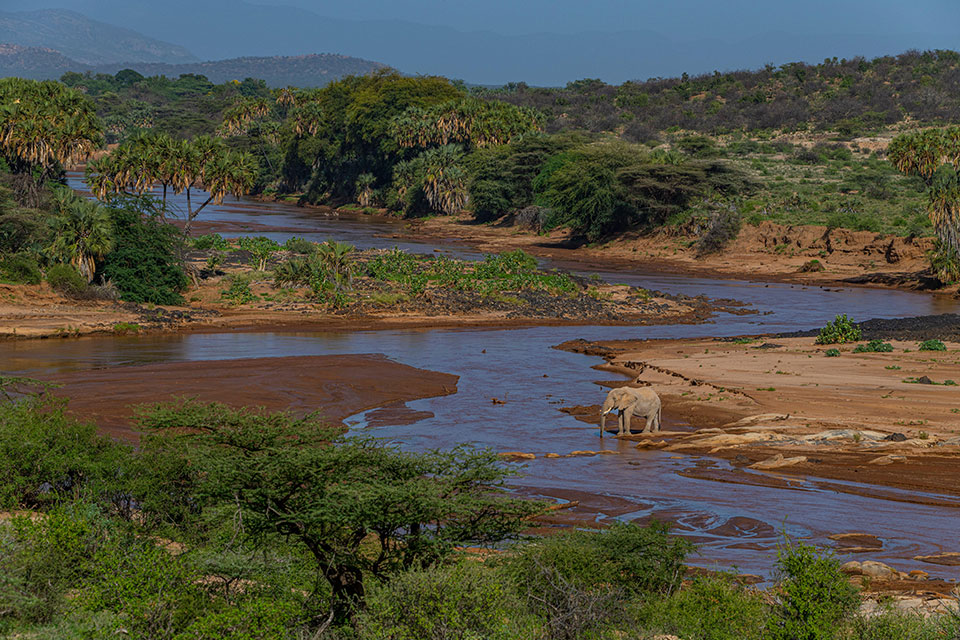
Elephant: Large herds migrate seasonally up the slopes as the montane forests become a critical dry-season refuge, part of a corridor linking Namunyak with Samburu and Laikipia to the south.
Grevy's zebra and reticulated giraffe: Two rare northern specialists, both present on the plains surrounding the range and more reliably encountered here than in most parts of Kenya.
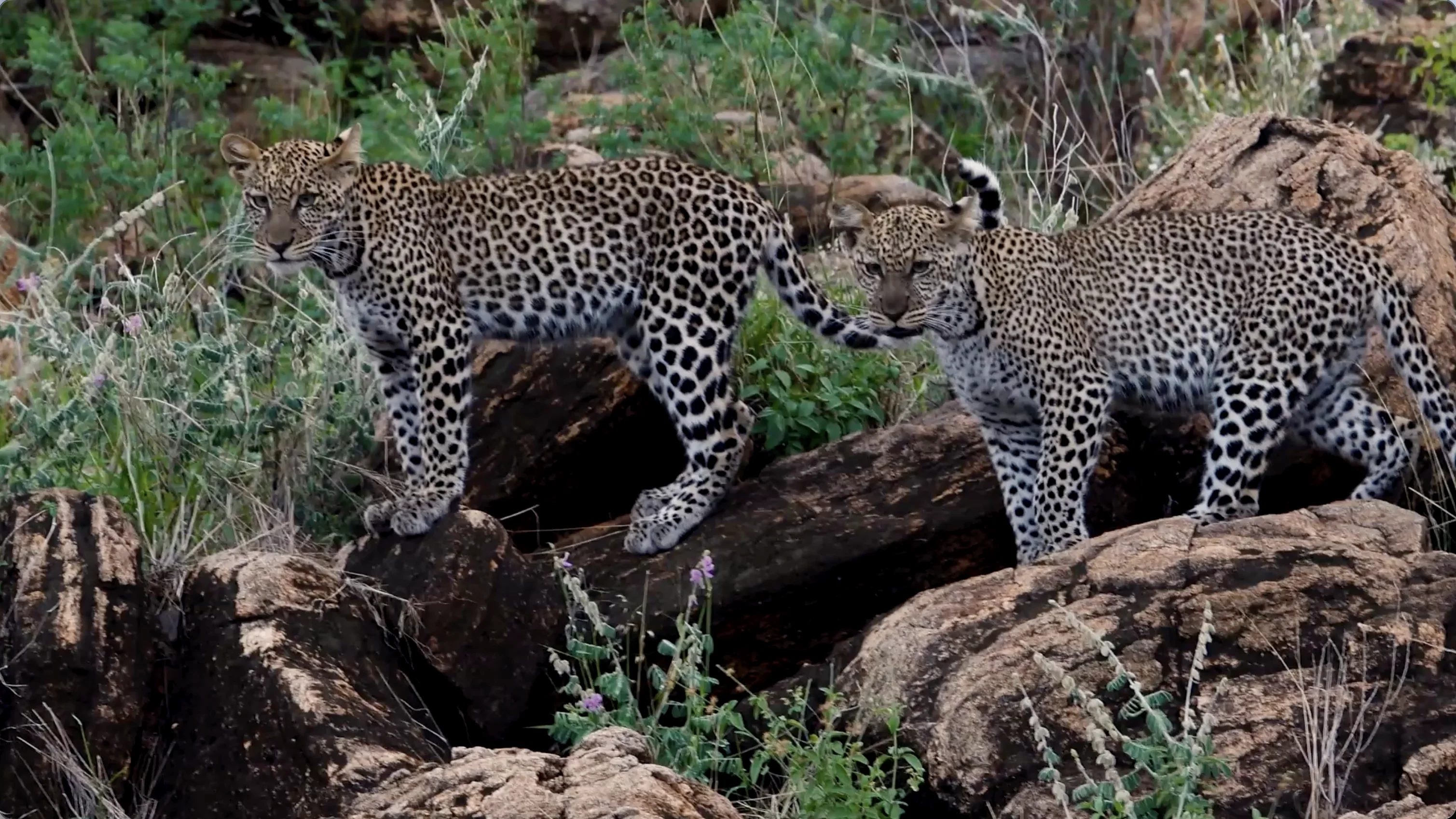
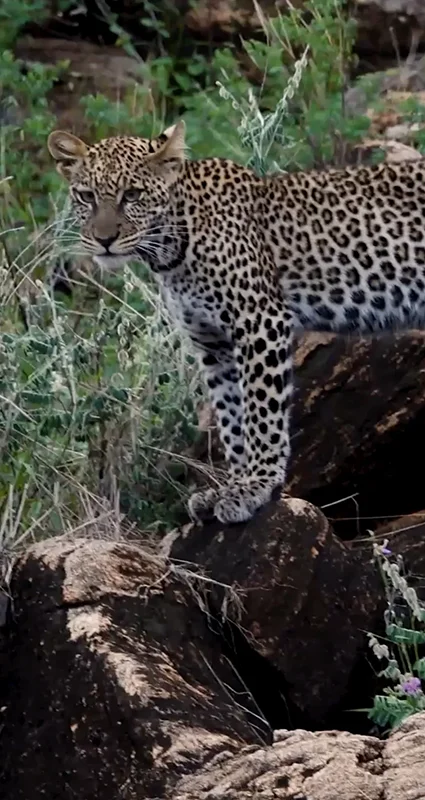
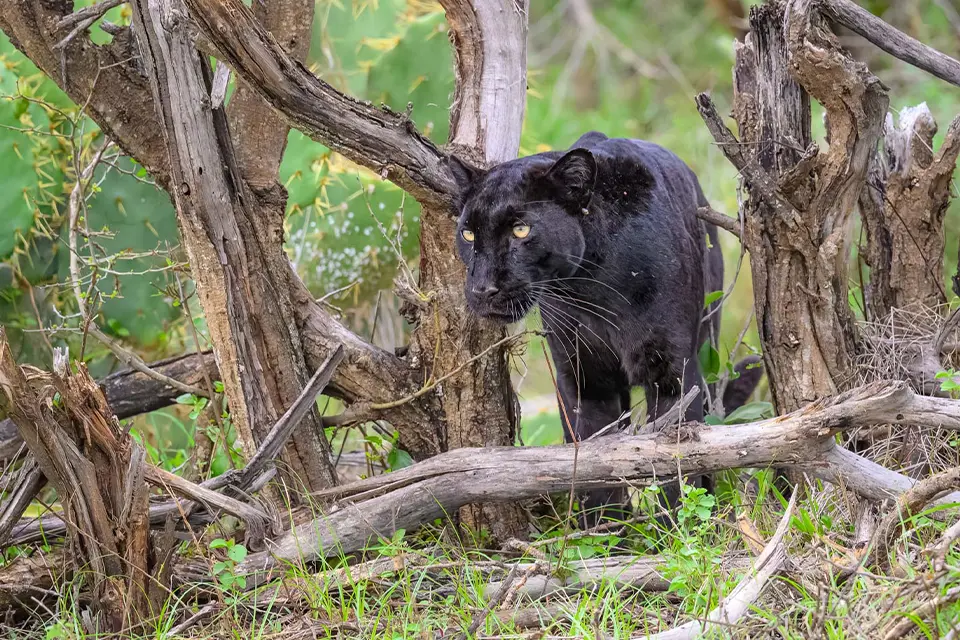
Leopard, buffalo and wild dog: All confirmed within the Namunyak Conservancy; sightings are possible though not guaranteed in an ecosystem where dense vegetation and naturally sparse populations are part of the character.
De Brazza's monkey: One of Kenya's rarest and most elusive primates, inhabiting the dense cedar and olive forest of the range's upper altitudes and a speciality of this montane ecosystem.
About 200 bird species, including Hartlaub’s turaco, narina trogon, African crowned eagle, golden-winged sunbird, red-fronted parrot, silvery-cheeked hornbill, African grey hornbill, cinnamon-chested bee-eater, Ayres’s hawk-eagle and scaly spurfowl.
Where to stay in the Mathews Range
Sarara Camp is the destination's flagship in every meaningful sense. A privately run lodge operating in partnership with the Samburu community's Namunyak Conservancy, supported by the Northern Rangelands Trust, it overlooks community wilderness framed by the mountains. Six tented suites share the view, anchored by a natural rock pool that mirrors the range on still mornings. Sarara is the main base for the Singing Wells, and its Samburu guides' cultural knowledge turns a walk into a genuine exchange with the landscape.
Sarara Treehouses, in the same conservancy, offers a different perspective. Set in the canopy, it immerses guests in the wilderness from above in a way no ground-level camp can match. Consistently among the area's most highly regarded properties, it suits travellers who put intimacy with nature above all else.
Reteti House is a private property inseparable from the neighbouring Reteti Elephant Sanctuary. It offers exclusive-use stays for groups who want the rescued calves to set the rhythm of their visit, with carers, calves and guests sharing the same quiet space in a way shared camps cannot offer.
Kitich Forest Camp, inside the forest, follows a deliberately different philosophy. Six rooms, long-drop toilets and bag showers reflect a commitment to simplicity and bush immersion, while an Italian owner's influence produces cooking that surprises visitors this far from anywhere. For travellers who value character over polish, Kitich is the natural choice.
Trusted by thousands of ecstatic travellers
✔️ 5-Star Trustpilot Rating ✔️ Condé Nast Travel Specialist Award Winner
✔️ Accredited by SATSA ✔️ 5,000+ Exceptional Safaris Since 1991
Why choose Africa Geographic to plan your safari?

"...Africa Geographic put together an unforgettable safari in Kenya...was able to create an incredible itinerary even though we reached out to her with less than a month before we wanted to depart...every detail was thoughtfully arranged and tailored to our pace and interests...I highly recommend...the Africa Geographic team to anyone planning an African safari."

"They put together a wonderful itinerary in Kenya...When one of our traveler's luggage got stuck in Europe...went above and beyond to reunite her with her things....The animals were plentiful and entertaining, the guides and staff everywhere were warm and knowledgeable, our lodgings were comfortable and beautiful, and we would use...Africa Geographic again and again."

"I cannot imagine a better way to customize a trip to Africa than with Africa Geographic....listened to what we hoped to accomplish and patiently went back and forth with suggestions and itineraries until it was perfect. Our trip to...Kenya exceeded all of our expectations. The transfers all went smoothly and our guides were exceptional. I wish I could give 10 stars."
Wish you were here?
Frequently asked questions
The Mathews Range is an ancient granite mountain range in northern Kenya, encompassed within the community-managed Namunyak Wildlife Conservancy. One of Kenya's most remote destinations, it is known for dense montane forests, Samburu culture and walking-led wilderness immersion.
It lies approximately 280 kilometres northeast of Nairobi, north of Samburu National Reserve and the Ewaso Nyiro River, in a remote corner of northern Kenya between the Laikipia safari region and the country's arid northern frontier.
Samburu National Reserve is a semi-arid savannah destination with reliable, high-density wildlife viewing from vehicles. The Mathews Range is a mountain and forest ecosystem where walking safari is the primary experience, wildlife is naturally sparse, and the emphasis falls on immersion, culture and rare species.
Elephant are the dominant presence, migrating seasonally to the montane forests during the dry season. Grevy's zebra, reticulated giraffe, leopard, buffalo and wild dog are all confirmed in the conservancy. The De Brazza's monkey and over 200 bird species make this a rewarding destination for forest and savannah birdwatchers.
The Singing Wells are sacred Samburu water sources where herdsmen draw water for their cattle while singing traditional songs, a ritual that calls the herds in and has been part of Samburu life for generations. Elephants and other wildlife share the same water sources, making the encounter deeply affecting.
Reteti is Africa's first elephant orphanage owned and operated entirely by a local community, the Samburu people of northern Kenya. It cares for rescued elephant calves and rehabilitates them toward an eventual return to the wild. The sanctuary can be visited from properties within the Namunyak Conservancy.
The dry season from June to February is generally considered the best period for wildlife and walking. January to March can offer particularly outstanding conditions. Seasonality here is relatively low, and there are good reasons to visit the Mathews Range at any time of year.
The standard access is by charter flight from Wilson Airport in Nairobi, with a flying time of approximately 45 to 60 minutes. Four airstrips serve the region, and some lodges also offer helicopter access. Flying in is strongly recommended over road travel given the distances involved.
A stay of four to seven nights is recommended to experience the walking, birdwatching, Samburu cultural activities and the Singing Wells. The unhurried nature of the destination rewards those who allow time to explore at a slower pace.
It is better suited to experienced safari travellers. Wildlife densities are naturally low compared to Kenya's major savannah reserves, the activities are walking-led and physically engaging, and the remoteness demands a degree of comfort with the unfamiliar. Those seeking high-volume wildlife sightings will be better served elsewhere first.
The Namunyak Wildlife Conservancy covers approximately 344,000 hectares of northern Kenyan wilderness, managed directly by the Samburu community. Supported by the Lewa Conservancy and the Tusk Trust, it forms part of an elephant corridor connecting the Mathews Range with Samburu National Reserve and the Laikipia Plateau.
The Mathews Range pairs naturally with Samburu National Reserve, Lewa Wildlife Conservancy and the Laikipia Plateau, all accessible by charter flight. For the adventurous, charter flights can also reach the remote shores of Lake Turkana to the north. The Maasai Mara provides a compelling contrast for a longer itinerary.
Most international visitors require a visa to enter Kenya. Requirements and processes vary by nationality and are subject to change, so checking current Kenyan entry requirements well in advance of travel is strongly advised. Your safari specialist will be able to advise further.
In the low season, prices range from about US$600 per person per night at Kitich Forest Camp to around US$1,300 at exclusive-use Reteti House. In peak season Kitich stays around US$600, while Sarara Camp and Sarara Treehouses rise to about US$1,500 or more. Rates are generally full board with activities. Namunyak's conservancy fee of US$160–185 per adult per night is usually extra.
Click here to schedule a no-obligation call with one of our Safari Experts or fill in our 2-minute form with your questions. Our team of experts are here to help! Whether you’re curious about the best time to travel, want to hear first-hand about an experience or need help planning your safari.
Explore more African destinations
Start planning your dream safari
Our travel experts will craft a no-obligation itinerary just for you. We have crafted over 5,000 safaris since 1991. Your personal details are protected; we only use this information to contact you.
Why book your safari with us?

Deep Experience & Knowledge
Handcrafted experiential safaris since 1991.
Travel in Africa is about knowing when and where to go, and with whom. A few weeks too early/late or a few kilometres off course, and you could miss the greatest show on Earth. And wouldn’t that be a pity?

Trust & Safety

Make A Difference
We donate a portion of the revenue from every safari sold to carefully selected conservation projects that make a significant difference at ground level.
YOUR safari choice does make a difference - thank you!