

Tailor-made safaris. Since 1991



Sossusvlei sunrise logistics
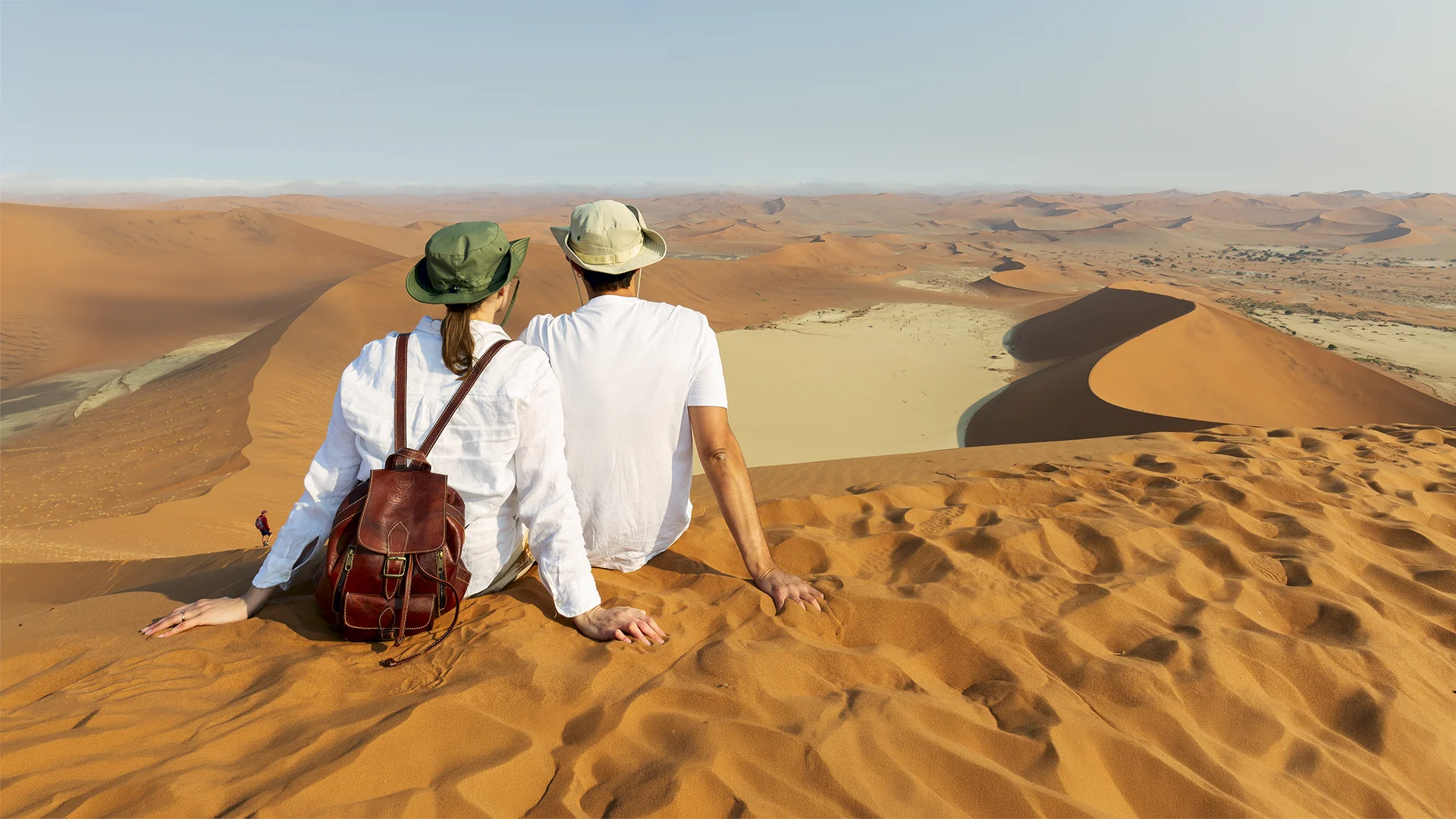
Before dawn, the road into Sossusvlei in Namibia is still black, and the dunes exist only as deeper shadows against a sky just beginning to pale. A jackal slips across the headlights and is gone before you've properly registered it, and the night's cold still sits in the air, sharp enough to feel through a jacket. None of that stillness gives away where you slept. Yet that single detail decides how soon you'll be standing among the dunes as the first light finds them.
Guests based inside Sesriem's outer gate use an internal gate that generally opens ahead of the public entrance, letting them start the roughly 60km drive while the desert is still cool and the light at its softest. Travellers staying outside wait for the main gate to open at sunrise, and a handful of lodges on neighbouring private reserves have their own separate, authorised access, though the route and timing vary by property.
That head start matters, but it isn't the whole story. The tar ends at the 2x4 car park, and the final five kilometres run through deep sand that calls for a proper 4x4 or the park shuttle, with Deadvlei itself reached on foot across ground no vehicle can cross. So the best base was never simply the nearest lodge on a map. It's the one whose access, transport and guiding put you exactly where you need to be when the first light finds the dunes.
Where to stay for Sossusvlei sunrise
There are three practical positions from which to approach Sossusvlei: inside Sesriem's outer gate, immediately outside it or on a neighbouring private reserve with authorised access. Each changes the timing and character of the morning.
Accommodation position | Access point | Approximate journey to Deadvlei |
Inside Sesriem's outer gate | Internal gate | About 60 km to the 2x4 car park, then the sand track and walk |
Immediately outside Sesriem | Public outer gate | The same park journey, plus the entrance queue |
Neighbouring private reserve | Property-specific access | Varies by lodge, route and authorised gate arrangements |
Drive times depend on gate procedures, traffic, wildlife on the road and whether you drive the final sand track or use the shuttle. Treat any minute-by-minute estimate as a planning guide rather than a promise.
None of these positions is inherently wrong. The choice is between the strongest possible head start, a broader range of accommodation and the seclusion of a private reserve – and the right answer depends on whether first light at the dunes is the priority of your stay.
"Wildlife moves freely through camp without much concern. Gemsbok passed within fifty metres of my verandah, followed later by jackals doing their usual rounds." – Anthony Young, Africa Geographic traveller, describing his stay in the Sossusvlei region.
His account is a useful reminder that a carefully chosen base offers more than quicker access to the dunes. Staying within the desert landscape gives its quieter life time to emerge before and after the morning's journey to Sossusvlei.
3 things we love about Sossusvlei mornings
The practical reward for an early start is not merely a cooler walk! Dawn briefly reveals a softer, more dimensional desert before the sun climbs and the scale of the Namib becomes almost overwhelming:
The dunes change by the minute: Low light catches one slope in burnt orange while the other remains in deep purple shadow, revealing contours that flatten as the sun rises.
The desert is still cool and quiet: Oryx and springbok may cross the plains beside the road, and the walk to Deadvlei is far more comfortable before heat begins radiating from the sand.
A second morning lets you look beyond the logistics: Once you know the gates, road, parking area and walking route, you can spend less time navigating and more time watching the light move across the pan.
Understanding Sesriem's two gates
The outer and inner gates
Sesriem has two gates, and confusing them leads to most of the uncertainty around sunrise. The public outer gate opens at sunrise and closes at sunset. Guests sleeping inside that gate can pass through the internal gate earlier – generally about an hour before sunrise – giving them a head start towards the dunes. Exact opening times shift with daylight and should be confirmed locally for your travel dates.
Private access is different again. Selected lodges on reserves adjoining Namib-Naukluft National Park have authorised gates leading towards Sossusvlei. This can shorten or simplify the journey, but it should not be described as a universal benefit of staying on private land; access conditions and timings depend on the lodge.
Why the first hour matters
In the low morning sun, each dune is divided into light and shadow. The iron-rich sand glows red and ochre, the pale floor of Deadvlei sharpens beneath the black silhouettes of camelthorn trees, and every ridge appears more sculptural. As the sun climbs, shadows shorten, contrast softens and heat begins to gather over the open sand. Thirty minutes can change the photograph – and the comfort of the walk – considerably.
The final stretch beyond the tar road
Where the sand begins
The tarred road runs for roughly 60 km from Sesriem towards the dune area and ends at the 2x4 car park. Beyond it lies approximately 5 km of deep, shifting sand. Confident drivers in suitable 4x4 vehicles may be permitted to continue, while other visitors leave their vehicles and use the shuttle. Access rules can change, so confirm the current arrangement before setting out.
Reaching the final parking area is not the end of the journey. Deadvlei lies beyond a walk of roughly 1 km across exposed sand and low dunes. Big Daddy requires considerably more time and effort, making it important to decide before departure whether the morning is for the pan, the climb or photography along the way.
Heat arrives faster than expected
The cold of a desert dawn can be deceptive. Once sunlight spills over the dunes, temperatures rise quickly and there is almost no shade on the walk to Deadvlei or the climb up Big Daddy. Carry ample water, wear a hat and sun protection, and use footwear suited to hot, loose sand. In warmer months, an hour gained at the gate can mean the difference between an exhilarating walk and a punishing return.
Wish you were here?
Why the second morning often wins
What a second morning gives you
On a first visit, small decisions consume the light: where to collect the permit, how long the drive takes, whether to use the shuttle, which path crosses to Deadvlei and how quickly your group moves over sand. Return the following morning and the uncertainty falls away. You know where to stop, what to carry and which landmark deserves the first light.
Two mornings also remove the pressure to force every experience into a single outing. One can be devoted to Deadvlei and its camelthorn silhouettes; the other to Dune 45, Big Daddy or simply watching the colour travel across the dune faces. Sossusvlei rewards repetition because the light, wind and cloud never arrange the desert in quite the same way twice.
Balloon flights as an alternative sunrise
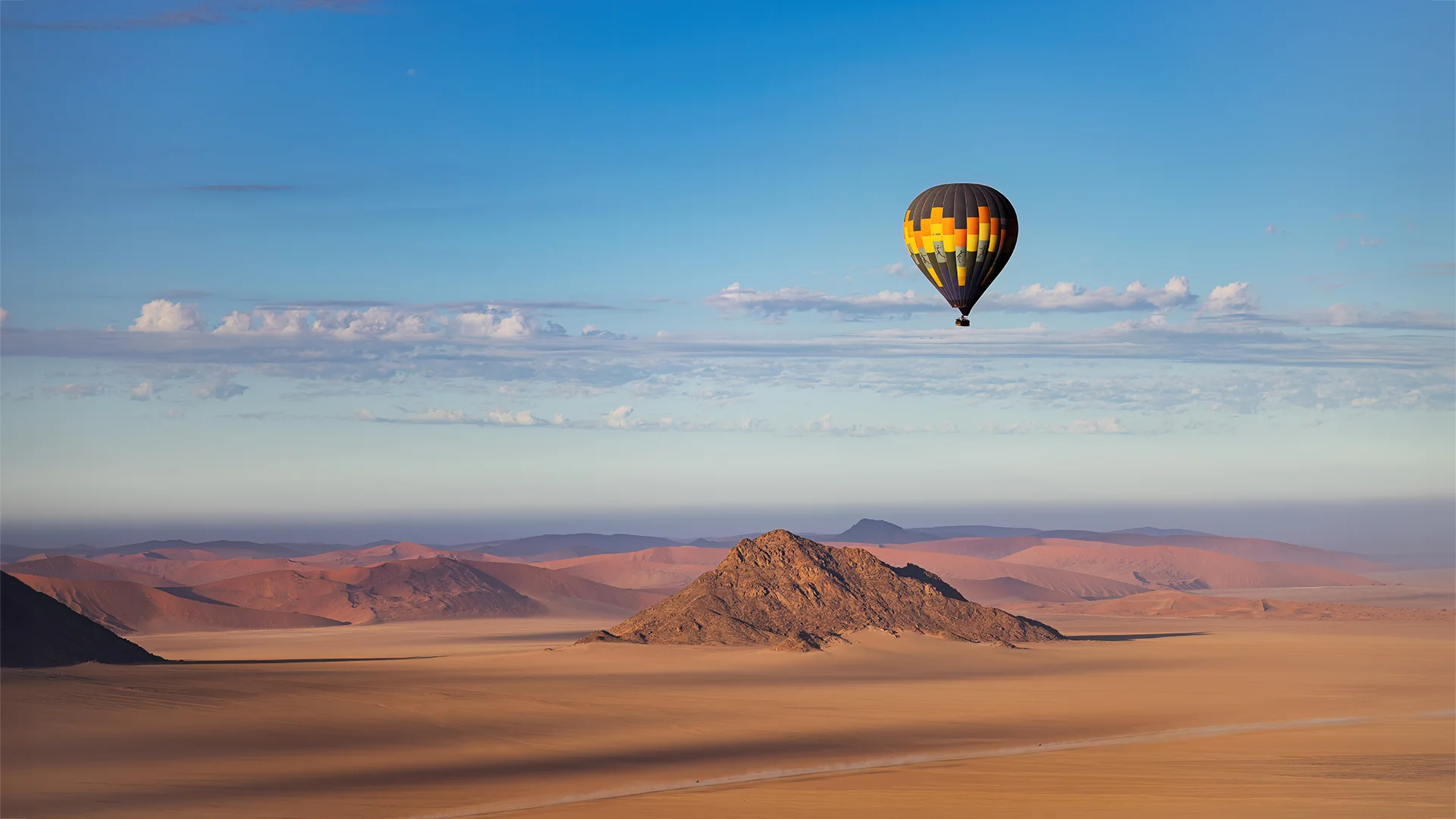
A hot-air balloon flight replaces the gate queue with an entirely different dawn. Launch sites lie outside the national park, and flights depend on suitable weather, but from the basket the Namib resolves into pattern: dune crests, gravel plains, dry river lines and shadows extending across the sand. It is not a substitute for standing among the trees of Deadvlei; it is a way of understanding the scale of the landscape that surrounds them.
Flights usually depart before sunrise and conclude with breakfast in the desert. Because operations are weather-dependent and places are limited, this morning should be planned in advance rather than treated as a last-minute alternative.
Combining both perspectives
With three nights in the Sossusvlei area, travellers can dedicate one dawn to the dunes and another to a balloon flight, leaving a further morning as weather insurance or for a return visit. This allows the desert to be seen first from within its folds and then from above, where individual landmarks become small details in the vast Namib Sand Sea.
Frequently asked questions
The public outer gate opens at sunrise, with the exact time changing through the year. The internal gate for guests staying inside the outer gate generally opens about an hour earlier. Confirm the current times locally before your visit.
The 2x4 car park is roughly 60 km from Sesriem. From there, about 5 km of deep sand leads to the final parking area, followed by an exposed walk of approximately 1 km to Deadvlei.
Not for the tarred road to the 2x4 car park. The final sand track requires a suitable 4x4 and confident soft-sand driving; otherwise, use the shuttle. Confirm current access rules before travelling.
Yes, when first light is the priority. Guests staying inside the outer gate can generally use the internal gate before the public entrance opens, giving them a valuable head start on the drive towards the dunes.
It can be. Familiarity with the gate, road, shuttle and walking route removes delays, while a second visit lets you separate Deadvlei, dune climbing and photography instead of rushing between them in one morning.
Dawn may be cold, especially in winter, but the exposed sand heats quickly after sunrise. Temperatures vary by season, so carry water and sun protection and complete strenuous walks or climbs as early as possible.
Start planning your dream safari
Our travel experts will craft a no-obligation itinerary just for you. We have crafted over 5,000 safaris since 1991. Your personal details are protected; we only use this information to contact you.
Why book your safari with us?

Deep Experience & Knowledge
Handcrafted experiential safaris since 1991.
Travel in Africa is about knowing when and where to go, and with whom. A few weeks too early/late or a few kilometres off course, and you could miss the greatest show on Earth. And wouldn’t that be a pity?

Trust & Safety

Make A Difference
We donate a portion of the revenue from every safari sold to carefully selected conservation projects that make a significant difference at ground level.
YOUR safari choice does make a difference - thank you!