

Tailor-made safaris. Since 1991



West Coast National Park: lagoons and wildflowers
West Coast National Park at a glance:
Location: Western Cape, South Africa - along the R27 tar coastal highway | Access from Cape Town: ~90 minutes by road via the R27 |
Nearest city: Cape Town | Currency: South African Rand (ZAR) |
Entrance gates: Southern Gate (off R27) and Langebaan Gate (north) | Best time to visit: August–September (wildflowers); year-round for birdwatching and wildlife |
Why visit West Coast National Park?
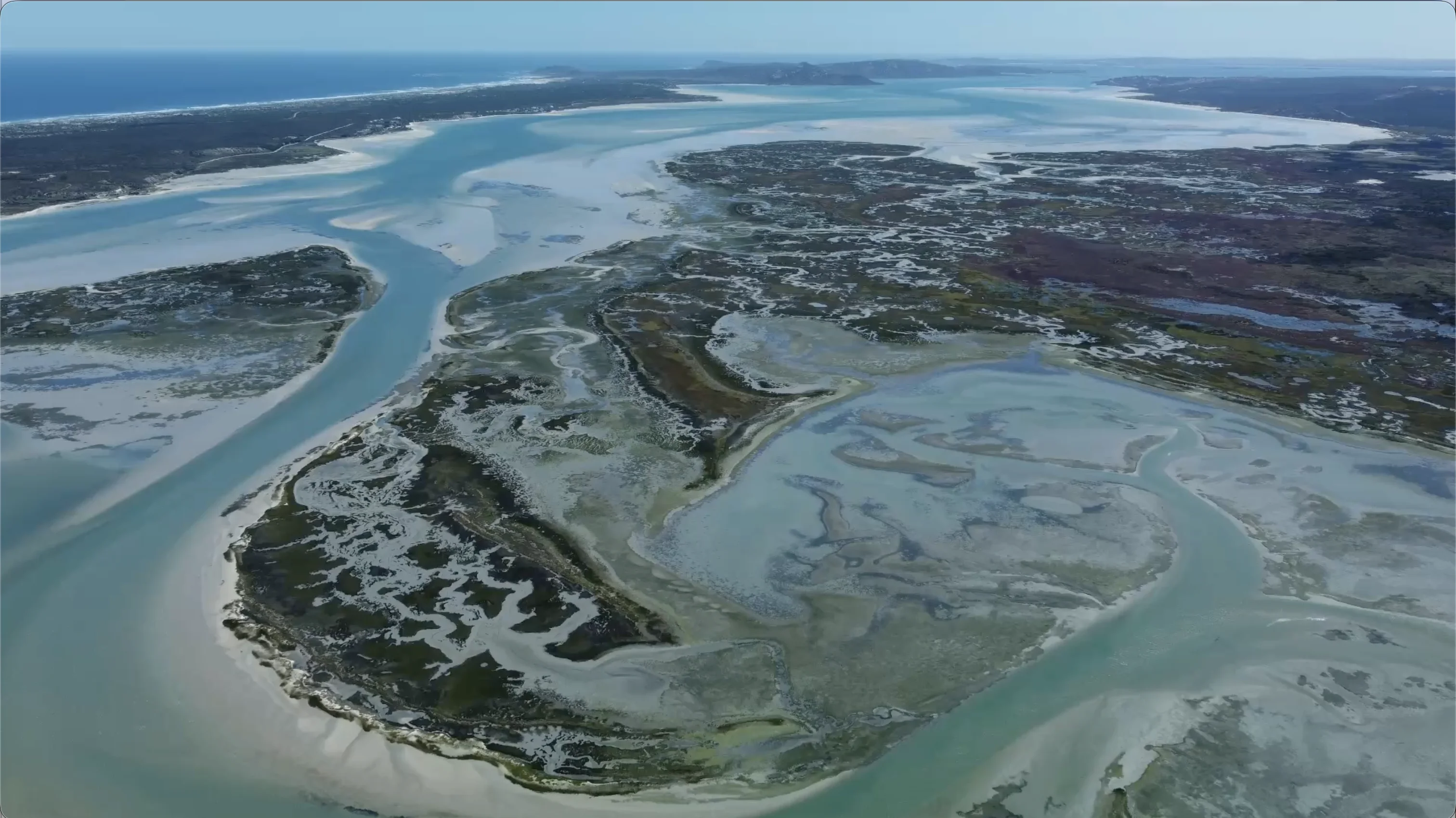
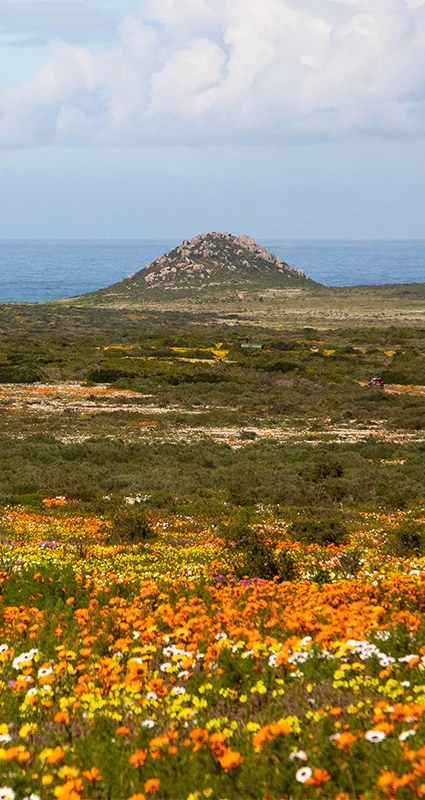
West Coast National Park sits on the edge of the cold Atlantic Ocean, roughly 90 minutes north of Cape Town along the R27, yet it occupies an entirely different emotional register to the city it neighbours. The park is built around Langebaan Lagoon, a sheltered, turquoise body of water warm enough to swim in and calm enough to mirror the surrounding fynbos on a windless morning. In spring, the landscape transforms. August and September bring the wildflower season, when the Postberg section erupts in colour - daisies and succulents carpeting the hillsides from granite outcrops down to the water's edge.
In 1995, fossilised footprints were discovered on the lagoon's edge, dated to 117,000 years ago: the oldest anatomically modern human footprints ever found on earth, lending a quietly profound dimension to a park already rich in natural wonder. Birdwatching draws visitors year-round: flamingoes at the lagoon hides near Geelbek, waterbirds at Abrahamskraal Waterhole, and the chance to encounter antelopes, zebras and mountain tortoises as you move through the fynbos and strandveld. Hiking and mountain biking trails range from a short lagoon-edge meander to a 37 km overnight through dunes and coastal scrub. This park rewards those who slow down, look closely, and let the landscape come to them.
5 reasons we love West Coast National Park
The lagoon: Langebaan Lagoon's sheltered waters are the park's focal point - swim, picnic on the shore, or watch flamingoes from the waterside bird hides.
Wildflower season: The wildflower season in August and September turns Postberg and Seeberg into one of South Africa's most vivid and celebrated natural displays.
Eve's Footprints: Eve's Footprints - fossilised tracks dated to 117,000 years ago - are the oldest anatomically modern human footprints ever found anywhere on earth.
Birdwatching: Four bird hides positioned around the lagoon and at Abrahamskraal offer an intimate window into flamingoes and other abundant waterbirds.
Trails: Hiking and mountain biking trails weave through dunes, fynbos, and strandveld, from a 4.8 km Bakoor meander to a 37 km Postberg overnight.
All you need to know about West Coast National Park
About West Coast National Park
West Coast National Park lies in the Western Cape, a 90-minute drive north of Cape Town along the R27 freeway. The park has two entrance gates: the Southern Gate off the R27, most convenient for those arriving from Cape Town, and the Langebaan Gate at the park's northern edge. The landscape is defined by Langebaan Lagoon at its centre, surrounded by fynbos, strandveld, sand dunes and low granite hills.
The Postberg section, a peninsula jutting into the lagoon, is the heart of the wildflower display and is accessible only in August and September. Geelbek Visitor Centre, housed in a Cape Dutch building overlooking the lagoon, serves as the main information hub and is home to a replica of Eve's Footprints. The park has four bird hides, a restaurant open daily, and two dedicated braai and picnic areas. The park has no ATMs or fuel stations.
Things to do in West Coast National Park
Swim in Langebaan Lagoon at Kraalbaai, the park's best and most sheltered swimming spot, and explore the Preekstoel Rock nearby.
Follow the wildflower trails through Postberg and around Seeberg Viewpoint in August and September, when the hills erupt in colour.
Explore the historic Geelbek Visitor Centre, set in a Cape Dutch building, to view a replica of Eve's Footprints and reach the bird hides.
Hike the Strandveld Trail - two 14 km loops from Geelbek through fynbos and sand dunes, with the second day leading to Sixteen Mile Beach.
Cycle from Langebaan Gate on two designated mountain biking routes, both moderate and winding around the granite Seeberg Viewpoint.
Watch for whales from Tsaarsbank Beach in August and September, where the open Atlantic runs north along the wild Sixteen Mile Beach.
What wildlife will I see in West Coast National Park?
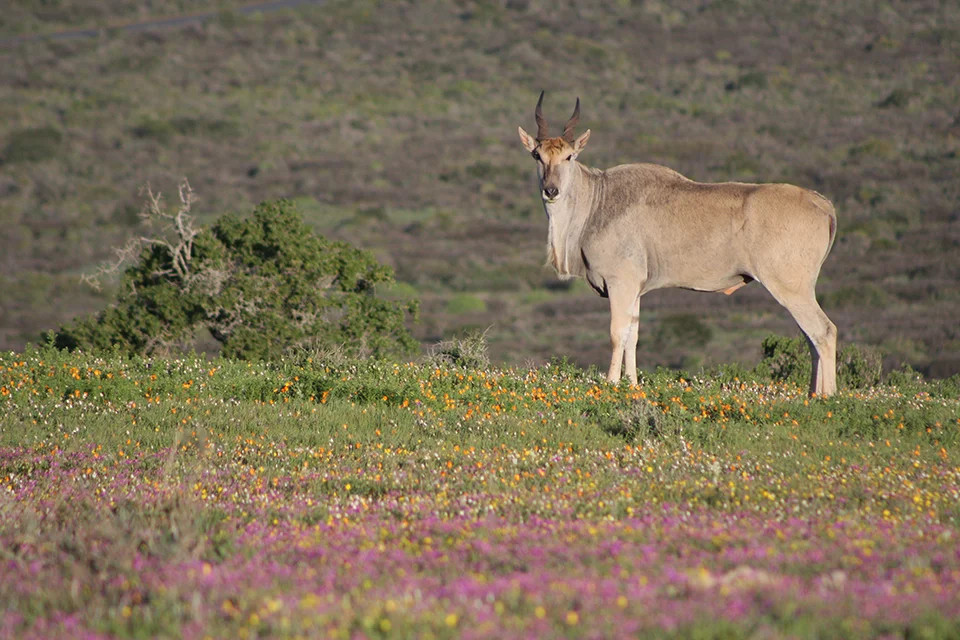
Mountain zebras and several antelope species, such as eland, bontebok, and grysbok, move through the fynbos and strandveld. Watch for them while driving the park roads.
Greater flamingos - pink adults and white juveniles - gather in large numbers at the Geelbek bird hides, reached by a lagoon-edge boardwalk.
Bontebok graze across the open terrain of the Postberg section and are among the most reliably spotted animals in the entire park.
Whales are occasionally spotted from Tsaarsbank beach during August and September, moving along the open Atlantic coastline below the dunes.
281 bird species, including African penguin, black harrier, southern black korhaan, chestnut-banded plover, African oystercatcher, greater flamingo, Cape clapper lark, Karoo lark, grey-winged francolin, terek sandpiper, South African shellduck and black-headed canary.
Where to stay in and near West Coast National Park
Inside the park:
Duinepos Chalets lie close to the Geelbek Visitor Centre and Restaurant. The 11 chalets are a community-run project, bookable directly by phone rather than through the national parks reservation system.
Outside the park:
The Farmhouse Hotel in Langebaan sits a few minutes' drive from the park's Langebaan Gate, in the small coastal town on the lagoon's edge. The location gives guests direct access to the park's northern entrance and to Langebaan's own restaurants and waterfront.
Strandloper Ocean Boutique Hotel in Paternoster faces the open Atlantic rather than the sheltered lagoon. The whitewashed fishing village setting is quieter and more remote than Langebaan.
Kaijaiki Country Inn in Yzerfontein sits at the southern end of this coastal stretch, positioned between Cape Town and the park's Southern Gate.
Darling Lodge Guest House lies in the inland town of Darling, surrounded by farmland and fynbos rather than shoreline. Darling has its own spring wildflower displays, and the lodge is particularly well suited as a base during flower season.
Grootvlei Guest Farm near Lambert's Bay places guests well to the north of the park, where the West Coast becomes more open and rugged.
Laaiplek Hotel in Velddrif sits at the mouth of the Berg River to the north. This working fishing town has a character quite unlike the coastal resort towns to the south and is known for its birdlife and its river estuary setting.
More about West Coast National Park experiences
West Coast National Park rewards a loose itinerary. Arrive when the gates open, let the morning light lead you to the lagoon, and allow the day to shape itself around what you find.
Wildflower walking in Postberg and Seeberg: The Postberg section is why many visitors time their trip for August and September. The two-day Postberg Flower Hike (37 km) leads walkers deep into the peninsula's interior, where fields of daisies and succulents spread across the hillsides in every direction. For those with less time, the one-day Steenberg Flower Hike (16 km) offers a comparable experience without the overnight camp. Book both well in advance - bookings open in early June, and weekend slots fill almost immediately. For a gentler introduction to the park's flora, the area around Seeberg Viewpoint rewards a short drive or an hour's cycle with wide views over the lagoon and reliable flower sightings, with no permit or prior booking required.
Swimming and picnicking at Kraalbaai: Kraalbaai is the heart of the lagoon experience. The sheltered bay offers calm, warmer (than the ocean) water ideal for swimming, a braai area with lagoon views, and enough space to spend a full afternoon. The strangely shaped Preekstoel Rock is a short walk along the shore and worth the detour. On weekends and during the summer holiday period, braai spots are in high demand, so arrive early to secure a spot, as all braai and picnic areas in the park operate on a first-come, first-served basis.
Birdwatching at Geelbek and Abrahamskraal: The two bird hides near Geelbek Visitor Centre rank among the best in the Western Cape. A 500 m and 1 km walk across a lagoon-edge boardwalk leads to the hides, where flamingoes, waders and a wide variety of waterbirds gather in the shallow lagoon margins. Abrahamskraal Waterhole, roughly 15–20 minutes by car from Geelbek, provides a freshwater contrast with a different set of species. The hide below Seeberg Viewpoint looks out across the open lagoon and is worth the short walk for the views.
Hiking and cycling the interior: The Strandveld Trail offers two 14 km loops from Geelbek through fynbos, dunes and the coastal scrub, with the second day leading out to Sixteen Mile Beach. The shorter Bakoor Trail (4.8 km) climbs from the Langebaan Gate to Seeberg Viewpoint and back. Two designated mountain biking routes, 13 km and 17 km, both start from the Langebaan Gate and wind around Seeberg on a mix of road and old vehicle track, with a moderate amount of climbing.
Tsaarsbank and the open coast: The park's Atlantic-facing edge is a different world from the sheltered lagoon. Tsaarsbank beach is open year-round and is often deserted even when the rest of the park is busy. It sits at the northern end of Sixteen Mile Beach, with a car park, braai area and toilets on-site. In August and September, whales move along this stretch of the open Atlantic coastline and patient observers with binoculars are occasionally rewarded.
Trusted by thousands of ecstatic travellers
✔️ 5-Star Trustpilot Rating ✔️ Condé Nast Travel Specialist Award Winner
✔️ Accredited by SATSA ✔️ 5,000+ Exceptional Safaris Since 1991
Why choose Africa Geographic to plan your safari?

"...did an outstanding job organizing an unforgettable trip for my family and me to South Africa...itinerary that far exceeded our expectations. We enjoyed two incredible safaris over the course of eight nights, which struck the perfect balance between family-friendly (ideal for our kids, ages 10 and 11) and fun experiences for adults...we had an extraordinary experience..."

"A top company to help organise and arrange your perfect safari trip...extremely helpful in tailoring our experience exactly how we wanted it...I would throroughly reccomend Africa Geographic, if you want peace of mine for your perfect once in a lifetime trip then this is the company for you. Will definitely be recommending them and using them again..."

"I could not believe how responsive Africa Geographic was during the planning...they listened to what we liked/disliked...The itinerary they put together was unbelievable! They were also very mindful of our budget...Their expertise, knowledge, help and support we're priceless! You will be so happy and thankful to have Africa Geographic plan your exciting safari."
Wish you were here?
Frequently asked questions
West Coast National Park is in the Western Cape, approximately 90 minutes north of Cape Town along the R27 coastal highway. The park sits just south of the small town of Langebaan and has two entrance gates: the Southern Gate off the R27, and the Langebaan Gate at the park's northern edge.
The park is open year-round, and each season offers a different experience. August and September are peak wildflower season, when the Postberg section and Seeberg Viewpoint are at their most spectacular - though this is also the busiest and most expensive period. Birdwatching and lagoon swimming are enjoyable year-round. Summer (December–January) is busy with local holiday visitors; weekday visits in spring are recommended to avoid queues.
The park gates are open September to March 07:00–19:00, and April to August 07:00–18:00. The Postberg Section has different hours and is only open in August and September: 09:00–16:00, with last entry at 15:00.
Entrance fees are higher during wildflower season (August and September). Outside flower season, the standard fee applies to South African and international visitors, with children admitted at half price. The Postberg Section, only accessible in August and September, is included in the park entry fee.
Eve's Footprints are a fossilised set of human footprints discovered in 1995 on the edge of Langebaan Lagoon. Dated to 117,000 years ago, they are considered the oldest anatomically modern human footprints ever discovered. A replica is on display at Geelbek Visitor Centre within the park. The footprints are believed to have belonged to a woman, and their age coincides with the period of the so-called mitochondrial Eve.
Wildflower season falls in August and September. The Postberg section of the park, only accessible during these two months, offers the most concentrated and vivid displays. The area around Seeberg Viewpoint is also particularly good for flowers. The best conditions are sunny mornings with low wind. Weekday visits and early arrivals are advisable, as the park gets very busy during peak flower weekends.
The park's wildlife is diverse, though not as dense as in dedicated game reserves. Mountain zebras, bontebok, eland, ostriches and mountain tortoises are all regularly seen. Flamingos are a highlight at the bird hides near Geelbek, and the lagoon and Abrahamskraal Waterhole attract a wide variety of waterbirds throughout the year. You can occasionally spot whales from Tsaarsbank beach in August and September.
The park has a range of trails to suit different levels and available time. The 4.8 km Bakoor Trail runs from the Langebaan Gate up to Seeberg Viewpoint and back. The Strandveld Trail offers two 14 km loops from Geelbek through fynbos and dunes. The two-day Postberg Flower Hike (37 km) and the one-day Steenberg Flower Hike (16 km) are only available in August and September and must be booked in advance. The guided Eve's Trail covers 33 km over 2.5 days and requires a prior booking through the Cape West Coast Biosphere.
Yes. Two designated mountain biking routes - 13 km and 17 km - both start from the Langebaan Gate and wind around Seeberg Viewpoint, using a combination of roads and old vehicle tracks. Outside of flower season, the park roads are generally quiet enough for road cycling as well. Langebaan Gate to Geelbek Visitor Centre is 30 km return; Langebaan Gate to Kraalbaai is 70 km return.
Yes. Kraalbaai, on Langebaan Lagoon, is the best and most popular swimming spot within the park. The lagoon's sheltered position and warm water make it suitable for swimming throughout the summer months. The ocean beach at Tsaarsbank, on the park's Atlantic side, is colder and more exposed.
No. Pets are not permitted within West Coast National Park.
The Geelbek Restaurant is located in a historic Cape Dutch building at Geelbek Visitor Centre and is open Monday to Friday 09:00–16:00, Saturday 09:00–17:00, and Sunday 08:30–17:00. The menu focuses on South African dishes including bobotie, Cape Malay curry and ostrich steaks. Cards are accepted, and both indoor and outdoor seating are available.
Accommodation options range from chalets inside the park - including the 11 community-run Duinepos Chalets (bookable by phone) - to a selection of boutique hotels and guesthouses along the West Coast in Langebaan, Paternoster, Yzerfontein, Darling, Lambert's Bay and Velddrif. Camping is not allowed within the park. Check-in for park accommodation is at the Geelbek Information Centre between 14:00 and 16:00.
Accommodation options inside and near the national park typically cost from R800 per person, per night, depending on the accommodation comfort level, time of year and activities. This price usually includes accommodation but excludes all meals, activities and park entry fees.
Click here to schedule a no-obligation call with one of our Safari Experts or fill in our 2-minute form with your questions. Our team of experts are here to help! Whether you’re curious about the best time to travel, want to hear first-hand about an experience or need help planning your safari.
Start planning your dream safari
Our travel experts will craft a no-obligation itinerary just for you. We have crafted over 5,000 safaris since 1991. Your personal details are protected; we only use this information to contact you.
Why book your safari with us?

Deep Experience & Knowledge
Handcrafted experiential safaris since 1991.
Travel in Africa is about knowing when and where to go, and with whom. A few weeks too early/late or a few kilometres off course, and you could miss the greatest show on Earth. And wouldn’t that be a pity?

Trust & Safety

Make A Difference
We donate a portion of the revenue from every safari sold to carefully selected conservation projects that make a significant difference at ground level.
YOUR safari choice does make a difference - thank you!