

Tailor-made safaris. Since 1991



Mafia Island: Tanzania's remote marine wilderness
Mafia Island at a glance:
Location: Mafia Archipelago, Pwani Region, Tanzania - approximately 160 km south of Zanzibar, opposite the Rufiji River delta; 30 minutes by light aircraft from Dar es Salaam. | Marine park: Mafia Island Marine Park (established 1995); Tanzania's first marine park; 822 km² |
Best time to visit: Whale sharks: October–February (reliable core: November–January). Reef diving: June–October. Avoid March–May (long rains). | Visa: Tanzania mainland visa required. A Zanzibar-only visa does not cover Mafia Island, an important distinction for travellers combining islands. |
Access: Light aircraft only (practical option). Kilindoni Airport (MFA). Auric Air and Coastal Aviation operate multiple daily flights from Dar es Salaam. Small aircraft with real weight limits; book early. | Cash: No usable ATM on the island. Bring all cash from Dar es Salaam in US dollars dated 2009 or later, plus Tanzanian shillings. Older or damaged notes are refused. |
Recommended stay: Minimum 3 nights; 5–7 nights to do the island justice. A whale shark or reef diving focus warrants at least 5 nights. | Health: Malaria present; antimalarial medication recommended. Comprehensive travel and medical evacuation insurance is essential given the island's remoteness. |
Why visit Mafia Island?
Mafia Island rewards travellers who love diving remote, pristine waters. Off the east coast of Tanzania, 160 kilometres south of Zanzibar and 30 minutes by light aircraft from Dar es Salaam, it is among the Indian Ocean's most compelling marine destinations and one of its least visited.
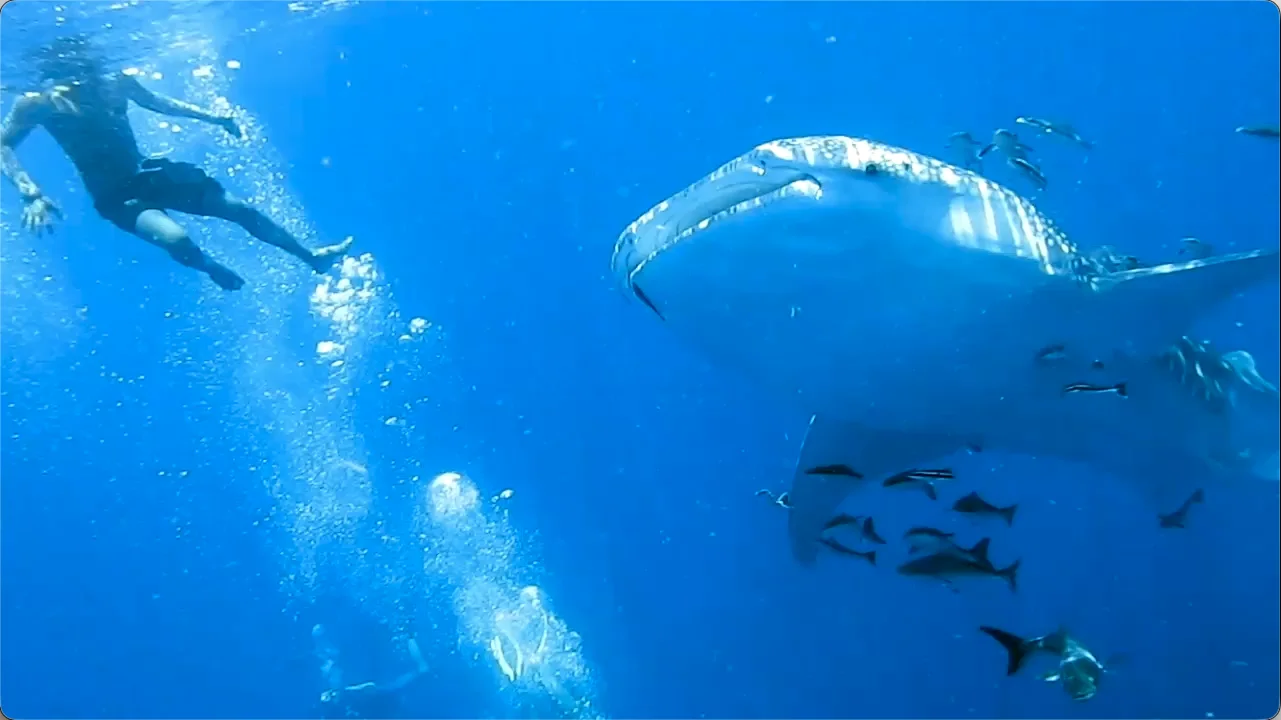
Between October and February, juvenile whale sharks gather off the island's west coast to feed on plankton blooms at the surface, in relatively shallow water close to shore. That behaviour, unusual for the species, makes encounters here more reliable and more intimate than at most aggregation sites in the world. You snorkel alongside them; you do not dive. On a good day, the animal is beside you for minutes rather than seconds.
For the rest of the year, the reef is the reason. Established in 1995 as Tanzania's first marine park, Mafia Island Marine Park protects some of the healthiest coral in the western Indian Ocean: coral that has come through the bleaching events of recent decades comparatively well, sheltered by the horseshoe shape of Chole Bay.
This is not a conventional beach island. There is no nightlife, no shopping and effectively no ATM. The lodges are small, the crowds non-existent, and the island's character is shaped as much by its Swahili fishing communities as by its reefs. Mafia suits the traveller who wants to be in the water, not beside it, and who understands that choosing between whale sharks and reef diving is not a compromise but a decision worth making carefully.
5 reasons we love Mafia Island
Whale sharks in the shallows: Between October and February, whale sharks feed at the surface in shallow water off the west coast, making Mafia one of the world's most reliable and intimate places to snorkel alongside the ocean's largest fish.
Coral reefs among the Indian Ocean's finest: The Mafia Island Marine Park protects more than 460 fish species and 50 coral genera across reefs that have weathered bleaching events better than most, rewarding divers and snorkellers with some of the region's cleanest water.
Centuries of Indian Ocean history: Swahili, Omani and German occupiers each left their mark across the archipelago, from the medieval ruins on Chole Island to the 13th- and 14th-century Kua settlement on Juani, one of the most significant historical sites on the East African coast.
Solitude as a genuine travel experience: A handful of small lodges and almost no other visitors. Mafia is the island that Zanzibar's visitors have never heard of, and that is the most compelling thing about it.
The natural pairing with Tanzania's southern safari circuit: Mafia's proximity to Dar es Salaam makes it an exceptional beach extension after a Ruaha National Park or Nyerere National Park safari, a complete contrast in landscape that few other Indian Ocean island pairings can match.
All you need to know about Mafia Island
Things to do in Mafia Island
Snorkel with whale sharks off the west coast: Between October and February, whale sharks feed at the surface in shallow water near Kilindoni. For your safari with us, we will choose an operator with a responsible code of conduct on group numbers and behaviour.
Dive Kinasi Pass and Chole Bay's reefs: The island's signature drift dive carries you through Kinasi Pass on an incoming tide with large schools of fish and coral in genuinely good condition; Chole Wall and Milimani Coral Gardens extend the options for divers of all experience levels.
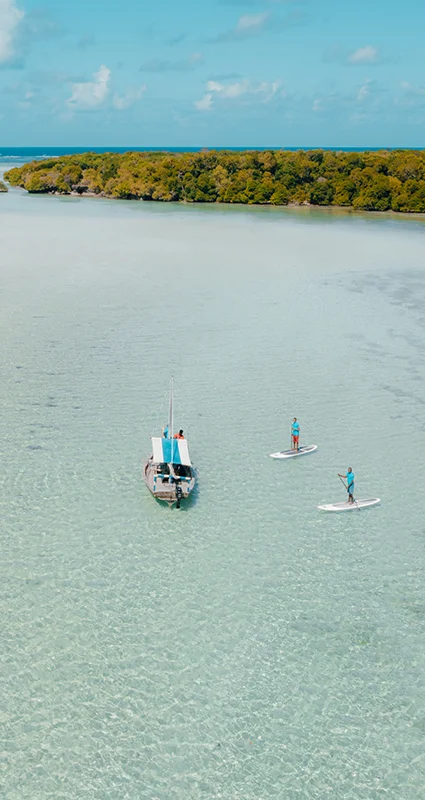
Explore the mangrove channels by kayak or dhow: The west coast's dense mangrove channels, paddled or motored at high tide, nurse much of the reef's fish life and offer the island's best birdwatching from the water.
Take a dhow to Chole, Juani and Jibondo: A short boat hop reaches Chole Island's ruins and working boatyard; Juani holds the medieval Kua ruins, a tidal blue lagoon and the community turtle programme; Jibondo's tidal beaches are essentially empty of humans.
Join the turtle hatchling release on Juani Island: Green turtles nest on Juani's beaches from June to September under a community conservation programme. We will ask your lodge to connect you directly with the local rangers.
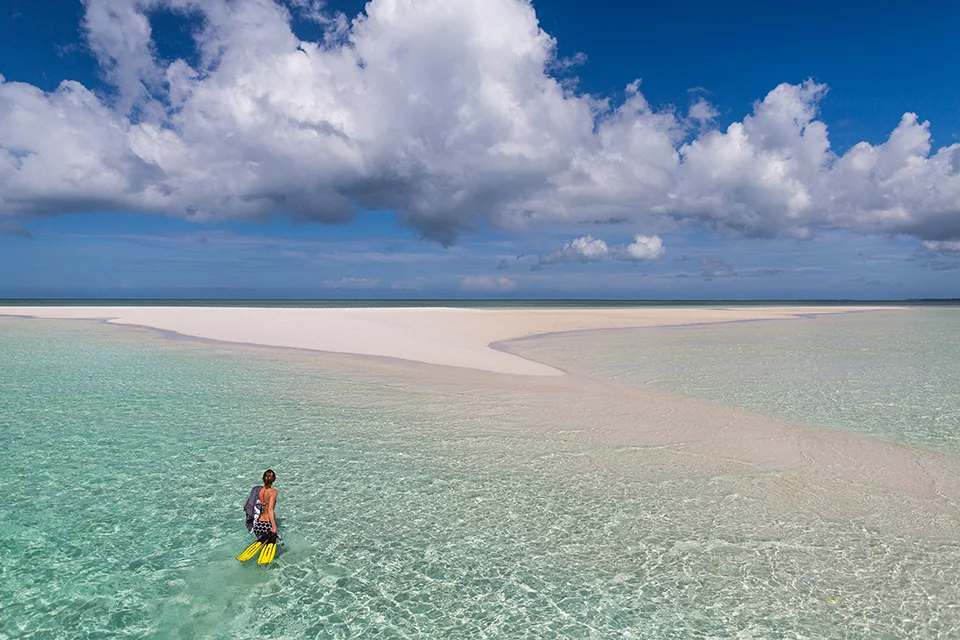
Spend a day on a tidal sandbank: Marimbani, a crescent of white sand about 20 minutes by boat from Utende, appears only at low tide and makes a natural stop for a picnic and a swim.
Where to stay in Mafia Island
Accommodation on Mafia Island is small in scale and limited in number. Where you stay shapes your entire trip: it determines your proximity to the reefs or the whale sharks, whether the marine park daily fee applies and what kind of experience the island delivers.
Chole Mjini Treehouse Lodge is on Chole Island, reached by a short dhow crossing from Utende. The rustic lodge is built into the ruins and forest of this historic island, with treehouses set among baobabs and strangler figs against a backdrop of centuries-old stonework. Among Tanzania's most environmentally aware lodges, it operates with a minimal footprint and a community trust that funds a school and health post on the island.
Pole Pole occupies the Utende shore of Chole Bay. Seven bungalows, exceptional food and views across the water toward Chole, Juani and Jibondo give it an intimacy that larger properties cannot replicate. Inside the marine park, it is ideally positioned for diving and snorkelling.
Butiama Beach Lodge, near Kilindoni on the west coast, sits outside the marine park boundary. Butiama is favoured by those who prioritise whale sharks over daily reef diving. It is under ten minutes from the airstrip, faces the sunset over the Mafia Channel and is run by an owner who has lived on the island for more than 20 years.
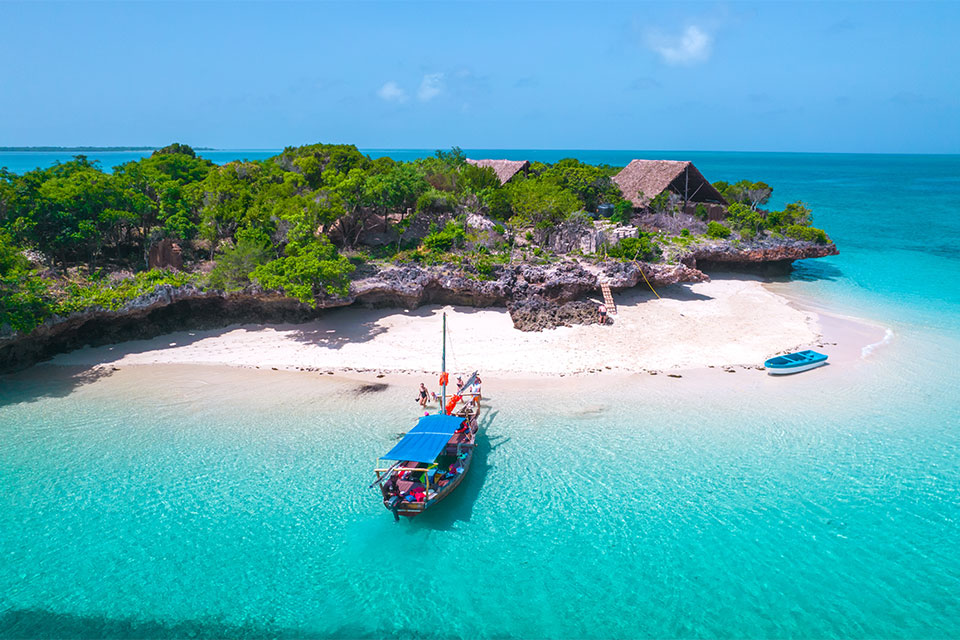
Thanda Island, on Shungimbili Island, is available to one group at a time, reached by boat or helicopter. It is a private island in the fullest sense, and for families or groups for whom complete exclusivity is the point, it exists in a category of its own.
Mafia's best visitor areas
Mafia Island divides into six distinct areas, each with a different character and a different reason to visit. Understanding the geography matters here because the island's two main draws, whale sharks and reef diving, are on opposite sides of the island, about two hours apart by road.
Chole Bay and Utende
The south-east of the main island is where most of Mafia's lodges sit and where the diving is best. Chole Bay is a sheltered deep-water anchorage, protected on its eastern side by coral reefs and Juani Island, and Utende Beach is the island's most popular. Most of the top lodges cluster along this shore, all within the marine park boundary, which means the daily park fee applies for every day of your stay regardless of whether you enter the water. The reefs here, including Kinasi Pass, Milimani Coral Gardens and Chole Wall, are accessible year-round, and a snorkelling reef sits about 300 metres offshore. You can reach the Marimbani and Mange sandbanks by boat from this side of the island.
The bay islands: Chole, Juani and Jibondo
A short dhow hop from Utende opens a different world. Chole Island is where the archipelago's history is most vividly present. Once the main settlement of wealthy Omani traders and later occupied by the Germans, whose structures stand alongside mosque ruins dating to the 14th century, the island rewards exploration on foot. A loop walk of around three kilometres takes in ruins wrapped in strangler figs, a colony of flying foxes that leave each evening to feed on the main island's mango and cashew trees, and a working boatyard where vessels are still built entirely by eye using traditional tools. The community trust on Chole funds a school and health post, and Chole Mjini Treehouse Lodge is the island's only accommodation.
Juani Island, larger and sheltering Chole Bay from the east, holds three attractions worth the crossing: the Kua ruins, a medieval Swahili site sometimes described as the Pompeii of East Africa, with finds including 13th- and 14th-century Islamic and Chinese ceramics; a tidal blue lagoon at the island's southern tip; and the community green turtle nesting programme. At low tide, you can walk across from Chole; otherwise a dhow takes a few minutes.
Jibondo offers the outer-island experience in its simplest form: beach, sandbar and the sound of water, with virtually nobody else there. Its shape changes through the day as the tide moves.
Kilindoni and the west coast
Kilindoni is the island's capital, a small market town, port, and airstrip. The west coast faces the Mafia Channel and catches the sunset. This is also where whale sharks feed at the surface in relatively shallow water close to shore between October and February, in concentrations found at very few other places in the world. Lodges on the west coast sit outside the marine park boundary, which means no compulsory daily park fee. The trade-off is a significant journey, around two hours by road, to reach the Chole Bay reefs for diving.
Ras Kisimani and Bwejuu
The far south-west of the main island and the small island of Bwejuu opposite it form Mafia's most ancient and most atmospheric corner. Kisimani Mafia, meaning "the place of the well," is the archipelago's oldest ruined town, with mosque foundations dating to around the 10th and 11th centuries. Much of the site has since washed into the Mafia Channel, and sections of wall remain visible just offshore; ancient coins occasionally surface on the beach. The whole area is now a protected core zone of the marine park. There is no accommodation here; it is reached as an all-day boat excursion from Kilindoni.
The north: Bweni and Ras Mkumbi
Mafia's northernmost point has a landscape unlike the rest of the island. Massive baobab trees dominate the horizon around Ras Mkumbi and the village of Bweni, and a coral cliff rises about four and a half metres above the sea. The Ras Mkumbi lighthouse, built in 1894 and standing 30 metres tall, looks south over Mlola Forest, a protected reserve that is home to Sykes' monkeys. A typical excursion drives through fishing villages to the lighthouse and ends with a picnic at Kanga beach. No established lodges exist in the north; reaching it properly requires local contacts and guides.
Thanda and the private islands
Thanda Island sits on Shungimbili Island, between the main island and the mainland, and operates as a fully exclusive private retreat. Only one group at a time for the whole island; arrival is by boat or helicopter. Activities include snorkelling, sailing, kayaking and stand-up paddleboarding. It offers a fundamentally different kind of Mafia experience: private-island luxury rather than small-lodge immersion, and is one of the most exclusive retreats in the western Indian Ocean.
Trusted by thousands of ecstatic travellers
✔️ 5-Star Trustpilot Rating ✔️ Condé Nast Travel Specialist Award Winner
✔️ Accredited by SATSA ✔️ 5,000+ Exceptional Safaris Since 1991
Why choose Africa Geographic to plan your safari?

"I made a trip to East Africa with Africa Geografic...Everything was running flawless...Then I continued travelling to Mafia Island (Tanzania). The lodge in Mafia was well chosen by Africa Geografic according to my interests. I would never have found this lodge without valuable help from...AG."
"...Our visit to Chole Mjini treehouses on Chole Island was also wonderful. Such a remote part of the world and staying in a 'real luxury' tree house built into the baobab was a once in a lifetime experience too. All the staff here were excellent and very friendly indeed...created a perfect holiday for us..."
"AG made the logistics and experience painless and stress free which is certainly what you want when on holiday. All of the information was on their online portal...The camps they selected were excellent and matched my needs to a tee. Would certainly highly recommend them to others."
Wish you were here?
Frequently asked questions
Mafia has two distinct seasons that barely overlap: June to October for reef diving, October to February for whale sharks, with November to January the most reliable window for encounters. Pick one as your focus, and avoid March to May when the long rains bring heavy rainfall and several lodges close.
Yes, and Mafia is one of the world's most reliable places for it. Between October and February, whale sharks feed at the surface in shallow water off the west coast; you snorkel alongside them rather than dive. Choose an operator with a clear code of conduct.
Yes, and this catches many travellers out. Mafia is part of mainland Tanzania, not the Zanzibar region, so a Zanzibar-only visa does not cover it. A Tanzania mainland visa (US$50 on arrival) covers the entire country, including Zanzibar and Pemba.
Light aircraft from Dar es Salaam is the only practical option, around 30 minutes with Auric Air or Coastal Aviation, several times daily. Aircraft are small and weight limits are real; build slack time around international connections. A mainland ferry exists but is slow and weather-dependent.
Very. Chole Bay's shallow reefs are accessible to all levels, and whale shark encounters are snorkel-only; no dive qualification is needed. Sandbank trips, dhow excursions and the Chole Island walk all suit non-divers equally well.
Established in 1995, it was Tanzania's first marine park. Covering 822 km², it protects reefs, seagrass beds and mangroves harbouring 460-plus fish species and 50 genera of coral. A daily fee of US$20–25 per person applies to visitors staying in lodges inside the park boundary.
Approximately 160 km south, and 30 to 40 minutes by light aircraft. The two islands are fundamentally different: Zanzibar offers beaches, culture and infrastructure; Mafia offers reef, whale sharks and solitude. A Tanzania mainland visa covers both.
Yes. Green turtles nest on Juani Island from June to September under a community conservation programme. Visitors can sometimes join a hatchling release; ask your lodge to connect you with the local rangers directly rather than booking a packaged experience.
Three nights is the practical minimum given the logistics; five to seven nights does the island justice. That allows multiple days on the reef or with whale sharks, plus dhow excursions to Chole and Juani and a day on a sandbank.
Thanda Island's exclusive-use format suits families wanting complete privacy, with snorkelling, sailing and kayaking on hand. Chole Bay lodges work well for nature-focused families comfortable with small-lodge settings. Mafia is an ocean destination rather than a resort island; it rewards water-confident, curious travellers of any age.
Mafia is a predominantly Muslim island. Modest dress is expected outside lodge grounds, and swimwear away from the lodge beach causes genuine offence. During Ramadan, local restaurants close during daylight and public eating or drinking is inappropriate; lodges operate normally, but the island around them does not.
No usable ATM exists on the island. Bring all cash from Dar es Salaam in US dollars dated 2009 or later, plus Tanzanian shillings; older or damaged notes are refused. The marine park fee, dives and whale shark trips are all cash transactions.
Yes. Mafia pairs naturally with Tanzania's southern safari circuit; access is through Dar es Salaam, which connects directly to Ruaha National Park and Nyerere National Park, creating a bush-and-reef journey with genuine contrast. Combining with the northern circuit is possible via Dar es Salaam but involves more travel.
Mafia Island safaris typically cost from US$160 to US$200 per person, per night, depending on accommodation comfort level, time of year and activities. Thanda Island is considerably more expensive, starting at US$33,000 per night for the entire lodge.
Click here to schedule a no-obligation call with one of our Safari Experts or fill in our 2-minute form with your questions. Our team of experts are here to help! Whether you’re curious about the best time to travel, want to hear first-hand about an experience or need help planning your safari.
Explore more African destinations
Start planning your dream safari
Our travel experts will craft a no-obligation itinerary just for you. We have crafted over 5,000 safaris since 1991. Your personal details are protected; we only use this information to contact you.
Why book your safari with us?

Deep Experience & Knowledge
Handcrafted experiential safaris since 1991.
Travel in Africa is about knowing when and where to go, and with whom. A few weeks too early/late or a few kilometres off course, and you could miss the greatest show on Earth. And wouldn’t that be a pity?

Trust & Safety

Make A Difference
We donate a portion of the revenue from every safari sold to carefully selected conservation projects that make a significant difference at ground level.
YOUR safari choice does make a difference - thank you!