

Tailor-made safaris. Since 1991



The best solo safari destinations in Africa
Solo safari travel in Africa is well-established, and the experience is shaped more by where to choose to go rather than by your travelling companions (or lack thereof). South Africa, Zambia, Botswana, Kenya, and Tanzania each offer distinct conditions for solo travellers – different in terms of wildlife access, lodge culture, activity structure, and social dynamic. This guide covers the key differences between them, explains what makes a lodge genuinely solo-friendly, and addresses the practical question of tailor-made versus group departure.
What makes a lodge solo-friendly
Most solo travellers on safari are not looking for solitude; they’re looking for a certain kind of connection. The lodge environment is central to that. Solo-friendly lodges usually have communal dining at a shared table, meaning you eat with guides, other guests, and staff rather than alone at a separate table. These lodges run shared wildlife drives, so you can join a vehicle with other guests rather than occupying one alone at full single-vehicle cost. Its guides are attentive to individual guests rather than managing large groups, and the lodge is small enough – typically six to twelve rooms – that faces become familiar within a day.
Large, resort-style lodges with individual chalets, multiple restaurants, and buffet dining can be pleasant but tend to produce a more isolated experience for solo travellers. The structure of the stay does not naturally generate conversation or connection.
Small bush camp vs large lodge for solo travellers
Feature | Small bush camp (6–12 rooms) | Large lodge (20+ rooms) |
Dining | Communal table, shared mealtimes | Individual tables, buffet or set menu |
Wildlife drives | Shared vehicle, typically 4–6 guests | Variable; private vehicles at extra cost |
Guide ratio | Higher attention per guest | Lower; guides manage larger groups |
Social connection | Natural; guests interact daily | Less structured; easier to feel isolated |
Single supplement | Often charged; some lodges waive seasonally | Almost always charged |
Solo traveller experience | Generally positive | Variable; depends on occupancy |
Solo safaris we recommend
A well-matched solo safari balances lodge culture, wildlife quality, and activity type. Here are three Africa Geographic safaris suited to solo travellers at different experience levels:
Zambia's South Luangwa and Lower Zambezi on foot: An immersive journey into Zambia's finest walking safari territory, combining the Luangwa Valley's legendary guides with the riverine wildlife of the Lower Zambezi. Small lodges, communal dining, and expert-led walks make this ideal for the independent solo traveller. Explore this safari
Botswana by light aircraft and mokoro: Fly between small lodges in the Okavango Delta and Chobe in northern Botswana, wildlife viewing on shared drives and mokoro (dugout canoe) excursions in one of Africa's most pristine ecosystems. View this safari
Kenya's Maasai Mara and Laikipia: A sociable, culturally rich safari combining the Mara's wildlife density with Laikipia's community conservancies and more off-the-beaten-track experiences. Read more about this safari
Top destinations for solo safari travellers
South Africa – the first-timer's entry point
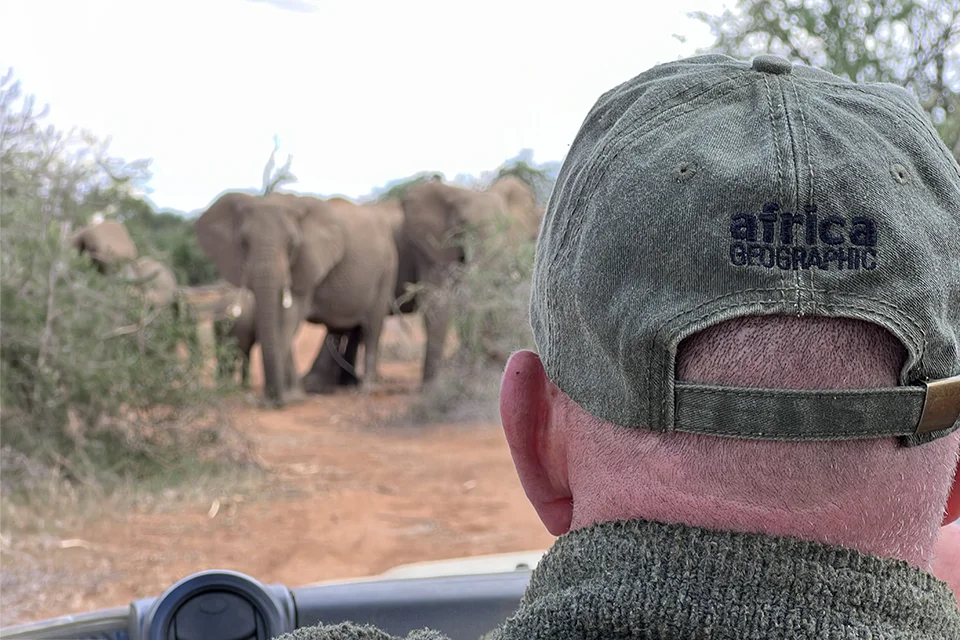
South Africa is the most accessible safari destination for solo first-timers. English is widely spoken, infrastructure is reliable, and the private reserves bordering Kruger National Park – Sabi Sand, Timbavati, MalaMala, and others – offer high-density Big 5 wildlife viewing on twice-daily shared drives. Lodges in the Greater Kruger region typically seat guests together at dinner, and the shared drive format means you spend mornings and evenings in a vehicle with the same small group of guests and a guide whose focus is the entire vehicle, not any single guest. For solo travellers arriving in Africa for the first time, this structure provides orientation without isolation.
South Africa also offers malaria-free Big 5 options in the Eastern and Northern Cape – useful for travellers with health considerations or those travelling outside peak season.
Zambia – walking safaris and authentic bush camps
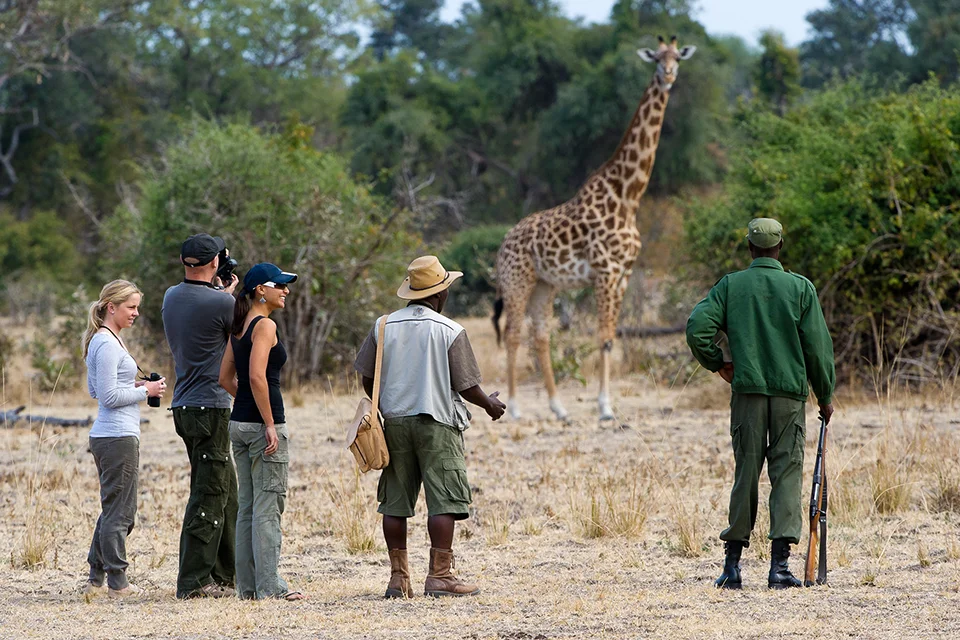
Zambia's South Luangwa and Lower Zambezi valleys contain some of Africa's best walking safari territory and some of its most intimate lodges. The walking safari format – on foot with an armed guide and tracker – is inherently focused and personal. It suits solo travellers who want active, skills-based wildlife engagement rather than vehicle-based wildlife viewing. South Luangwa lodges are typically small, meals are communal, and the guiding culture is attentive and story-led.
Zambia does require more advanced planning and is not the easiest first destination, but for experienced solo travellers with a specific interest in walking or authentic bush culture, it stands apart.
Botswana – exclusivity and small-camp immersion
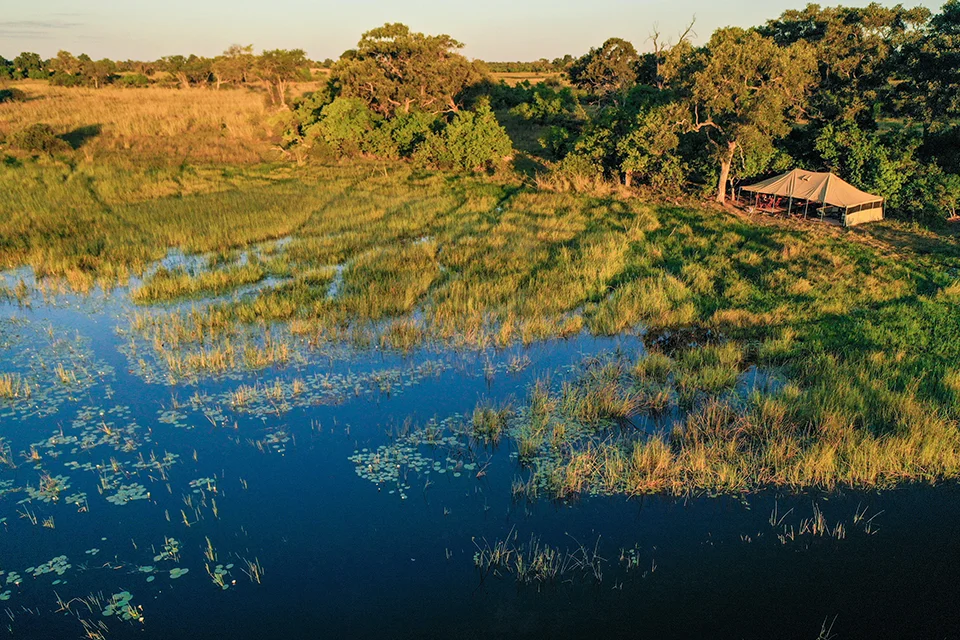
Botswana's Okavango Delta, Moremi Game Reserve, Chobe National Park, and the Linyanti Concessions are accessed by small, owner-managed lodges reached by light aircraft. Lodge sizes of six to eight tents are standard. This produces a very particular solo experience: you are rarely among more than ten or twelve guests in total, guides learn your interests quickly, and the rhythm of morning and evening activities structures each day. Botswana's low-volume safari model is the closest thing to a private safari experience within a group-camp setting.
Many solo travellers also favour Botswana's fly-in safaris because all logistics between lodges are handled seamlessly, allowing them to travel independently without having to navigate complex road transfers or changing arrangements.
The trade-off is cost. Botswana's conservation model limits visitor numbers and positions itself at the premium end of the market. Solo travellers who travel outside peak season (November to March, the green season) may find that single supplements are waived or reduced at certain lodges and that occupancy is lower.
Kenya and Tanzania – sociability and the migration
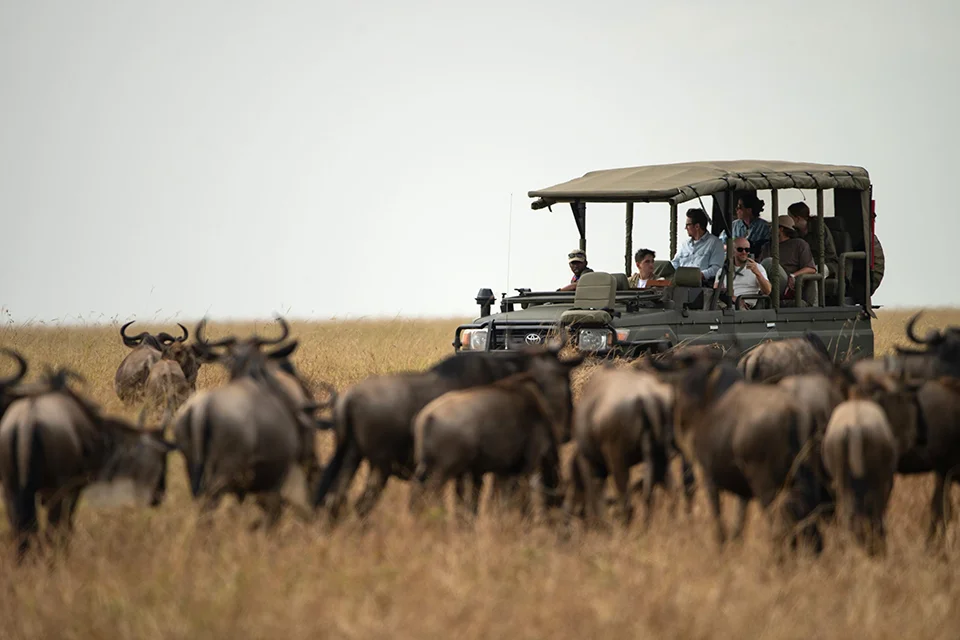
Kenya and Tanzania have the most developed safari lodge culture in Africa, and many lodges along the Maasai Mara and Serengeti corridors seat guests communally and run full shared-vehicle operations. The Great Migration – the movement of over 1.5 million wildebeest between the Serengeti and the Maasai Mara – is one of the most significant wildlife events in Africa and draws a broad range of travellers. This can work in a solo traveller's favour: occupancy is higher in peak migration season (July to October), guides are experienced at managing mixed groups, and the shared excitement of a river crossing or predator sighting generates natural social connection.
Kenya also has a strong community-based tourism sector in areas like Laikipia, where conservancies combine wildlife access with cultural engagement. This suits solo travellers who want to understand the broader landscape of people and wildlife rather than focus solely on Big 5 sightings.
Tailor-made solo safari vs group departure
Tailor-made solo safaris
A tailor-made solo safari is planned around your specific dates, interests, fitness level, and budget. You travel independently, moving between lodges on a private itinerary, but you join shared wildlife drives and communal meals at each property. This gives you the social experience of the lodge while retaining full control over your routing and pace. It is the model Africa Geographic recommends for most solo travellers, and it is what the testimonials in this article describe.
Group departure safaris
Group departure safaris place you on a fixed itinerary with a set group of other travellers, typically eight to sixteen people. The advantage is cost – single supplements are often waived or absorbed into a per-person price – and the assurance of built-in company. The limitation is that the itinerary is fixed, the group dynamic is unknown before you travel, and the pace is set by the group. Group departures suit cost-conscious solo travellers or those who prefer structured social arrangements.
Africa Geographic offers both models. Our safari experts can advise on which structure suits your circumstances and whether specific group departures with scheduled solo-traveller places align with your preferred dates.
From our CEO
Simon Espley, CEO of Africa Geographic, reflects on what solo safari travel looks like in practice:
"There was an American lady who spent 53 days travelling solo in Africa. She journeyed to Tanzania, Mozambique, Malawi and South Africa. To better understand the vast Serengeti, rather than simply witness it, she immersed herself in the philosophy of guiding and learning to track and understand animal behaviour. She marvelled at huge skies, black-maned lions and absolute luxury in Tswalu Kalahari, and she tracked pangolins in the emerging safari haven of Mozambique's Gorongosa. Then she visited Malawi's Liwonde, Nkhotakota and the Big 5 Majete to witness some of Africa's greatest conservation success stories – the restoration of once-poached reserves into naturally behaving ecosystems where people and wildlife thrive. Amazingly, many of her stays have been in empty or near-empty lodges. Barbara chose to travel outside the prime safari season to avoid crowds and enjoy exclusive, unhurried wildlife encounters. Her safari was compiled by our safari expert Stef and managed remotely by our 24/7 concierge crew."
– Simon Espley, CEO, Africa Geographic
Wish you were here?
Planning your solo safari
Timing and single supplements
Single supplements – the extra charge levied on solo travellers occupying a double room – vary widely between properties. Some small Botswana and Zambia lodges waive the supplement during green season (roughly November to March). Others apply a supplement of between 25% and 50% on top of the per-person sharing rate. Africa Geographic's experts can identify current single supplement waivers and green-season pricing when building your itinerary. Travelling outside peak season also means lighter occupancy, quieter drives, and more one-to-one guide time.
Safety and support
Africa is a large and varied continent, and safety on safari depends on destination, lodge, and how your trip is managed. All Africa Geographic safaris include 24/7 concierge support, pre-departure briefings, and vetted transfers between properties. Solo travellers are met at airports, guided between lodges, and have a named point of contact throughout. The testimonials below from Sarah, Vicky, and Wendy – all solo female travellers – describe feeling safe, well-supported, and confident throughout their trips.
Wildlife activities for solo travellers
Most wildlife activities on safari – shared vehicle drives, guided walks, mokoro excursions, boat trips, night drives – are group activities in the sense that multiple guests participate together. Solo travellers are rarely alone on a drive. Walking safaris are particularly suited to solo travel because the guide's attention is constant and the format is inherently focused.
What solo travellers say
"As a solo traveller, I felt very safe, and I never felt scared. In all, I could go on and on about how wonderful the trip was. As a solo female traveller, sometimes things can be difficult. However, this was planned well, and I felt so safe... I can truly say that this has been the best trip that I have taken up to this point." – Sarah, United States
"I recently returned from a safari in Tanzania. I am a 65-year-old female travelling solo, and it was an unforgettable experience... [Africa Geographic] took the time to understand my needs and expectations, then tailor-made the entire trip accordingly. The people I met were wonderful, the landscapes absolutely exquisite, and the wildlife sightings exceeded all expectations." – Vicky, South Africa
"As a solo female traveller from Canada who typically enjoys handling my own planning and bookings, I was initially nervous about letting someone else take the reins for such a significant trip... Throughout my trip, I always felt safe, and I could reach out to any team member if I needed assistance. Pick-ups were always punctual, and I was greeted with smiles at every turn... I truly had the safari of a lifetime! " – Wendy, Canada
Frequently asked questions
South Africa is one of the most accessible first safari destinations for solo travellers, with reliable infrastructure, English widely spoken, and a well-established lodge culture built around shared wildlife drives and communal dining. Botswana suits those seeking small-camp exclusivity. Zambia is best for solo travellers interested in walking safaris. Kenya and Tanzania offer sociable lodge environments and access to the Great Migration. The right country depends on your experience level, budget, and what kind of wildlife activities interest you most.
Safari in Africa, when properly planned through a reputable company, is very safe for solo travellers. You travel between vetted lodges with confirmed transfers, 24/7 support contacts, and experienced guides at each property. Solo female travellers are well-accommodated at most lodges in East and southern Africa. Urban transit carries different considerations, which is why Africa Geographic manages all inter-property logistics and transfers as part of a tailor-made itinerary.
Most safari lodges charge a single supplement for solo occupancy of a double room. The supplement typically ranges from 25% to 50% of the per-person sharing rate, though some properties waive it during green season or for multi-night stays. Group departure safaris frequently include no single supplement as part of the per-person pricing structure. Africa Geographic's experts can identify which lodges currently offer single-friendly pricing when building your itinerary.
Small bush lodges of six to twelve rooms, with communal dining at a shared table and shared wildlife drives, are generally the best fit for solo travellers. The structure naturally generates conversation and connection. Large resort-style lodges with individual room service and multiple dining areas can produce a more isolated experience. Owner-managed lodges in Botswana, Zambia, and the private reserves of South Africa typically offer the most attentive guiding and strongest communal culture.
A tailor-made safari gives you full control over routing, pace, and dates while still joining shared activities at each lodge. A group departure places you on a fixed itinerary with a pre-assembled group and typically eliminates the single supplement. Tailor-made works best for travellers with specific interests, flexible dates, or a higher budget. Group departures suit cost-conscious travellers or those who prefer the security of pre-confirmed company. Africa Geographic offers both and can advise on which fits your circumstances.
Zambia is the leading destination for solo travellers interested in walking safaris. South Luangwa National Park and the Lower Zambezi are home to some of Africa's most experienced walking guides. The format – on foot with a small group of up to six walkers, an armed guide, and a tracker – is particularly well-suited to solo travellers because the guide's attention is closely focused. Zimbabwe's Mana Pools and Hwange also offer excellent walking in a wilder, less-visited setting.
Yes. Bush and beach combinations are well-established in East Africa (safari in Kenya or Tanzania, followed by Zanzibar or the Kenya coast) and in southern Africa (Greater Kruger or Botswana combined with Mozambique's Bazaruto Archipelago or Vilanculos). The logistics of combining the two are straightforward when managed through a single company. Africa Geographic's bush and beach specialists can advise on routing, timing, and which beach destinations offer the best solo experience. See our bush and beach safari page for more detail.
Africa Geographic has operated since 1991 and combines a conservation editorial heritage with full-service safari planning and management. Solo travellers benefit from 24/7 concierge support, named safari expert contacts, pre-departure guidance, and vetted lodge partnerships. Our team includes specialists in solo travel who can match travellers to specific lodges known for strong solo guest experiences – not a generic list, but specific properties where the camp culture suits solo travellers. We also have direct experience of solo female traveller requirements and can advise accordingly.
Start planning your dream safari
Our travel experts will craft a no-obligation itinerary just for you. We have crafted over 5,000 safaris since 1991. Your personal details are protected; we only use this information to contact you.
Why book your safari with us?

Deep Experience & Knowledge
Handcrafted experiential safaris since 1991.
Travel in Africa is about knowing when and where to go, and with whom. A few weeks too early/late or a few kilometres off course, and you could miss the greatest show on Earth. And wouldn’t that be a pity?

Trust & Safety

Make A Difference
We donate a portion of the revenue from every safari sold to carefully selected conservation projects that make a significant difference at ground level.
YOUR safari choice does make a difference - thank you!