

Safari experts & storytellers. Since 1991



Trust us to find you the rarest animals, the most spectacular wildlife events, the remotest landscapes and deeply meaningful cultural encounters!
Tanzania's chimp trekking secret: Mahale and Gombe compared
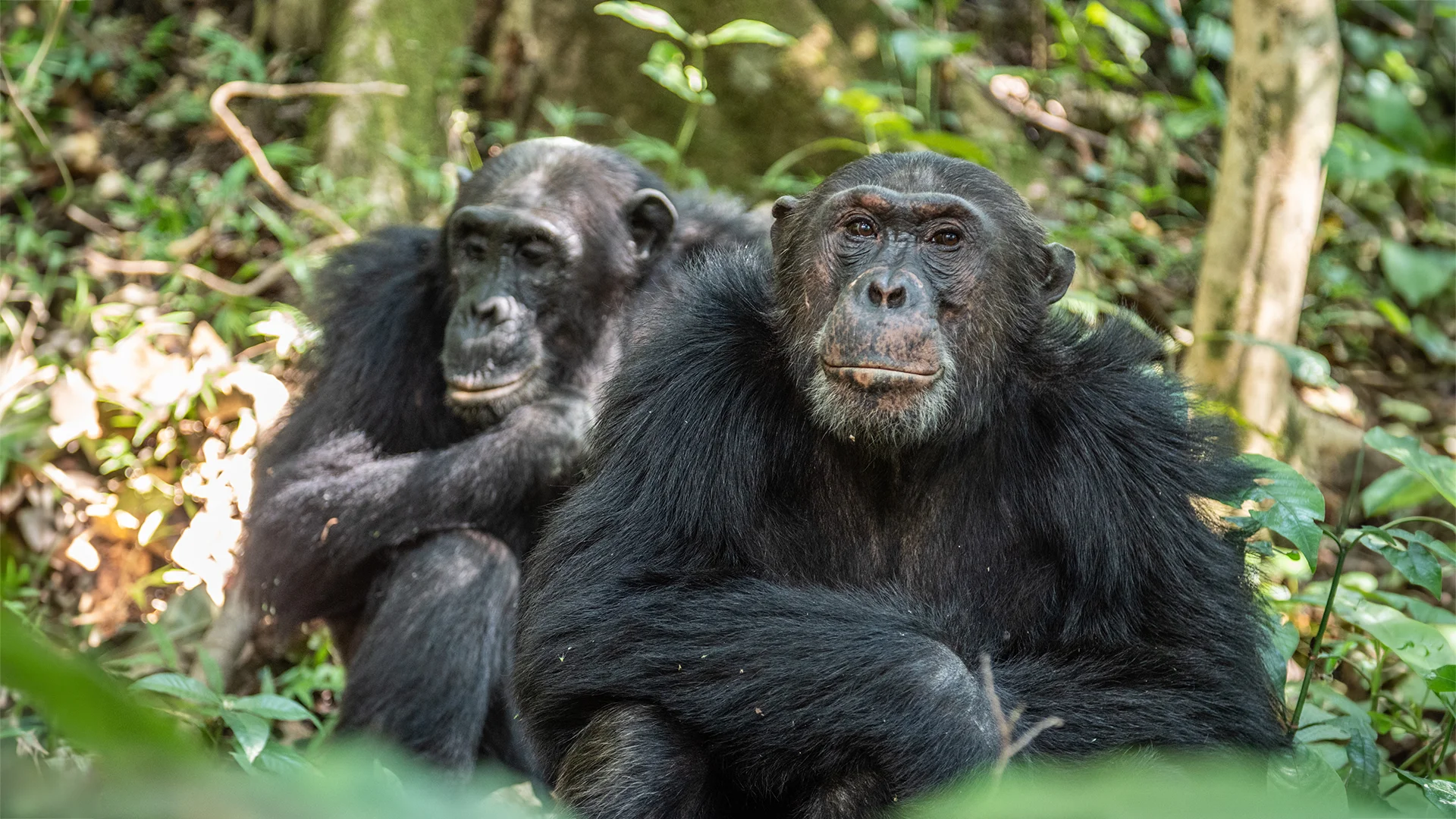
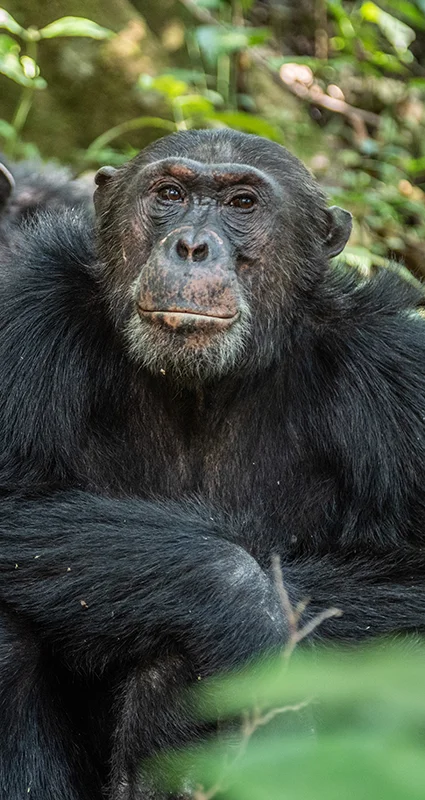
Tanzania holds two of Africa's most remote chimpanzee trekking destinations – Gombe Stream National Park and Mahale Mountains National Park, both set on the eastern shore of Lake Tanganyika. Both parks are reachable by boat (or charter flights to Mahale Airstrip) and are explored only on foot, and both protect wild populations of Eastern chimpanzees (Pan troglodytes schweinfurthii). The best trekking conditions fall between May and October, Tanzania's dry season. Gombe suits shorter, more accessible visits, while Mahale rewards travellers seeking greater remoteness and a beach-and-forest combination.
Gombe or Mahale – which chimp trek suits you?
Both parks protect Eastern chimpanzees on Lake Tanganyika's eastern shore, but access, pace and scale differ considerably. Here is how the two compare before you decide.
Gombe is Tanzania's smallest park, reached by a short boat ride from Kigoma.
Mahale is thirty times larger, reached only by charter flight and dhow trip.
Gombe suits shorter stays; Mahale rewards travellers wanting deeper remoteness.
Both parks demand fitness for steep, humid forest walking.
Gombe and Mahale at a glance
Feature | Gombe Stream | Mahale Mountains |
Park size | 56km² | About 1,650 km² |
Getting there | Boat from Kigoma | Charter flight plus dhow trip |
Chimp population | About 100 individuals | Around 800–1,000 individuals |
Best suited to | Shorter, easier-access trips | Longer, more remote immersion |
Research legacy | Jane Goodall's original 1960s study | 50+ year Japanese-led chimp study |
3 things we love about Tanzania's chimp forests
Beyond the trekking lists most other guides repeat, here is what actually makes Gombe and Mahale worth the long, deliberate journey west, on their own terms:
A living research legacy: Gombe is where Jane Goodall began her landmark 1960s study, now the longest-running study of any wild animal species on record.
A lake like an inland sea: Lake Tanganyika holds seventeen percent of the world's fresh water, with clear water, sandy coves and endemic cichlid fish.
A rare double safari: chimp forest and open savanna are connected via a brief flight, letting treks pair naturally with lion and elephant country in Katavi or Ruaha.
Two protected worlds on Lake Tanganyika
Gombe Stream National Park
Just 56 km² and 16km north of Kigoma, Gombe is Tanzania's smallest national park and the site of Jane Goodall's original 1960s research. Day visits are possible, though a two-night stay allows more time for a successful chimp trek and for the park's habituated baboon troop along the shoreline.
Mahale Mountains National Park
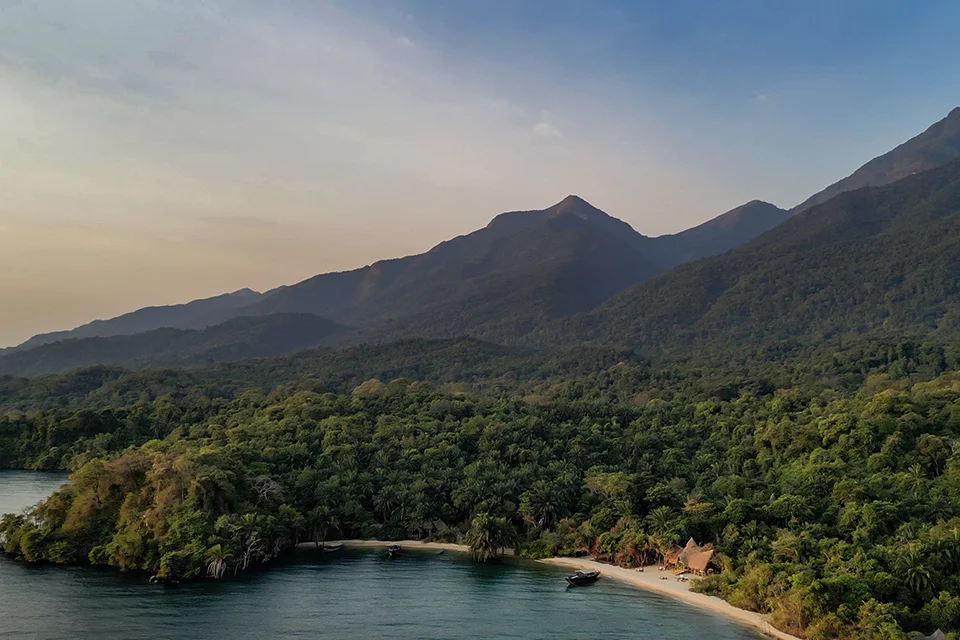
Mahale covers roughly 1,650 km² of forested mountains rising from the shores of Lake Tanganyika. It holds one of Africa's largest protected chimpanzee populations and has been part of a research study since the 1960s. No roads reach the park; visitors arrive by charter flight and dhow crossing and explore entirely on foot.
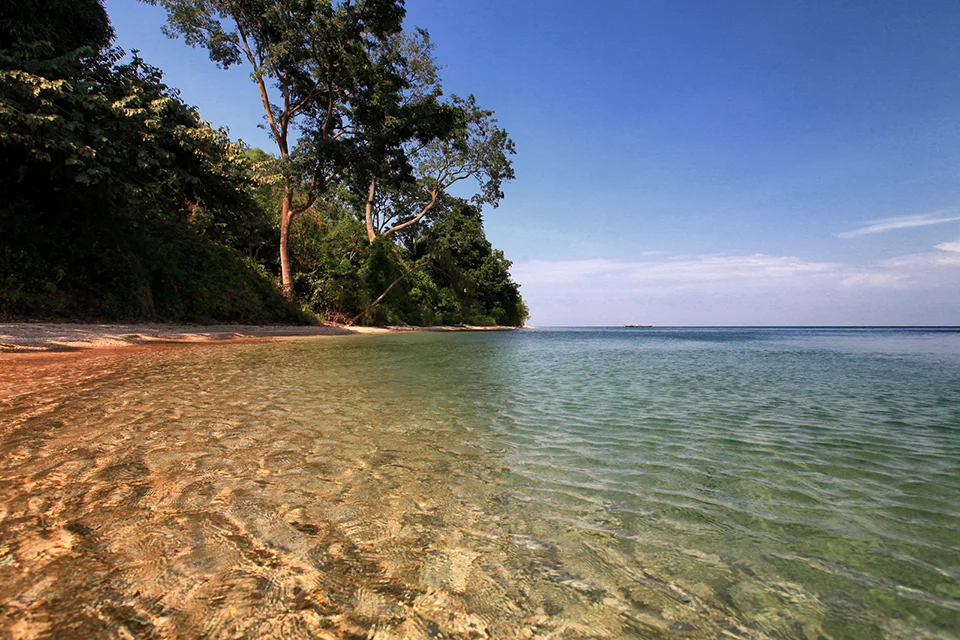
Lake Tanganyika, the connecting thread
Lake Tanganyika is the world's longest freshwater lake and its second-deepest, holding around seventeen percent of the planet's fresh water. Its clear, warm shallows and white beaches sit directly below both parks' forested slopes, giving each safari a rare forest-and-lake combination.
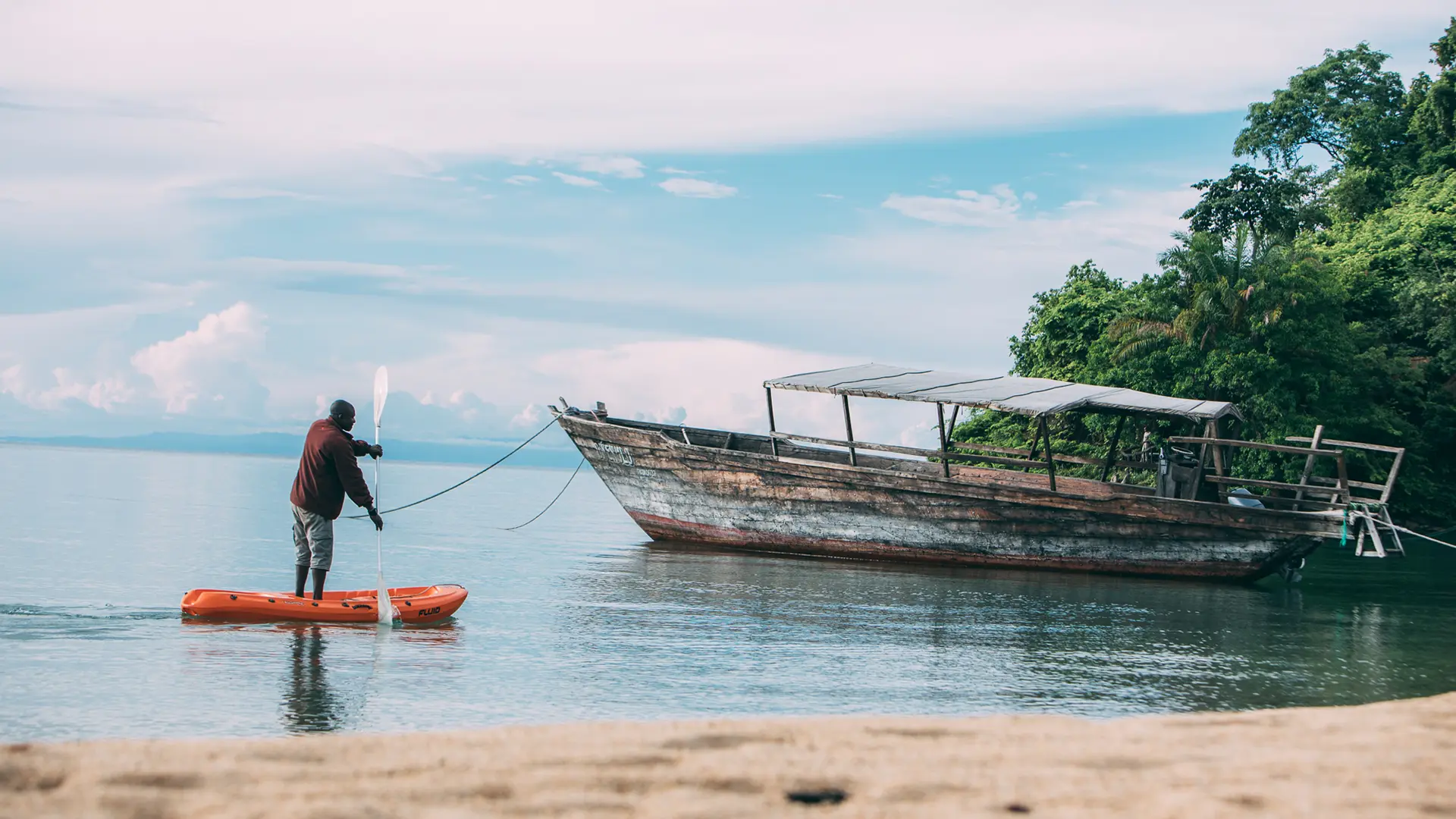
Wish you were here?
Planning your chimp trek in Tanzania
Best months for chimp trekking
The dry season, from May to October, offers the most reliable trekking conditions in both parks. Paths are firmer, forest visibility improves, and chimpanzees spend more time on the ground rather than sheltering in the canopy. The wet season, from November to April, brings heavier rain, slippery mountain paths and more physically demanding treks, though it also means quieter parks and lush, green scenery for those prepared for the conditions.
Getting to Gombe and Mahale
Both parks ca reached via Kigoma, which you can access by scheduled or charter flight from Arusha, Dar es Salaam, or Zanzibar. From Kigoma, Gombe is a short boat transfer along the lakeshore. Mahale requires a further charter flight south to an airstrip near the park, followed by a boat trip of an hour or more to reach the lodges. You can also reach Mahale directly by flight from Arusha and Dar es Salaam. There are no roads inside either park, so all onward movement is on foot or by water.
What to pack and prepare
Two pairs of sturdy, already broken-in hiking boots for slippery, muddy forest terrain.
Waterproof dry bags to protect cameras, phones, binoculars and documents from rain and sweat.
Lightweight, long trousers and long sleeves as protection against stinging nettles and thorns.
A daypack carrying water, energy snacks and a light rain layer for sudden equatorial showers.
A realistic level of fitness, given climbs that can run from two to six hours over steep ground.
Malaria precautions arranged in advance with a travel health professional before departure.
A surgical face mask, required near chimpanzees to reduce the risk of disease transmission.
Comprehensive travel insurance that covers remote medical evacuation by light aircraft.
Our favourite Tanzania chimp trekking safari ideas
What a day of chimp trekking involves
The search through the forest
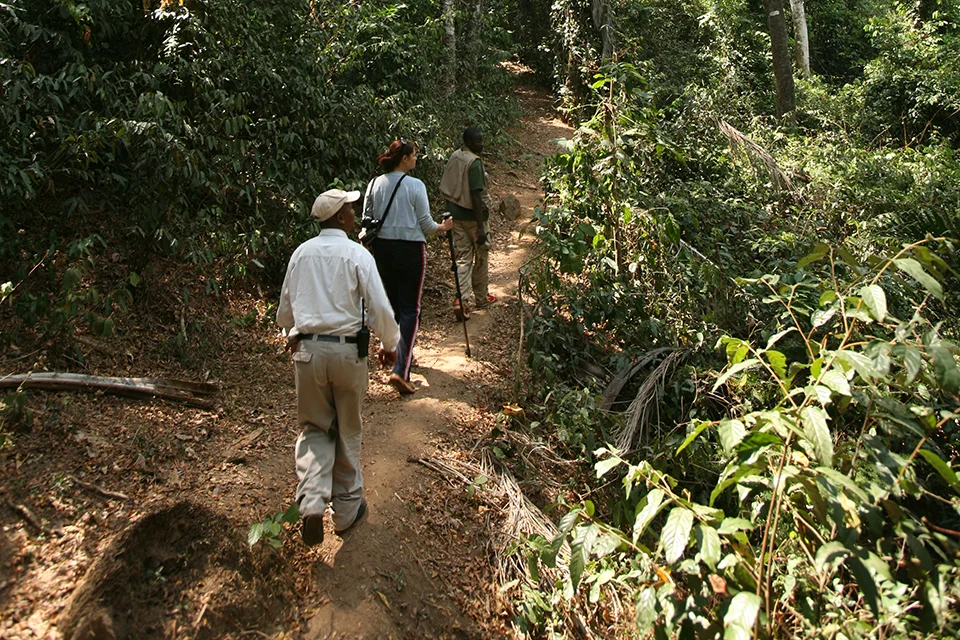
Trackers set out at dawn, following calls, feeding signs and nests from the previous night to locate the nearest troop. Because chimpanzees range widely and move quickly through the canopy, the search can take anywhere from thirty minutes to six hours, over steep, humid terrain with few marked paths. Fruit availability determines their movements, so guides read the forest's seasonal patterns closely before setting a route.
Time face to face with a troop
Once located, visitors typically spend up to an hour with the chimpanzees, watching feeding, grooming and the shifting politics of the troop's hierarchy play out at close range. Sarah Kingdom, who trekked with Greystoke Mahale's guides, describes the moment the search ends: “nothing can adequately convey the adrenaline rush that kicked in when we first heard the calls of the chimpanzees.” A minimum distance of ten metres is requested, though curious chimps do not always keep to it.
House rules for visiting chimps
Groups are limited to a small, fixed number of visitors per habituated troop, per day.
Surgical masks are required for all visitors within close proximity of the chimpanzees.
Anyone showing signs of illness is asked not to join that day's scheduled chimp trek.
Eating, drinking and flash photography near chimpanzees are not permitted at any time.
A minimum ten-metre distance is requested, though inquisitive chimps may close that gap.
Time spent with a habituated troop is capped at one hour, to limit disturbance.
Rest days apply on set days each week, when no chimp trekking takes place in the park.
Guides and trackers have the final say on safety and when to end any encounter early.
Frequently asked questions
Chimpanzee trekking in Tanzania takes place in two national parks on Lake Tanganyika's eastern shore, Gombe Stream and Mahale Mountains. Both protect wild populations of Eastern chimpanzees and are reached only by boat, since neither park has roads. Gombe, near Kigoma, is Tanzania's smallest park and the site of Jane Goodall's original research. Mahale is far larger and more remote, reached by charter flight followed by a dhow trip on the lake.
The dry season, running from May to October, offers the most reliable chimp trekking conditions in both Gombe and Mahale. Forest paths are firmer and safer underfoot, visibility improves, and chimpanzees spend more time at ground level rather than high in the canopy. The wet season, November to April, brings heavier rain and more physically demanding treks, though it does reward visitors with quieter parks and notably lush, green forest scenery throughout.
Chimp trekking is generally considered more physically demanding than gorilla trekking, because chimpanzees range over much wider areas and move quickly through the forest canopy rather than remaining in one place. Treks can last anywhere from thirty minutes to six hours over steep, humid terrain, often without marked paths. Gorilla trekking, by contrast, usually involves shorter walks to a settled troop. Fitness and a realistic expectation of exertion matter for both experiences.
Gombe holds a much smaller population, generally estimated at around 100 individuals, reflecting its modest 56 km² size. Mahale is considerably larger at roughly 1,650 km² and supports one of Africa's largest protected chimpanzee populations, with estimates ranging between 800 and 1,000 individuals across the park, though only a portion of these troops are habituated and regularly visited. Confirm exact current figures with park authorities before publishing precise numbers.
Yes. Both Gombe and Mahale connect by charter flight to savanna reserves further south, allowing chimp trekking to form part of a broader western Tanzania itinerary. Katavi National Park, known for exceptionally large elephant and buffalo herds, and Ruaha National Park, home to significant wild dog and elephant populations, both pair naturally with a stay in the chimpanzee forests, combining forest primates with classic savanna wildlife viewing.
Both parks can be reached via Kigoma, which you can access by scheduled or charter flight from Arusha, Dar es Salaam, or Zanzibar. From Kigoma, Gombe is a short boat transfer along the lakeshore. Mahale requires a further charter flight south to an airstrip near the park, followed by a boat trip of an hour or more to reach the lodges. You can also reach Mahale directly by flight from Arusha and Dar es Salaam. There are no roads inside either park, so all onward movement is on foot or by water.
Chimp trekking is a managed wilderness activity with established safety protocols, including trained trackers and guides, a requested ten-metre viewing distance, surgical masks to prevent disease transmission, and capped visitor numbers per troop. Chimpanzees are wild and unpredictable, and encounters can occasionally be close or intense, so visitors should follow guide instructions closely at all times. A reasonable level of fitness is also required for the forest terrain involved.
Essential items include two pairs of sturdy, already broken-in hiking boots, waterproof bags for cameras and electronics, lightweight long trousers and sleeves for nettles and thorns, and a daypack with water and snacks. A realistic level of fitness is required for climbs of up to six hours. Malaria precautions, a surgical mask for chimp encounters, and travel insurance covering remote medical evacuation are also strongly recommended before departure.
Gombe is Tanzania's smallest national park, offering shorter, more accessible chimp trekking near Kigoma and the historic site of Jane Goodall's research. Mahale is around fifty times larger, considerably more remote, and reached only by charter flight and a dhow crossing across Lake Tanganyika. Mahale suits travellers seeking greater exclusivity and a longer, immersive lake and forest stay, while Gombe suits those working with more limited time or budget.
Yes. Chimp trekking permits are required for both Gombe and Mahale national parks, alongside standard park entry fees. Permits are typically arranged as part of a lodge stay or safari booking rather than purchased independently, since both parks are remote and accessible only through registered lodges and safari operators. Our safari experts can confirm current permit and park fee costs, and secure trekking slots, as part of planning your itinerary.
Start planning your dream safari
Our travel experts will craft a no-obligation itinerary just for you. We have crafted over 5,000 safaris since 1991. Your personal details are protected; we only use this information to contact you.
Why book your safari with us?

Deep Experience & Knowledge
Handcrafted experiential safaris since 1991.
Travel in Africa is about knowing when and where to go, and with whom. A few weeks too early/late or a few kilometres off course, and you could miss the greatest show on Earth. And wouldn’t that be a pity?

Trust & Safety

Make A Difference
We donate a portion of the revenue from every safari sold to carefully selected conservation projects that make a significant difference at ground level.
YOUR safari choice does make a difference - thank you!