

Tailor-made safaris. Since 1991



Chimp trekking at a glance
Where | Uganda, Rwanda, Tanzania |
Trek duration | Roughly 1–7 hours of walking; to spend 1 hour with the chimps |
Best seasons | Dry months: June–October and January–February |
Minimum age | Generally 15 years |
Chimp trekking - meet our closest wild relative
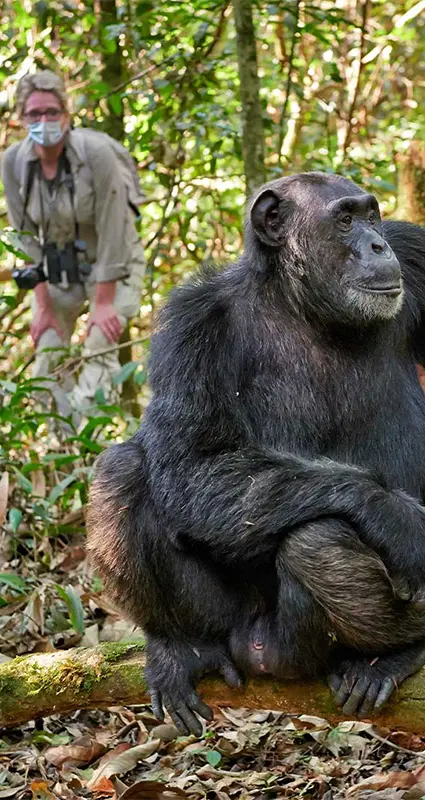
Few wildlife encounters in Africa feel as personal as time spent with wild chimpanzees. Where a predator sighting quickens the pulse, a chimp encounter does something quieter and stranger: it holds up a mirror. You watch a fellow great ape that shares almost all of your DNA cradle an infant, settle a squabble, groom a companion or crash through the canopy, and the resemblance is impossible to shake.
Chimpanzees are omnivores and far more active than gorillas, ranging widely through the forest after fruiting trees and other food. That restless energy is what makes the experience so absorbing. Once your guide locates the group, you may find them feeding on the forest floor, swinging overhead or moving fast to new ground. If you are fortunate, you might hear the rising crescendo of a pant-hoot echoing through the trees, one of the most evocative sounds in the African forest or, more rarely still, witness a hunting party set off in pursuit of colobus monkeys.
It is a humbling, often moving encounter, and for many of our most experienced travellers it becomes the highlight of an entire safari.
What is chimpanzee trekking?
Chimpanzee trekking is a guided forest hike to spend one closely regulated hour with a habituated community of wild chimpanzees, our closest living relative, sharing roughly 98–99% of our DNA.
The finest, best-organised trekking is in East Africa: Uganda, Rwanda and Tanzania.
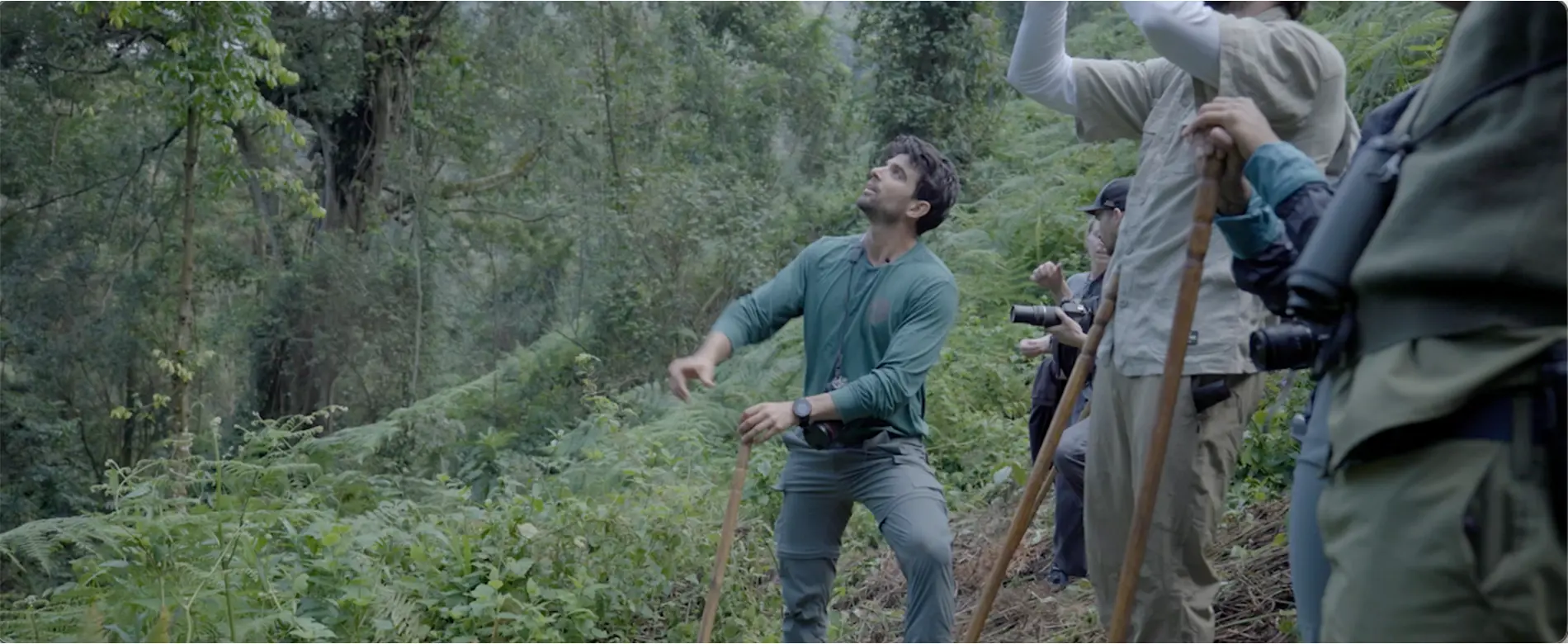
Treks typically involve one to seven hours of walking through dense forest. Chimps are far more mobile than gorillas, so the search is part of the reward.
The dry seasons, broadly June to October and January to February, bring firmer trails, thinner vegetation and clearer sightings.
A minimum age of 15 applies for trekking, group sizes are capped at eight people, and masks and minimum-distance rules protect chimps from human disease.
Habituation experiences allow up to a full day with a semi-habituated group for travellers who want deeper insight into chimp society.
Chimpanzees are Endangered, and the Western subspecies is now Critically Endangered, responsibly run trekking directly funds their protection.
Five reasons we love chimp trekking
A mirror in the forest. Sharing 98–99% of our DNA, chimps show emotions, personalities, and intelligence so familiar it is disarming; melancholy, tenderness, envy, and sudden fury all played out before you.
The thrill of the search. Unlike sedentary gorillas, chimps roam fast and far. Following their calls and feeding signs through dense forest makes this one of the more active and adrenaline-charged primate experiences in Africa.
Extraordinary forests. Trekking immerses you in some of East Africa’s richest rainforests, alive with colobus and red-tailed monkeys, forest birds, butterflies, giant forest hogs and, in places, forest elephants; biodiversity on a grand scale.
It pairs beautifully. Chimp trekking slots naturally alongside gorilla trekking, a Big Five safari, the Serengeti Great Migration or time spent on a beach, letting you build one seamless, richly varied East African journey.
Your visit protects them. Chimpanzees are Endangered. Responsibly run trekking channels permit revenue and community employment directly into conservation and the forests these great apes depend on.
About the chimpanzee
Chimpanzees are among the smallest of the great apes and, alongside bonobos, our closest living relatives, sharing roughly 98% of our DNA. There are two species in the genus Pan: the common chimpanzee (Pan troglodytes), with four subspecies, and the bonobo (Pan paniscus). They live in complex, hierarchical troops that average around 35 members, communicating through hoots, pants, barks, gestures and expressions, and they are accomplished tool users, fishing for termites with sticks and cracking nuts with stone and wooden hammers.
Like us, chimps are omnivorous and opportunistic, with fruit making up about half of their varied diet, which also includes leaves, seeds, insects, eggs and meat. They are the most carnivorous of the great apes after humans, forming coordinated hunting parties to pursue prey such as colobus monkeys. Remarkably, they also self-medicate, using specific plants to treat ailments such as intestinal parasites — one of many behaviours that blur the line between them and us. Read more about chimps here.
An encounter to remember
Africa Geographic CEO Simon Espley describes the sheer range of chimp behaviour he witnessed in Mahale Mountains National Park (Tanzania):
"A nursing mother firmly rebuffing a curious alpha male one day, and the next, that same male erupting without warning into thirty seconds of raw, chaotic violence before the forest fell silent again. It is this proximity to a wild intelligence so like our own, tender and savage by turns, that makes the experience so unforgettable. As Jane Goodall put it, these are beings that possess so very many human-like characteristics, and an hour in their company tends to stay with travellers for a lifetime."
Chimp trekking rules
Trekking rules are essential to protect chimpanzees' health, as they are susceptible to human diseases. Chimps will be stressed if there are too many visitors or if visitors misbehave.
Mask. Wearing a surgical mask while meeting chimpanzees is mandatory.
Feeling sick? If you show any sign of illness on the day of your trek, please let your guide or the park staff know. They may decide to prevent you from trekking on that day. Exposing chimps to disease may be catastrophic for the entire population. Also, if you are in the company of chimps and need to cough or sneeze, face away from the chimps - even while wearing the required mask.
Group size and duration. Group size is limited to 8 tourists, and the interaction time is 1 hour.
Minimum visitor age. The minimum age for tourists is 15 years old, to prevent exposing the chimps to childhood diseases such as mumps, chickenpox, measles, etc.
Photography. Flash photography is not permitted - the flash may frighten the chimps or provoke an aggressive reaction.
Minimum distance. Tourists must remain at least seven metres from the chimps. They may approach you, in which case you should retreat slowly if possible.
Stay together. Try to remain in a tight group - to make it easier for your guides to manage the situation and to prevent the chimps from feeling threatened.
Your behaviour while with chimps. Remain seated or crouching and keep your arms at your side when spending time with chimps. Keep quiet - even when filming a selfie. Shouting, standing or gesturing with your arms may be perceived as a threat by chimps.
Eating, drinking & smoking. No eating, drinking or smoking is permitted anywhere near chimps. This may attract their attention, leading to unwelcome close encounters. Your food may also be harmful to their health.
Toilet. Please go to the bathroom before you set out on your trek. If you need to go to the toilet whilst in the forest, you will need to dig a deep hole to bury any excrement and fill it in afterwards. Your guides will lend you a machete for this purpose, but you will need to bring toilet paper.
Litter. Please keep all of your rubbish in your backpack and deposit it at your lodge after the trek.
Our favourite Chimp Trekking safari ideas
Why book with us?
Tailor-made experiential safaris - with love
"Travel in Africa is about knowing what, when and where to go - a few weeks too early/late or a few kilometres off course, and you could miss the Greatest Show on Earth. And wouldn’t that be a pity?
Our crew of passionate safari experts have lived and worked in Africa for most of their lives. Trust us to find you the rarest animals, the most spectacular wildlife events, the remotest landscapes and deeply meaningful cultural encounters!"
Simon Espley - CEO, Africa Geographic
All you need to know about chimpanzee trekking
Where to find the best chimp trekking
Chimpanzees occur across a wide swathe of central and west Africa, but the best places to view them are:
Kibale National Park (Uganda): Often called the primate capital, home to around 1,500 chimps and roughly a dozen other primate species (including the elusive potto), with consistently high success rates and both trekking and habituation.
Budongo Forest, Murchison Falls (Uganda): Several hundred chimps in ancient mahogany forest, easily paired with Nile boat cruises and savannah wildlife viewing.
Kyambura Gorge, Queen Elizabeth National Park (Uganda): An isolated population of the “Lost Chimpanzees” survives in the mystical forests of Kyambura Gorge, viewed during savannah wildlife game drives, including tree-climbing lions.
Nyungwe National Park (Rwanda): High-altitude montane rainforest with chimpanzees and 12 other primate species, including a 400-strong mega-troop of Rwenzori pied colobus and the rarely seen owl-faced monkey. Hot tip: When booking chimp trekking, ask specifically for the Cyamudongo troop, as they are easier to find and more relaxed around tourists.
Mahale Mountains National Park (Tanzania): More than 1,000 chimps, subjects of a long-running study, venture onto the white-sand beaches of Lake Tanganyika.
Gombe Stream (Tanzania): Tiny, historic and biodiverse, the birthplace of Jane Goodall’s landmark research and the longest-running wild-animal study.
Chimp trekking experiences
Most travellers choose the standard trek. After a morning briefing, you set off on foot with expert trackers and, if large mammals are present, an armed ranger, following fresh vocalisations, footprints, and feeding signs. Walking can last from one to seven hours depending on where the chimps have wandered, sometimes on visible paths and sometimes bush-bashing on hands and knees through dense vegetation. Terrain varies from the flat forests of Kibale and Budongo to the steep highlands of Nyungwe. Once the group is located, you are allotted one hour with them. The encounter is intimate, tightly regulated and, thanks to the animals’ speed and drama, gloriously unpredictable.
For those who want to go deeper, parks such as Kibale offer a chimpanzee habituation experience. Here you spend far longer, up to a full day, alongside researchers and a semi-habituated community, following the slow process by which chimps grow accustomed to human presence. It is more demanding and more immersive, letting you recognise individuals, read group hierarchy and contribute to genuine fieldwork. Many travellers pair chimp trekking with gorilla trekking for a complete primate journey.
Chimp trekking accommodation types
Because chimp trekking takes place in remote forests, accommodation ranges from comfortable to genuinely exceptional, and your choice of lodge shapes the overall experience.
In Uganda, Ndali Lodge overlooks a water-filled volcanic crater bordering Kibale National Park, and Kyambura Gorge Lodge overlooks the gorge of the same name, near the trekking trailheads of Queen Elizabeth National Park. In Rwanda, Nyungwe National Park offers Munazi Lodge deep inside the park and One&Only Nyungwe House in a tea plantation outside the park, where breakfast is often eaten on the move as trackers lead you in at first light.
Tanzania offers some of the most atmospheric stays of all. On the shores of Lake Tanganyika in the Mahale Mountains, barefoot-luxury camp Greystoke Mahale, which is reached only by boat. Here you can rinse off the trek with a snorkel over the lake’s endemic cichlids.
Across all three countries, the emphasis is on low-impact, well-guided experiences that pair comfort with a genuine conservation ethos.
Trusted by thousands of ecstatic travellers
✔️ 5-Star Trustpilot Rating ✔️ Condé Nast Travel Specialist Award Winner
✔️ Accredited by SATSA ✔️ 5,000+ Exceptional Safaris Since 1991
Why choose Africa Geographic to plan your safari?

... I am not the easiest client to arrange trips for, being a full-time wheelchair user, but that doesn't prevent Christian from coming up with a plan to ensure I get to do what I wish. The last trip earlier this year to Uganda and Rwanda included chimp trekking, the shoebill stork, and, finally, gorilla trekking; what an amazing experience ...
On Uganda: The main attraction was obviously the gorillas, but for this trip chose to spend 2 weeks visiting other areas in Uganda as well ... the trip included the rhino sanctuary in Ziwa, Murchison Park, Kibale Forest, QE park and Bwindi. Don't miss the chimp treks...they are endlessly fascinating! ...
My trip was beyond belief ... I saw more forest elephant than I ever imagined. I even saw some rare creatures, be it ever so fleeting, including chimpanzee, bongo, and sitatunga antelope. I have been asked where I want to go next, but the truth is ... I just want to go back. No disappointments... not one.
Frequently asked questions
Chimpanzee trekking is a guided forest hike to find and observe a habituated community of wild chimpanzees. You walk with expert trackers (and often an armed ranger) for anywhere from one to seven hours, then spend one closely regulated hour watching the chimps feed, groom, play and interact.
Uganda, Rwanda and Tanzania are the premier destinations because they have habituated chimp groups. Uganda’s Kibale is widely regarded as the finest single location for high numbers of chimps and strong success rates; Tanzania’s Mahale and Gombe offer remote, historic encounters on Lake Tanganyika; and Rwanda’s Nyungwe pairs trekking with a spectacular canopy walkway.
Uganda offers more locations, generally flatter terrain and higher chimp densities, which tends to mean higher success rates. Rwanda’s Nyungwe is a straightforward drive from Kigali on good roads and combines beautifully with the canopy walkway and gorilla trekking in Volcanoes National Park. Neither is “better”; it depends on your wider itinerary and appetite for terrain.
The dry seasons, broadly June to October and January to February, are ideal. Trails are less muddy, vegetation is thinner, and chimps spend more time on the ground, making them easier to find. Because chimp habitats straddle the equator, you can trek year-round, but expect rain in a rainforest whatever the season.
Sturdy, waterproof hiking boots with good grip, lightweight long-sleeved tops and trousers, a rain jacket, a hat, sunscreen and insect repellent are essentials. Bring a small daypack, water, snacks, binoculars and a camera with the flash disabled. Garden gloves and gaiters help with nettles, thorns and forest ants, and waterproofing for your gear is wise in any season.
Difficulty ranges from moderate to challenging depending on the park and where the chimps are. The hiking pace is usually relaxed, but it speeds up when the chimpanzees are on the move. The landscape is usually not as steep as it is for gorilla trekking, which means a lower level of fitness is required. But you still need to be able to walk for three to seven hours at a relaxed pace.
The minimum age is 15. There is no maximum age. Many lodges offer childminding or half-day programmes so families with younger children can still take part.
Standard treks allow one hour with the chimps once they are found, a limit set to minimise disturbance. A chimpanzee habituation experience, offered in select parks, allows considerably longer, up to a full day, with a semi-habituated group.p to 4 hours with a semi-habituated group.
Rules require you to keep a minimum distance, commonly cited as 7 to 10 metres depending on the park, to protect the chimps from human disease and stress. Chimps often ignore this themselves and may pass or sit very close by; in which case, you stay calm and still and let them move on.
Core rules protect the chimps’ health: wear a mask when with the chimps, keep the minimum distance, no flash photography, no eating, drinking or smoking near the animals, keep voices low, stay in a tight group and never trek if you are unwell. Disease transmission is a real risk, flu passed from humans has killed chimps in habituated communities, so these rules matter. Always follow your guide.
Permits are relatively modest compared with gorilla permits, and prices vary by country and trek type, between $ 100 and $ 300. Because permit fees change and daily numbers are strictly limited, confirm current costs and availability with your safari planner.
Permits are issued by the relevant national parks authority (Uganda Wildlife Authority for Uganda; Rwanda Development Board for Rwanda; TANAPA for Tanzania). Our team handles the booking of chimp trekking permits as part of your safari package. Independent bookings can be made directly through the authority websites, but they sell out quickly in peak season, and communications can be poor or non-existent.
When conducted responsibly, chimp trekking is both ethical and safe. It funds conservation and community livelihoods, group sizes are kept small to limit stress, and strict health rules protect the chimps. You will be led by experienced guides and trackers; choose established sites that follow conservation guidelines and avoid any operator that permits touching or feeding.
Chimpanzees are classified as Endangered on the IUCN Red List, and the Western subspecies (bonobo) as Critically Endangered, driven by poaching for bushmeat, habitat loss from agriculture, logging, mining and roads, and disease such as Ebola. Populations have declined sharply in recent decades, which is precisely why well-managed, revenue-generating trekking is such an important conservation tool.
Click here to schedule a no-obligation call with one of our Safari Experts or fill in our 2-minute form with your questions. Our team of experts are here to help! Whether you’re curious about the best time to travel, want to hear first-hand about an experience or need help planning your safari.
Explore more African safari experiences
Start planning your dream safari
Our travel experts will craft a no-obligation itinerary just for you. We have crafted over 5,000 safaris since 1991. Your personal details are protected; we only use this information to contact you.
Why book your safari with us?

Deep Experience & Knowledge
Handcrafted experiential safaris since 1991.
Travel in Africa is about knowing when and where to go, and with whom. A few weeks too early/late or a few kilometres off course, and you could miss the greatest show on Earth. And wouldn’t that be a pity?

Trust & Safety

Make A Difference
We donate a portion of the revenue from every safari sold to carefully selected conservation projects that make a significant difference at ground level.
YOUR safari choice does make a difference - thank you!