

Tailor-made safaris. Since 1991



Trust us to find you the rarest animals, the most spectacular wildlife events, the remotest landscapes and deeply meaningful cultural encounters!
Photographing the gorillas
Mountain gorillas live in two regions on Earth: the Virunga Massif volcanoes straddling Rwanda, Uganda, and the DRC, and the ancient rainforests of Bwindi Impenetrable Forest in Uganda. The global population is over 1,000 individuals – a figure that represents one of conservation's genuine success stories, up from around 620 in the 1980s. For wildlife photographers, a habituated gorilla family in Volcanoes National Park, Bwindi Impenetrable National Park, or Mgahinga Gorilla National Park offers one of the most intimate wildlife encounters available anywhere: an hour on the forest floor with a family group whose members may include a dominant silverback, nursing mothers, juveniles, and infants. Getting a strong photograph requires preparation, patience, and a clear understanding of gorilla behaviour.
Why gorilla photography is different
Most wildlife photography involves distance, telephoto lenses, and a subject that may never know you are there. Gorilla photography is the opposite. Habituated groups are accustomed to human presence, and encounters happen at close range – sometimes within two or three metres of a silverback weighing up to 220kg. The hour-long visit creates a contained, structured opportunity with no guarantee of light, positioning, or subject behaviour.
Dewald Tromp, winner of the Africa Geographic Photographer of the Year 2024, described his encounter in Volcanoes National Park: "While I was trekking for mountain gorillas in Volcanoes National Park, the dominant silverback casually flopped down directly in front of me, observing his reflection in the lens of my camera. Surrounded by thick vegetation, I had nowhere else to go. I kept a submissive posture with my eyes downcast. He stretched out his hand to touch his reflection in the lens, and for the briefest moment, I imagined him extending his hand to greet me as an old friend." He shot the image on a Nikon Z9 with a 14–24mm lens at 14mm, ISO 1250, f/8.0, 1/320sec – in this case, a wide-angle lens, not telephoto, was the right tool for the job.
Rwanda vs Uganda – gorilla photography at a glance
Altitude | 2,400 – 4,507m | 1,160 – 2,607m | 2,227 – 4,127m |
Forest type | Montane bamboo and Hagenia forest | Dense tropical rainforest | Montane forest and Virunga lava flows |
Typical trek duration | 30 min – 4 hrs to find group | 1 – 8 hrs | 1 – 5 hrs |
Photography conditions | More open understorey in places; good for wider shots | Dense canopy; challenging but rewarding low light | Less visited; more time with groups in some cases |
Permit cost (approx.) | US$1,500 | US$800 | US$800 |
Note: Permit costs are subject to change.
Gorilla safaris we love
A well-planned gorilla safari pairs the trek itself with the wider primate landscape – chimpanzees, golden monkeys, colobus troops – for an encounter with our nearest animal relatives that goes well beyond a single hour in the forest. Here are three Africa Geographic safaris to consider:
Rwanda primate bonanza: This immersive 8-day Rwanda journey brings together the country’s most compelling primate encounters, from the misty slopes of the Virunga volcanoes to the ancient rainforests of Nyungwe. View safari →
Trek for Kibale chimps and Bwindi gorillas: An immersive 7-day journey through Uganda's densest mountain forests, combining chimpanzee trekking in Kibale with mountain gorilla encounters in Bwindi Impenetrable Forest. View safari →
The ultimate primate safari: An 8-day expedition through the ancient volcanic rainforests of Uganda and Rwanda, trekking for mountain gorillas, chimpanzees, golden monkeys and 400-strong colobus troops. View safari →
Understanding gorilla behaviour for better photographs
Silverback leadership and group dynamics
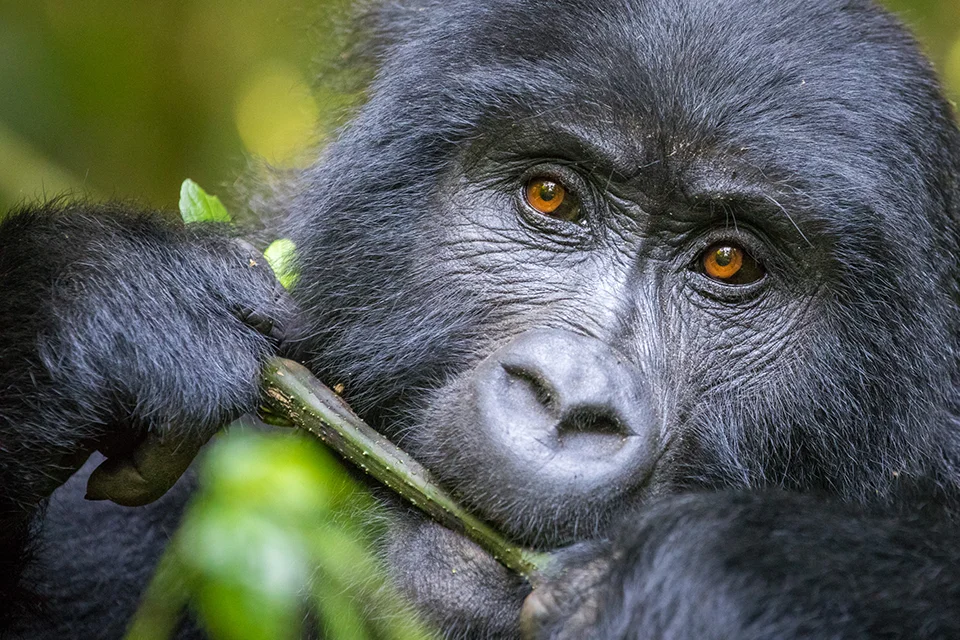
Each habituated group is led by a dominant silverback – an adult male identifiable by the silver-grey saddle of hair across his back, which develops from around 12 years. Observing where he sits and how group members respond to him tells you a great deal about where activity is likely to happen. A silverback at rest often means younger animals will play nearby; a silverback moving means the group moves.
Juveniles and infant behaviour
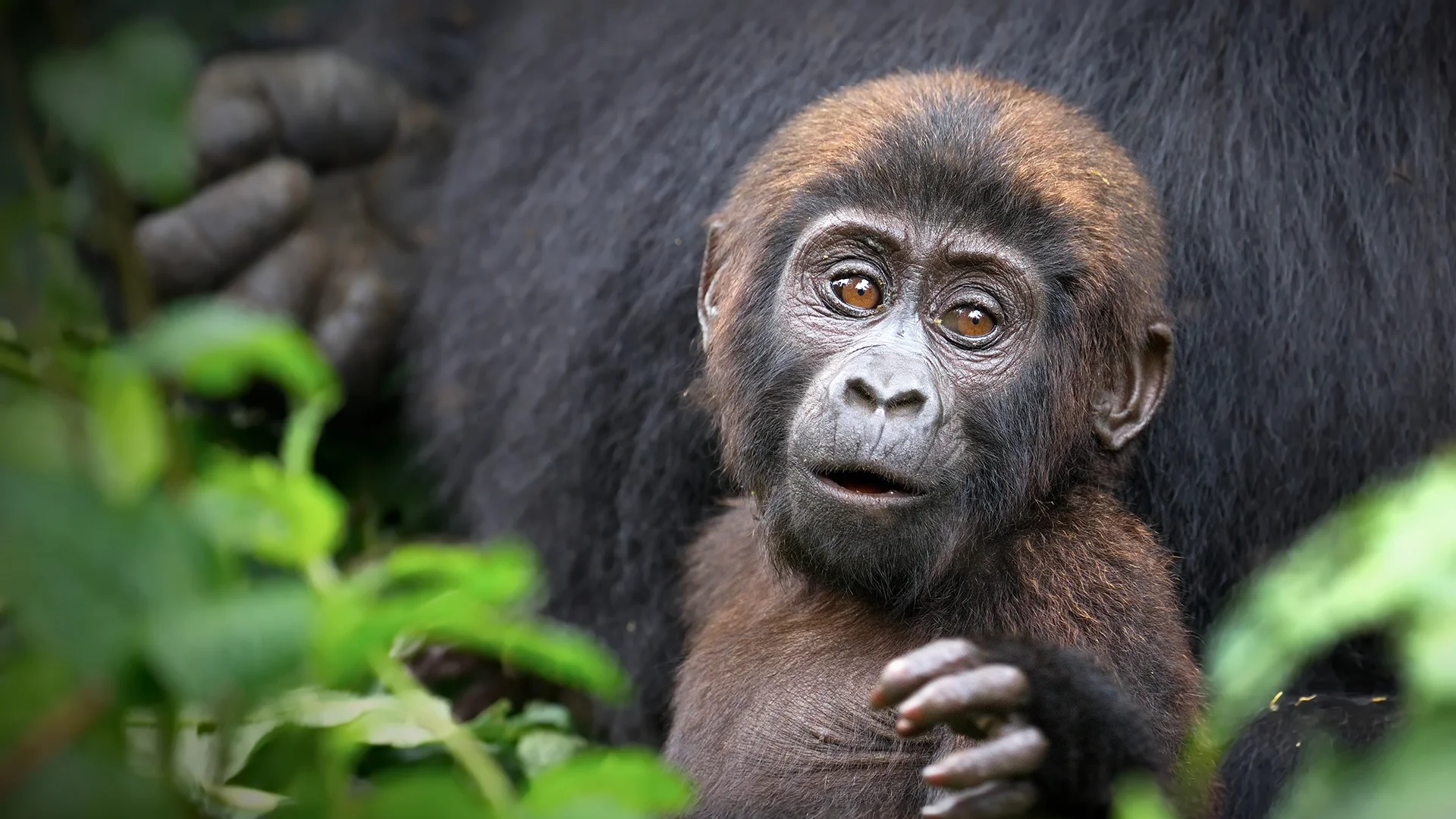
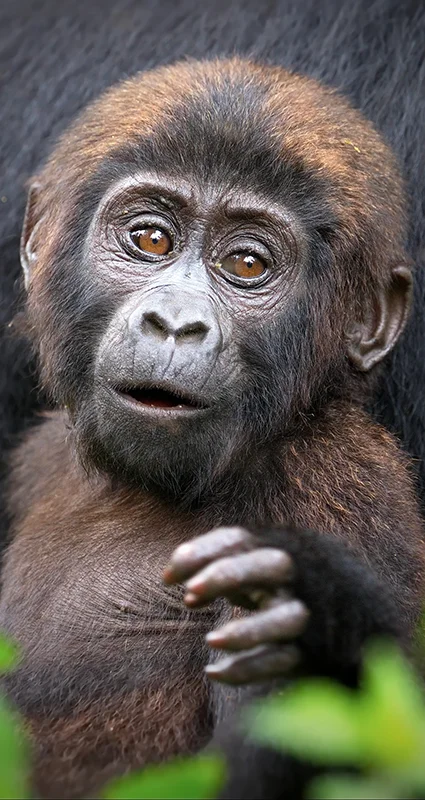
Juvenile gorillas between three and six years old produce the most active, photographically varied behaviour: climbing, wrestling, tumbling, and pestering adults. Infants, typically under three years, stay close to their mothers and are carried on backs or held to the chest. These interactions are most likely to happen when the group is settled and feeding. The first 20 minutes of an encounter are often the most active as the group adjusts to your presence; watch for juveniles moving into open areas once adults are calm.
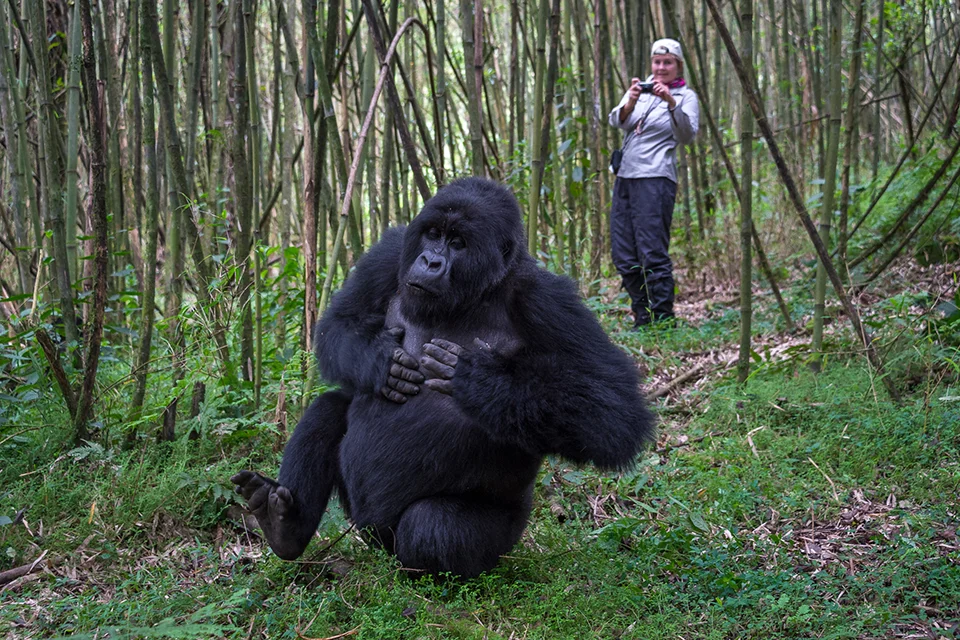
Reading the forest floor
Mountain gorillas feed primarily on leaves, stems, bark, roots, and occasionally fruit. During a session you are likely to see foraging, resting, grooming, and play. The gorillas will not remain still for long, so practise moving quietly and repositioning with your guide's direction rather than chasing subjects. Mary Schrader, a Photographer of the Year entrant who photographed in Bwindi, described her approach: "Photography isn't just about seeing, it's about feeling the rhythm of the wild. That kind of awareness only comes when you stop, breathe, and truly settle into the moment. Some of the most powerful images unfold slowly, not through pursuit but through presence."
Photography technique for gorilla encounters
Focal length and camera setup
The single most common mistake in gorilla photography is arriving with a telephoto lens. Encounters take place at close range – often between one and five metres – and a 400mm or 500mm lens becomes unusable. A 16–85mm zoom or a 24–105mm zoom covers most situations. A wide prime (24mm or 35mm) works well when a silverback is within touching distance. For the odd moment when animals are further into the undergrowth, a 70–200mm is useful as a second body. Bring both if you can.
Exposure in dense forest
The primary challenge is light. Bwindi and Mgahinga have dense canopy that reduces ambient light significantly; Volcanoes NP has more open areas but is often mist-covered in the early morning. Set your camera to aperture priority at f/4 to f/5.6 and push ISO as high as your body handles cleanly – ISO 1600 to 6400 is common. Enable auto-ISO with a minimum shutter speed of 1/250sec to prevent motion blur. Gorilla fur is dark and absorbs light; metering off mid-tone vegetation rather than the subject often produces better-exposed results.
Essential kit checklist
Pack light – you will carry everything on the trek, often uphill through dense vegetation for several hours.
Camera body with strong high-ISO performance (mirrorless full-frame or APS-C recommended)
Wide-to-standard zoom: 16–85mm or 24–105mm as primary lens
Mid-telephoto zoom: 70–200mm as secondary option
Spare batteries – cold altitude temperatures drain batteries faster
Extra memory cards – shoot in RAW for maximum latitude in post-processing
Rain cover for camera body and bag – forest rain arrives quickly
Small, quiet dry bag for electronics
Monopod rather than tripod – lighter and faster to adjust on the forest floor
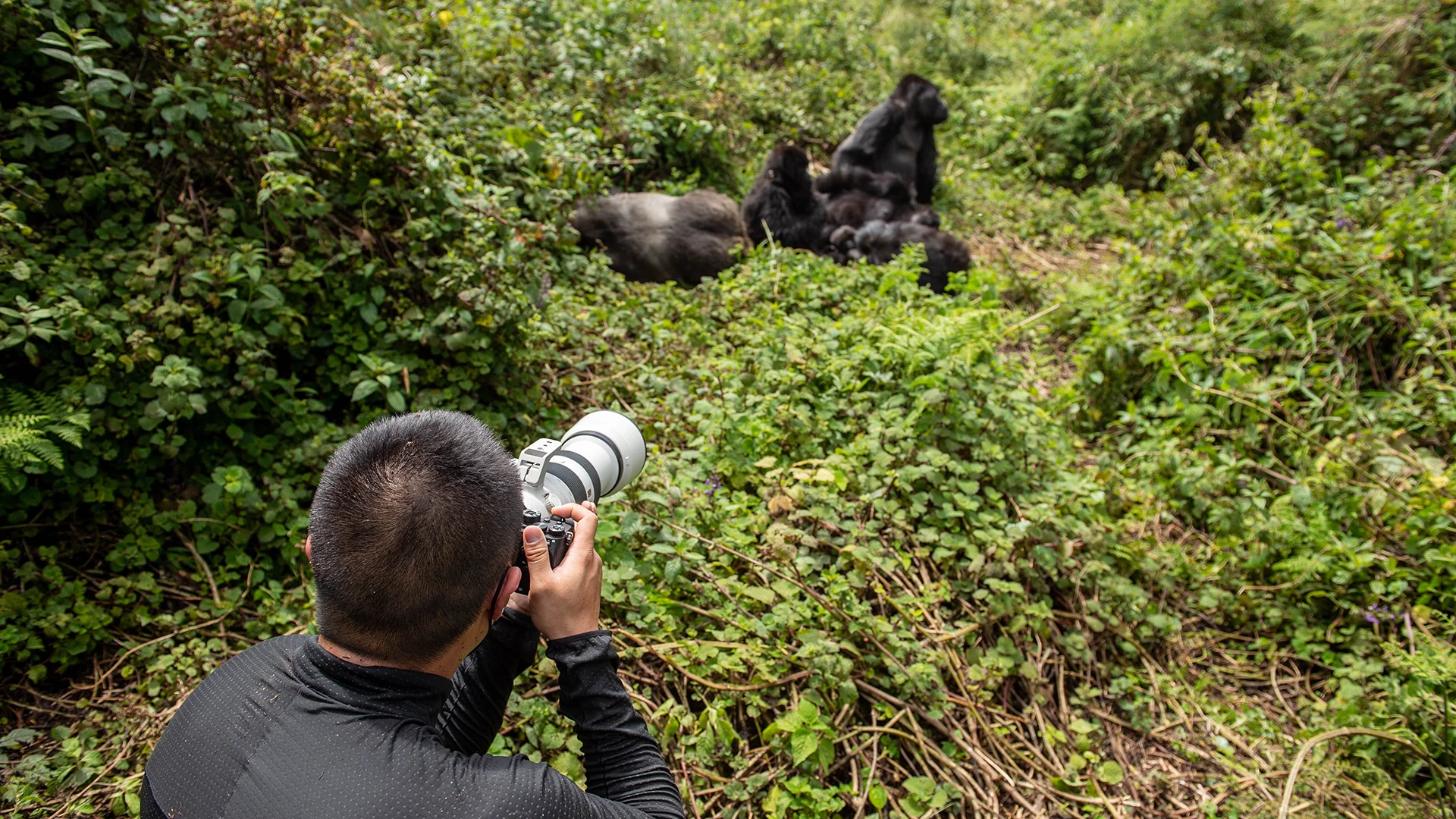
Gorilla photography and conservation
How permit fees fund protection
Mountain gorilla permit fees form the primary revenue stream for national park management in both Rwanda and Uganda. In Rwanda, the Rwanda Development Board allocates a portion of Volcanoes NP permit revenue to communities surrounding the park through its Revenue Sharing Programme. In Uganda, the Uganda Wildlife Authority directs 20% of park entry fees to adjacent communities. This direct financial link between tourism and protection is one of the mechanisms that has contributed to the mountain gorilla population increasing from approximately 620 individuals in the 1980s to over 1,000 today. Responsible photographers, by purchasing permits and adhering strictly to guidelines, actively participate in this conservation model.
Ethical photography practice
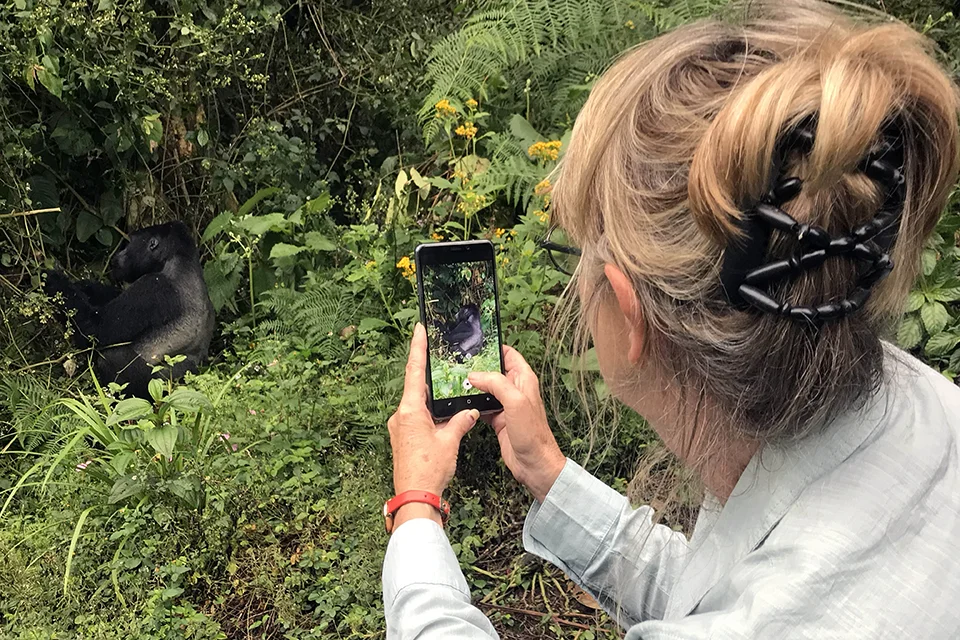
A minimum distance of seven metres from gorillas is required at all times, although while you are observing, on occasion, a gorilla may approach closer to you. Flash photography is prohibited as it distresses the animals and disrupts natural behaviour. Masks must be worn (often provided at the park gate) to reduce disease transmission risk. Nili Gudhka, a Photographer of the Year entrant, describes the principle underpinning ethical wildlife photography: "You must first understand the intricacies of animal behaviour. This begins with observing, learning, and listening to the animals and nature. Once you understand their behaviour, you will be able to anticipate their next move. In doing this, you will also learn how to give them space and respect them, ensuring that your presence doesn't prohibit their natural behaviour." These rules apply to gorilla photography without exception.
Photography as documentation
Images produced during gorilla treks serve a broader purpose than personal record. Africa Geographic’s Photographer of the Year competition, which has run for multiple decades, has produced some of the most widely shared conservation imagery of mountain gorillas in circulation. Images that document habituation behaviour, family structures, and health status contribute to the scientific and conservation record. Stefan Winterboer, a gorilla trekking safari expert with Africa Geographic, notes: "I was unprepared for how deeply, profoundly we mirrored each other, the great apes and I. In their eyes and movements, I saw our shared humanity reflected. It was a humbling, unforgettable experience of connection and fragility." That sense of connection, translated into photography, is what drives the conservation case for gorilla protection to a global audience.
Wish you were here?
When to go for gorilla photography
Dry season – clearest conditions
The primary dry seasons in both Rwanda and Uganda run from June to September and from December to February. During these, months trails are firmer, vegetation is less saturated with water (reducing lens condensation), and overcast light – often preferable to harsh midday sun in the forest – is more consistent. The June-to-September window coincides with peak demand; permits should be secured three to six months in advance during this period.
Wet season – green and intimate
The long rains run from March to May in both countries; a shorter wet season occurs in October and November. Vegetation is at its most lush and green during this period, which can produce striking images, and demand is lower meaning permits are more accessible. Trail conditions are harder – steep, muddy, and slippery – and rain can arrive quickly. Waterproof camera covers and sealed bags are essential. Some photographers prefer the atmospheric quality of misty wet-season light, particularly in Bwindi.
Plan your gorilla photography safari – speak to a specialist
Frequently asked questions
Mountain gorillas (Gorilla beringei beringei) live in two African locations: the Virunga Massif, shared between Rwanda, Uganda, and the DRC, and Bwindi Impenetrable National Park in Uganda. The global population stands at over 1,000 individuals, making them one of the few great ape species whose numbers are increasing. Wildlife photography encounters take place during hour-long habituated group visits in Volcanoes National Park (Rwanda), Bwindi Impenetrable National Park, and Mgahinga Gorilla National Park (Uganda). Effective gorilla photography requires wide-to-standard focal lengths of 16–85mm, high ISO capability, and an understanding of gorilla social behaviour to anticipate subjects before they move.
A wide-to-standard zoom in the 16–85mm or 24–105mm range is the most versatile choice for gorilla photography. Encounters happen at close range – often one to five metres – making telephotos impractical for most of the session. A 70–200mm on a second body is useful when animals move further into vegetation. Wide primes such as a 24mm or 35mm f/1.8 are good choices for close-range silverback portraits. Avoid bringing only telephoto equipment; it is the most common mistake photographers make on their first gorilla trek.
Standard gorilla trekking permits allow one hour with a habituated group. This time limit is strictly enforced by park rangers to minimise stress on the animals. Some parks offer additional special permit options – Rwanda's Volcanoes NP offers a private gorilla family option that allows a longer, more exclusive visit – but these come at significantly higher cost. The hour moves quickly; preparation before the session (camera settings pre-configured, bag organised for quick lens access) is important.
Both countries offer excellent gorilla photography under different conditions. Rwanda's Volcanoes National Park has more open understorey in some sectors and slightly easier terrain in certain gorilla group sectors, which can mean better light and positioning. Uganda's Bwindi Impenetrable National Park has denser forest and more challenging light but a larger number of habituated groups (more than 20 compared to around 12 in Rwanda). Many photographers visit both countries on a combined itinerary to experience the contrast and increase the range of images captured.
ISO 1600 to ISO 6400 is common in dense forest environments such as Bwindi. Camera bodies with strong high-ISO performance – typically modern full-frame mirrorless or DSLR bodies – handle these settings well. Set a minimum shutter speed of 1/250sec in auto-ISO mode to prevent motion blur from animals moving. In Volcanoes NP where light levels are sometimes higher, ISO 800 to ISO 1600 may be sufficient in clearings. Shoot in RAW format to retain maximum flexibility in post-processing, particularly for recovering shadow detail in dark gorilla fur.
Flash photography is strictly prohibited during gorilla trekking encounters in Rwanda, Uganda, and the DRC. Flash can startle and distress gorillas and may provoke a stress response from dominant silverbacks. This rule is enforced by park rangers and guides and applies to all visitors without exception. Photographers should plan camera settings in advance to work with available natural light, including high ISO, wide aperture, and image stabilisation. The results – achieved with available light – are typically more naturalistic than flash-lit images would be.
Mountain gorillas are listed as Endangered on the IUCN Red List. The global wild population is approximately 1,063 individuals across two subpopulations: the Virunga Massif (spanning Rwanda, Uganda, and the DRC) and Bwindi Impenetrable National Park (Uganda). This represents a significant recovery from a population low of around 254 individuals in 1981. Conservation success has been attributed to anti-poaching enforcement, veterinary intervention by organisations such as the Gorilla Doctors, community benefit programmes tied to tourism revenue, and the economic value created by gorilla trekking.
Behavioural photography requires anticipation rather than reaction. Study gorilla social dynamics before your trek: juveniles wrestle and climb near adults; mothers carry and nurse infants; silverbacks perform chest-beating displays when asserting dominance or responding to perceived threats. Position yourself with your guide's assistance to have clear sightlines to where activity is most likely. Keep your camera to your eye and track animals that are moving. Shoot in burst mode when animals are active and review in quiet moments to check focus and exposure.
Standard gorilla trekking permits include a professional park ranger guide who manages the group's behaviour and directs visitors. For photography-specific guidance – lens selection, light reading, positioning for composition, and timing of behaviour – a specialist photographic safari guide or a photography-focused itinerary adds significant value. Africa Geographic's photographic safari experiences pair travellers with guides who have specific wildlife photography knowledge, and some gorilla trekking itineraries include pre-trek briefings on gorilla behaviour and photography technique.
Start planning your dream safari
Our travel experts will craft a no-obligation itinerary just for you. We have crafted over 5,000 safaris since 1991. Your personal details are protected; we only use this information to contact you.
Why book your safari with us?

Deep Experience & Knowledge
Handcrafted experiential safaris since 1991.
Travel in Africa is about knowing when and where to go, and with whom. A few weeks too early/late or a few kilometres off course, and you could miss the greatest show on Earth. And wouldn’t that be a pity?

Trust & Safety

Make A Difference
We donate a portion of the revenue from every safari sold to carefully selected conservation projects that make a significant difference at ground level.
YOUR safari choice does make a difference - thank you!