

Tailor-made safaris. Since 1991

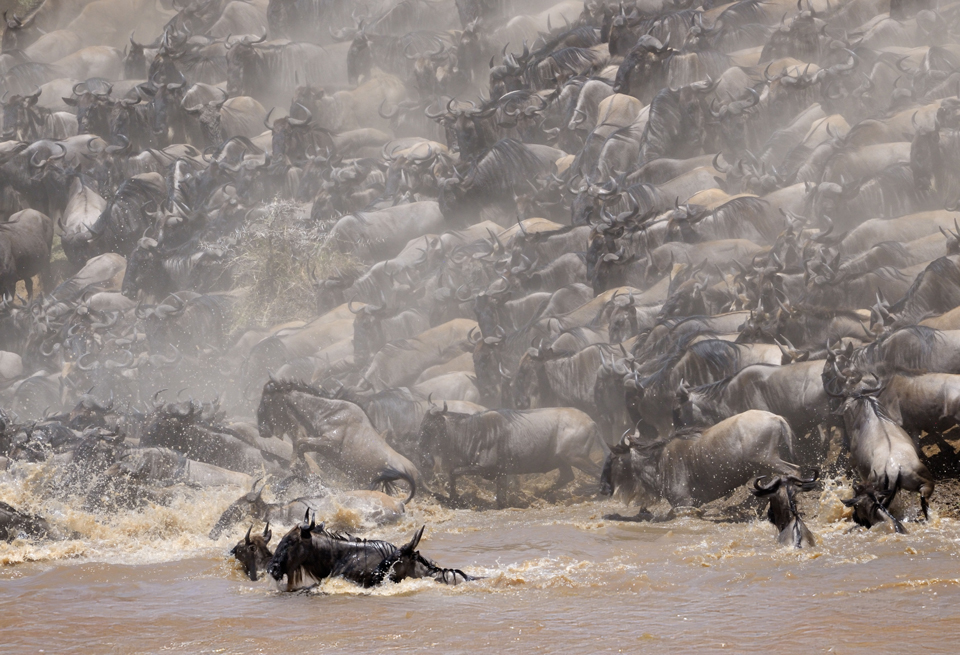
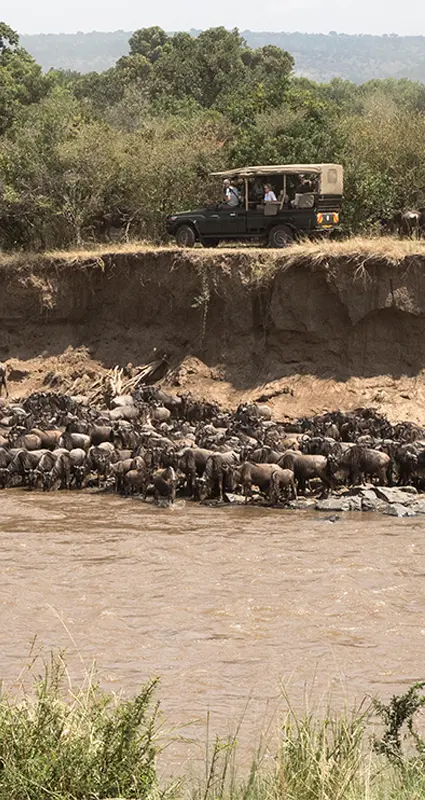


The Great Wildebeest Migration is one of Earth’s most dramatic wildlife spectacles. Each year, over a million wildebeest and thousands of zebra and gazelles traverse the Serengeti–Mara ecosystem in search of fresh grazing. From adrenaline-charged Mara River crossings to intimate walking safaris and family-friendly game drives, there are many ways to experience this ancient natural phenomenon.
Read on to discover four personal migration stories and find the safari style that matches your sense of adventure.
Handcrafting your
Great Migration safari
Africa Geographic’s handcrafted migration safaris place you in the right locations at the right time, using expert local guides and small, low-impact camps. Whether you prefer a mobile walking trail, a secluded tented camp or a front-row seat at the Mara River, we will craft a journey that matches your sense of adventure.
Speak to our safari experts to plan your migration experience.
Few wildlife encounters match the immediacy and raw power of the Great Migration. More than a million wildebeest and thousands of zebra and gazelles traverse the Serengeti–Mara ecosystem each year, drawing predators, storms of dust and a tide of life that reshapes the plains. Witnessing this spectacle is a privilege that takes many forms. Some travellers choose a remote walking safari, stepping quietly into the animals’ world. Others immerse themselves in the drama of the Mara River, waiting for the herds to make their perilous leap of faith. Some head to the Serengeti with family to create memories that last a lifetime. And some are swept up in the energy of daily game drives as the migration thunders from horizon to horizon.
Read 11 expert tips for planning your ultimate Wildebeest Migration safari here
What follows are excerpts from four personal accounts from our experts and travellers who experienced the migration in different corners of the Serengeti and Mara. Their stories speak of adrenaline, awe, silence, fear and gratitude. They remind us that this is not theatre. It is a living, ancient natural phenomenon – a rhythm older than memory.
Walking among giants
Our CEO Simon Espley experienced the Serengeti on a mobile walking safari
"'Listen', says Jean, cupping his ears and staring at the distant horizon. I listened. Nothing, except for that constant muuuuuh muuuuh? muuuuh coming from the wildebeest herds dotted around us, and the constant buzz of birds and insects.
You see, the Serengeti can be pretty busy during the Great Wildebeest Migration season, and yet we had been on safari for days without hearing a vehicle or seeing another soul. It turns out that the Serengeti is VAST, and there are massive swathes of wilderness far away from the roads, and therefore no tourism traffic. I was on a walking and fly-camping safari in these Serengeti wilderness areas. Heaven on Earth.
Four hours later, we walked the last hour to our camp for the night. It was just us on that rock, with regular visits from white-headed barbets and Fischer’s lovebirds. Could life be better?"
The greatest spectacle on Earth
Faizel Ismail, a wildlife photographer, experienced the Mara River drama
"The energy in the air is feverish, filled with anticipation and burgeoning adrenaline. The chorus of thousands of voices echoes through the dust as the herds make their way towards the banks of this legendary river. If the conditions are favourable, what follows will be the breathtaking pinnacle of nature’s greatest spectacle: the crossing of the Mara River.
For some, witnessing the Great Migration is a bucket-list experience. But for me, finding myself on the banks of the Mara River was fulfilling my ultimate dream. The scene unfolding before me left me spellbound – life playing out as nature intended: unbridled, visceral, unconquerable and triumphant."
Read the full account, complete with exceptional photography, here
The Mara River’s wild theatre
Simon Espley, Africa Geographic CEO, experienced the Serengeti on a classic game-drive safari during river-crossing season
"They came thundering from all sides, driven by a primordial instinct and sucked in by the cacophony and energy of those already crossing, plunging into the Mara River. Seemingly without a care, they chanced their luck against the current, the rocks and the crocs. Chaotic, pulsating, exhilarating…
The day started like any other on my Serengeti safari – early. The previous day, we had enjoyed bucket list bliss as a 30-minute stream of thousands of wildebeest and zebra crossed the Mara River in front of us, with four going down to massive Nile crocodiles. All four victims were young wildebeest that had strayed from the safety of thousands of churning hooves."
Southbound with the herds
Our editor Taryn van Jaarsveld experienced the Serengeti, Lake Manyara and Ngorongoro on a classic family safari with a private guide
"We landed at Kilimanjaro Airport in late December and met our private guide. As a party with two kids and three adults, this made an immense difference – from managing long drives to adjusting the pace whenever we needed breaks. After a gentle two-day introduction to Manyara’s wildlife, we continued toward the Serengeti, where the migration was shifting south. Nothing prepared us for the scale of it. Rolling waves of wildebeest flooded the grasslands, spreading across the horizon in moving bands. Constant low grunting became the soundtrack of our days. Giraffes stood above the herds like watchtowers, and it felt like almost every rocky outcrop we passed held lions – many with playful cubs tumbling around the boulders. Our days in Serengeti settled into an easy rhythm as we explored the park, from the short grass plains in the south to the Hippo Pools in central Serengeti. Relaxed morning drives and lazy lunches allowed ample hours amidst the migration unfolding around us.
In Ngorongoro, zebras grazed near the road, buffaloes lounged in muddy pools, lone bulls wandered, and Maasai herders navigated their cattle amongst the wildlife, the crater walls ever-present behind them. Days of easy sightings, calm weather, and serenity. But it was the Serengeti that stitched itself deepest into our family memories."
Frequently asked questions about the Great Migration
It depends entirely on when you plan to travel – and this is where understanding the full migration story matters.
The Great Migration is a Tanzanian event for twelve months of the year, with herds moving through vast areas of the Serengeti ecosystem. Between February and March, the southern Serengeti hosts the calving season – one of the migration's most remarkable and often overlooked chapters, when hundreds of thousands of wildebeest calves are born in a matter of weeks. Between May and July, the herds push north through the central and western Serengeti corridors toward the Grumeti River – spectacular in their own right, and largely crowd-free. From around August, the herds approach the Mara River region on the Kenya–Tanzania border, where crossings become possible through to October.
So the honest answer is: your travel dates should drive your destination, not the other way around. If you're set on river crossings, plan for August to October – and note that this is the one window where Kenya's Maasai Mara becomes a compelling option, as the herds spill across the border. For the calving season or the Grumeti corridor, Tanzania's Serengeti is your destination.
The migration is complex and unpredictable. As specialist African safari experts since 1991, we monitor herd movements and can adjust itineraries when needed. The small price premium is worth the expertise and problem-solving when things don't go to plan.
August to October offers peak probability, but there are never guarantees. Some visitors visit for a week without witnessing a single crossing.
This is why diversifying your itinerary is crucial. With proper planning, you'll still experience vast herds, intense predator action, the Big Five, and extraordinary landscapes. Many travellers report that experiencing the herds themselves – watching family groups mill and graze across endless plains – proved more moving than the river crossings they'd anticipated.
The months with the absolute lowest visitor numbers are generally April and May (during the "long rains") and November (the "short rains"). However, if you are looking for the best balance of excellent wildlife viewing and fewer crowds, consider early June and early December.
It is important to distinguish between the two countries:
Tanzania: February and March are actually peak season in the Southern Serengeti for the wildebeest calving. If you want to avoid crowds in Tanzania, avoid February and March, the festive season (mid-December to mid-January), and the river crossing season (August to October).
Kenya: In contrast, February and March are part of the "Secret Season" in the Maasai Mara. While the migration is in Tanzania, Kenya offers lush landscapes, resident big cats, and significantly fewer tourists during this time.
The rainy season in East Africa generally falls into two distinct periods: the "long rains" (typically April and May) and the "short rains" (typically November). While rainfall patterns can shift annually due to climate change, the wettest conditions are usually found in April, May, and November.
What to expect: The rains are often misunderstood. Rather than constant, all-day washouts, the rainy season is characterised by afternoon tropical downpours and thunderstorms. Mornings are frequently bright and clear, with clouds building up nicely throughout the day to create dramatic skies.
Trusted by thousands of ecstatic travellers
✔️ 5-Star Trustpilot Rating ✔️ Condé Nast Travel Specialist Award Winner
✔️ Accredited by SATSA ✔️ 5,000+ Exceptional Safaris Since 1991
Why choose Africa Geographic to plan your safari?
Start planning your dream Great Migration safari
Time to finally book that Great Migration safari? Let our conservation experts craft a journey that matches your values with your dreams of Africa. Your personal details are protected; we only use this information to contact you.
Why book your safari with us?

Deep Experience & Knowledge
Handcrafted experiential safaris since 1991.
Travel in Africa is about knowing when and where to go, and with whom. A few weeks too early/late or a few kilometres off course, and you could miss the greatest show on Earth. And wouldn’t that be a pity?

Trust & Safety

Make A Difference
We donate a portion of the revenue from every safari sold to carefully selected conservation projects that make a significant difference at ground level.
YOUR safari choice does make a difference - thank you!