
Tailor-made safaris. Since 1991

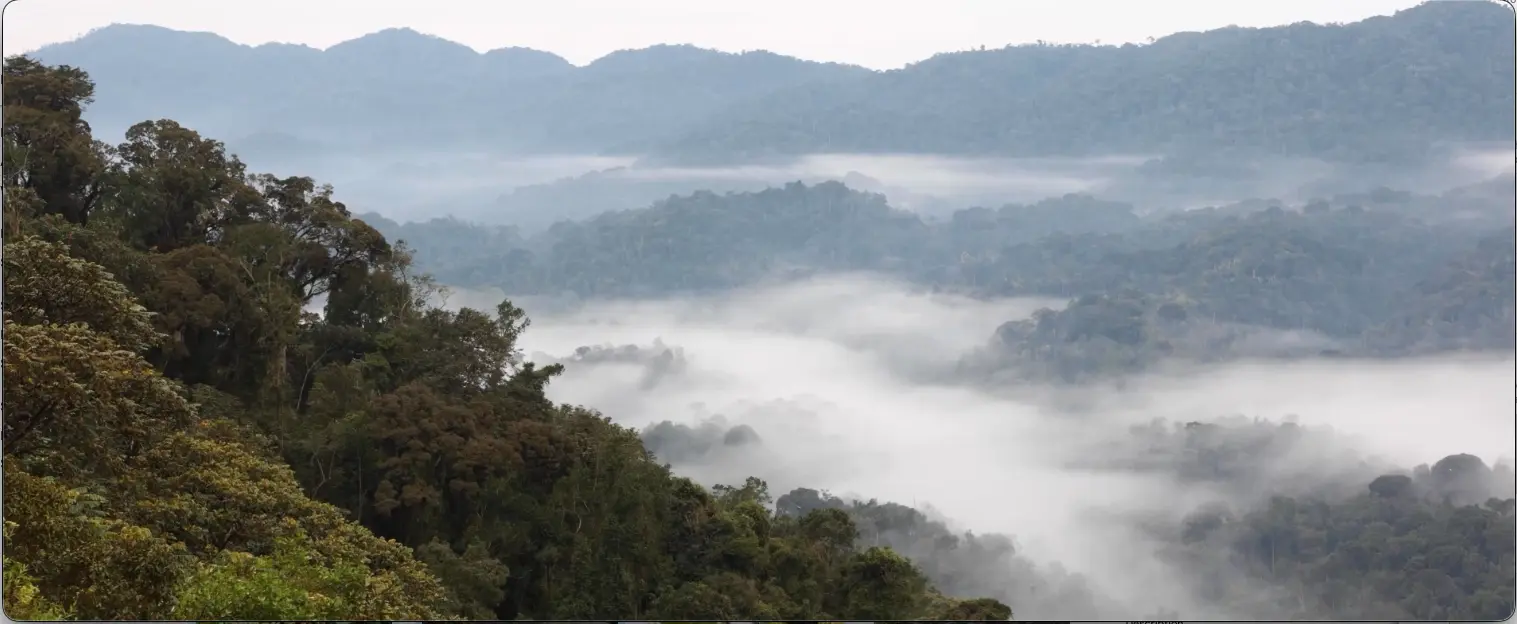


Nyungwe: a slice of verdant heaven in Rwanda
Why visit Nyungwe National Park?
Nyungwe National Park is a large tract of protected montane forest in Rwanda, and is an excellent location for chimpanzee trekking. Apart from hikes to visit our closest cousins in the primate family tree, Nyungwe has 12 other primate species, including the Rwenzori pied colobus monkeys (including a mega-troop of over 400 individuals), grey-cheeked mangabey, L'Hoest's, Sykes', silver, red-tailed monkeys, and the olive baboon.
Nyungwe covers 1,019km² (over 100,000 hectares) of forested mountains, towers above Lake Kivu, and is believed to be the remote source of the Nile River. Exploring this forested gem is possible not only through treks but also by visiting the elevated Canopy Walkway, which offers a rare view into the forest's treetops.
Nyungwe is a bucket-list destination for fans of pristine forests, chimp trekking, birdwatching, and hiking.
5 Reasons We Love Nyungwe National Park
Chimpanzee trekking. Chimpanzees share 98% of human DNA, making this one of the most compelling wildlife encounters in Africa.
Bird-watching. Bird-watching is extremely rewarding at Nyungwe, with 345 species - including 29 Albertine Rift endemics.
A 400-strong mega-troop of Rwenzori pied colobus monkeys!
Canopy walkway and ziplining. Both activities offer incredible views into and beyond the forest canopy. The 160m canopy walkway is divided into three sections and is accessible via the 2.1km Igishigishigi Trail, which commences at the Uwinka Visitors Centre. The park’s zipline delivers a thrilling perspective of the canopy. Spanning an impressive 1,935m, it is one of the longest ziplines in Africa.
Spectacular biodiversity. Apart from its rich primate life (13 species), Nyungwe also has a wide range of plant life, including 250 species endemic to the Albertine Rift. 140 of these plant species are orchids.
Our favourite Nyungwe safari ideas
All you need to know about Nyungwe
About Nyungwe National Park
Nyungwe National Park is a 1,019km² high-altitude montane rainforest in south-west Rwanda, part of the Albertine Rift, and managed by African Parks in partnership with the Rwanda Development Board. It protects Africa's largest contiguous tract of montane forest – ranging from 1,600m to 3,000m – and is the country's premier destination for chimpanzee trekking, primate safaris, and birding. The park is home to 13 primate species, 345 bird species (including 29 Albertine Rift endemics), and over 1,000 plant species.
When to visit Nyungwe
It really depends on why you're visiting! June to September is generally the best time for chimpanzee trekking and hiking, as rainfall is lower and trails are easier to navigate. Birding is excellent from January to June, when species are most vocal.
Things to do in Nyungwe
Fitness note: Nyungwe has steep hills, and activities usually involve trekking up and down forest trails for two to six hours. You need at least moderate hiking fitness.
Chimpanzee trekking: Hot tip: When booking chimp trekking, ask specifically for the Cyamudongo troop, as they are easier to find and more relaxed around tourists.
Find the mega-troop of Rwenzori pied colobus: Hot tip: When booking this activity, ask specifically to visit the Gisakuru troop, as they are easier to find.
Find 13 primate species: chimpanzee, potto, Rwenzori pied colobus, grey-cheeked mangabey, L'Hoest's, Sykes', silver, vervet and red-tailed monkeys, olive baboon, the hard-to-find owl-faced monkey, spectacled lesser galago and Thomas' dwarf galago.
Other mammals among the 75 species include Congo clawless otters, servals, golden cats, Lord Derby's scaly-tailed squirrels, and the rare Central African linsang (related to genets).
Canopy walkway and zipline: The spectacular 160 m-long Canopy Walkway and 1,935m guided zipline through the forest canopy provide adrenaline and stunning panoramic views.
Bird-watching: Look out for 345 species, including 29 Albertine Rift endemics. Look for the Albertine owlet, red-collared mountain babbler, Rockefeller's sunbird, Ruwenzori turaco, handsome francolin, Neumann's short-tailed warbler, and Shelley's crimsonwing.
Take a night walk with a spotlight to find species such as potto, Lord Derby's flying squirrel, spectacled lesser galago, and Thomas's dwarf galago.
Visit the site of the source of the Nile River.
Where to stay in Nyungwe National Park
We recommend Munazi Lodge, the only available accommodation inside the national park. This fully catered lodge features nine ensuite chalets, including 2 family units and an executive unit. Nestled under the shady canopy of enormous trees, this forest lodge accommodates twenty-two people.
The ensuite wooden guest chalets with tin roofs are located a short walk along a wooden boardwalk from the central area.
There are several lodges and hotel options on the outskirts of the national park. Ask our safari experts to find accommodation that best suits your needs.
Trusted by thousands of ecstatic travellers
✔️ 5-Star Trustpilot Rating ✔️ Condé Nast Travel Specialist Award Winner
✔️ Accredited by SATSA ✔️ 5,000+ Exceptional Safaris Since 1991
Why choose Africa Geographic to plan your safari?

As expected, the ... Nyungwe forest was a highlight but unexpectedly the Rwandan countryside, culture and society turned out to be just as fascinating. We learnt so much... Thank you to our excellent driver and guardian, Gaston, who enhanced our experience through sharing and answering all our questions.
We started off with 3 days in Nyungwe and it made me want to go again and stay longer. After Nyungwe we were whisked to Akagera… we managed to reach Akagera in time for a sunset boat cruise. I have used other travel agents before … but for future trips will not look any further than AG travel.
Wow!! What an unforgettable experience... When Christian heard we were interested in birds he added a day in the Nyungwe Forest, which was also quite incredible. And the way he worked with us to tailor-make a program specifically including our interests was also impressive. Highly recommend them.
Wish you were here?
Frequently asked questions
Nyungwe National Park is a 1,019km² high-altitude montane rainforest in south-west Rwanda, part of the Albertine Rift and managed by African Parks in partnership with the Rwanda Development Board. It protects Africa's largest contiguous tract of montane forest – ranging from 1,600m to 3,000m – and is the country's premier destination for chimpanzee trekking, primate safaris, and birding. The park is home to 13 primate species, 345 bird species (including 29 Albertine Rift endemics), and over 1,000 plant species. Key activities include chimpanzee trekking, the 160m canopy walkway, guided birding, colobus monkey tracking, night walks, and 130km of hiking trails. Nyungwe is commonly combined with gorilla trekking in Volcanoes National Park and a Big Five safari in Akagera National Park for a complete Rwanda itinerary. The best time for trekking and hiking is June to September; birding peaks from January to June.
Nyungwe is open year-round, and there's genuinely no bad time to visit. The park sits at high altitude, keeping temperatures pleasantly mild and rarely exceeding 30°C, though nights and rainy periods can turn cold, so layers are essential.
The driest months fall in June to August and December to February, making these the most popular times to visit. The rainy seasons run from September to November and March to May, with November typically the wettest month. Even then, rain usually comes in short bursts rather than all-day downpours, and the forest is dramatically lush and alive.
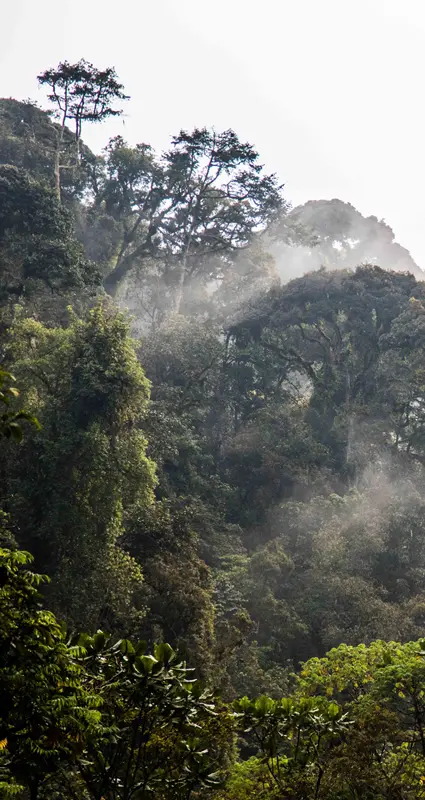
The landscape itself is unforgettable in any season: towering mountain peaks, steep forested hillsides, dense ancient canopies, sun-starved valleys, and a web of streams and swamps that give Nyungwe its primeval, otherworldly atmosphere.
Nyungwe wildlife watching is all about primates and birds.
Nyungwe hosts 13 species of primates, and tourists delight in trekking for chimpanzees and other primates such as Rwenzori pied colobus monkeys (including a mega-troop of over 400 individuals), grey-cheeked mangabey, L'Hoest's, Sykes', silver, red-tailed monkeys, and the olive baboon. Owl-faced monkeys occur here but are hard to locate.
Amongst the 75 mammal species found, notables include Congo clawless otters, servals, golden cats, Lord Derby's scaly-tailed squirrels and the rare Central African linsang (related to genets).
The park also hosts over 1,068 plant species (including 140 orchids adding splashes of colour), of which 250 are endemic to the Albertine Rift.
The bird species tally of 345 includes 29 Albertine Rift endemics. Species to look out for include Albertine owlet, red-collared mountain babbler, Rockefeller's sunbird, mountain masked apalis, Rwenzori turaco, dwarf honeyguide, handsome francolin, Neumann's short-tailed warbler, red-throated alethe and Shelley's crimsonwing.
Your Africa Geographic safari to Nyungwe contributes directly to the conservation of the park to the benefit of local people because:
100% of Nyungwe tourism revenue earned by African Parks goes to the park's conservation efforts and local communities.
We donate a portion of every safari sold to selected conservation efforts at ground level.
Your safari supports our conservation publishing efforts, which educate the world about Nyungwe and other threatened ecosystems.
Our chosen lodges and other service providers support local community initiatives, ensuring that tourism benefits the nearby villages directly. They also adhere to strict environmental practices, such as limited visitor numbers to primate sightings and sustainable camp operations, which help protect the ecosystem.
African Parks has managed Nyungwe since 2010, in a successful partnership with the Rwanda Development Board.
Historically, Nyungwe’s rich fauna and flora were exposed to rampant poaching, illegal mining, unsustainable harvesting and agricultural encroachment, endangering the survival of its rich biodiversity.
The park is now on a strong upward trajectory to restore and protect wildlife, engage with and involve local communities, and develop a strong tourism offering to improve the economic sustainability of the park.
Nyungwe's trails are steep and the forest is wet year-round. Waterproof hiking boots are essential – the park hires hiking shoes on-site if you don't have them. Bring long trousers, a long-sleeved top, a waterproof jacket, a hat, insect repellent, plenty of water, and snacks. Binoculars are useful for both primates and birds. Walking sticks are provided for the canopy walkway. Porter hire is available at the park entrance and is worth considering for longer treks.
Nyungwe has over 100km of marked trails ranging from short forest walks to full-day mountain hikes. The Igishigishigi Trail (2.1km) leads to the canopy walkway at Uwinka. The Bigugu Trail reaches the park’s highest peak, with views across Lake Kivu and into the DRC. The Isumo Trail leads to the park’s largest waterfall through dense forest. Trails vary in difficulty – your guide will advise which suits your fitness level and what you want to see.
Click here to schedule a no-obligation call with one of our Safari Experts or fill in our 2-minute form with your questions. Our team of experts are here to help! Whether you’re curious about the best time to travel, want to hear first-hand about an experience or need help planning your safari.
Explore more African destinations
Start planning your dream safari
Our travel experts will craft a no-obligation itinerary just for you. We have crafted over 5,000 safaris since 1991. Your personal details are protected; we only use this information to contact you.
Why book your safari with us?

Deep Experience & Knowledge
Handcrafted experiential safaris since 1991.
Travel in Africa is about knowing when and where to go, and with whom. A few weeks too early/late or a few kilometres off course, and you could miss the greatest show on Earth. And wouldn’t that be a pity?

Trust & Safety

Make A Difference
We donate a portion of the revenue from every safari sold to carefully selected conservation projects that make a significant difference at ground level.
YOUR safari choice does make a difference - thank you!