

Tailor-made safaris. Since 1991



Odzala-Kokoua: the Congo rainforest reveals its secrets
Odzala-Kokoua National Park at a glance:
Location: Remote northwest of Congo-Brazzaville, Congo Basin | Access from Brazzaville: ~1h45m by scheduled flight to park airstrip, or ~9–10h by tarred N2 highway |
Size: 13,500 km² (1.35 million hectares) | Best time to visit: June–September; January–February (low rainfall) |
Nearest airport: Maya-Maya International Airport, Brazzaville (BZV) | Minimum recommended stay: 5 nights |
Currency: Central African CFA Franc (XAF) | Malaria risk: Yes – prophylaxis compulsory; yellow fever certificate required; visa required |
Why visit Odzala-Kokoua National Park?
Few places on earth reward the effort of getting there quite like Odzala-Kokoua National Park. Buried in the equatorial forests of northern Congo-Brazzaville, it operates on its own quiet, unhurried logic. The smell of Marantaceae plants after overnight rain, the tremor of a silverback gorilla stepping into a sunlit forest clearing, the distant roll of a forest elephant herd crossing the Mambili River: guests who make the journey consistently describe Odzala-Kokoua as one of the most extraordinary wildlife experiences of their lives. Even for seasoned travellers, it is a safari unlike any other.
Odzala-Kokoua covers 13,500 km² of forests, rivers, swamps and savannas in the northern reaches of the Republic of Congo – not to be confused with the neighbouring Democratic Republic of Congo to the east. As a core part of the Congo Basin, the world's second-largest tropical rainforest, the park protects one of the most important and least-visited ecosystems on earth.
Since 2010, African Parks has managed Odzala-Kokoua under a 25-year agreement with the Congolese government, transforming it through law enforcement, community enterprise and a remarkable amnesty programme that converted former poachers into park rangers. The results are visible in every baï: gorilla numbers recovering steadily from the Ebola outbreaks of the 2000s, forest elephants gradually habituating to human presence, and a young Congolese team running a tourism operation with infectious energy and pride. What was once truly off the map is now a safe, functioning and deeply rewarding destination – yet so remote that visitors can spend days exploring over a million hectares of pristine Central African habitat and encounter almost no one else.
5 Reasons We Love Odzala-Kokoua
The Forest Five: Western lowland gorillas, forest elephants, forest buffalo, bongo and giant forest hog are all drawn to Odzala's mineral-rich baïs – and nowhere else in Africa can you watch all five from an elevated treehouse.
Gorillas on their own terms: Odzala's western lowland gorillas are wilder and more arboreal than mountain gorillas in Rwanda or Uganda. A silverback appearing in a sunlit clearing viewed from a raised treehouse is rawer, less managed – more thrilling.
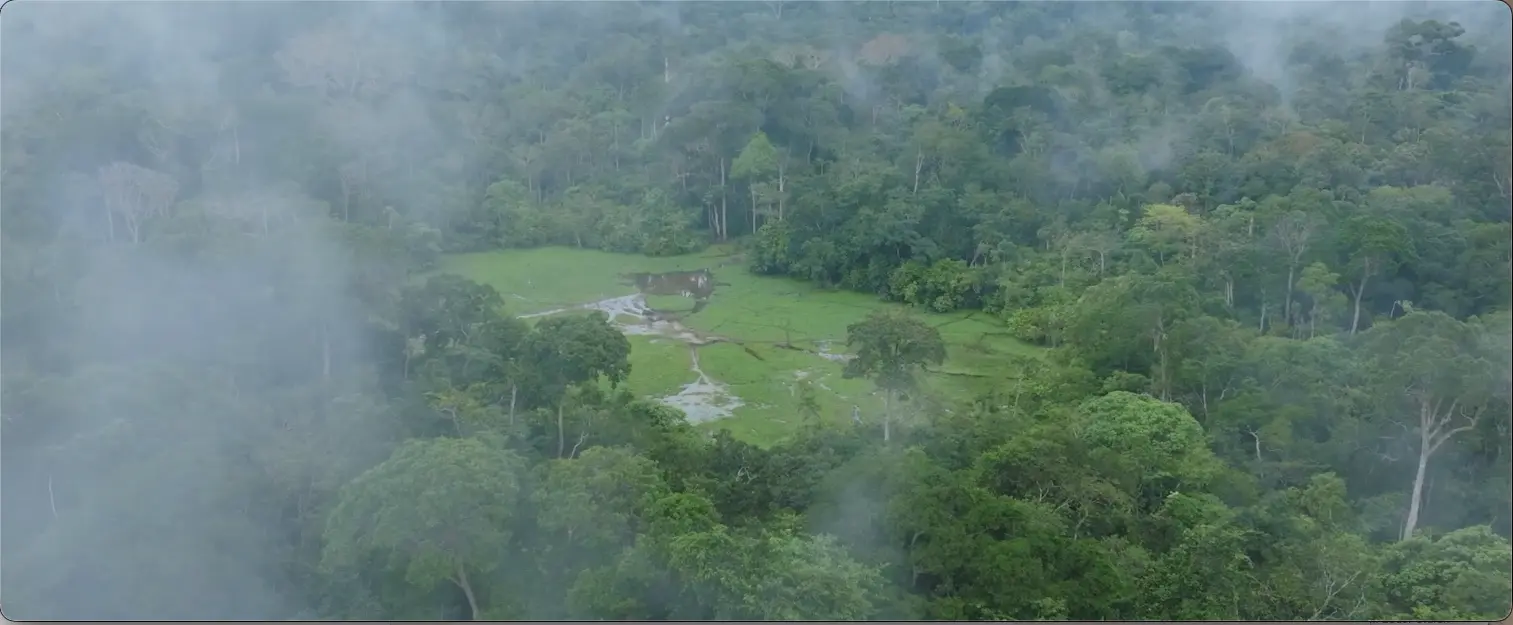
The baïs: Island clearings in the sea of trees, where mineral soils draw grey parrot flocks, feeding gorillas, wallowing forest elephants and shy bongos picking their way to the water's edge.
Biodiversity: 440+ bird species, 100+ mammals, dwarf crocodiles, golden pottos and canopy butterflies – Odzala-Kokoua is a naturalist's paradise.
Solitude in the north: Up to 12 guests, one off-grid lodge in a forest whose nights are defined by sounds your ears cannot yet name.
Our favourite Odzala-Kokoua safari ideas
All you need to know about Odzala-Kokoua
About Odzala-Kokoua
Odzala-Kokoua sits in the remote northwest of Congo-Brazzaville, directly on the equator, embedded in the Congo Basin rainforest – the largest tropical forest in Africa and second only to the Amazon globally. It forms a core component of the TRIDOM Transfrontier Park, a cross-border conservation landscape shared with Gabon and Cameroon, and an integral part of a system protecting tens of millions of hectares of Central African forest.
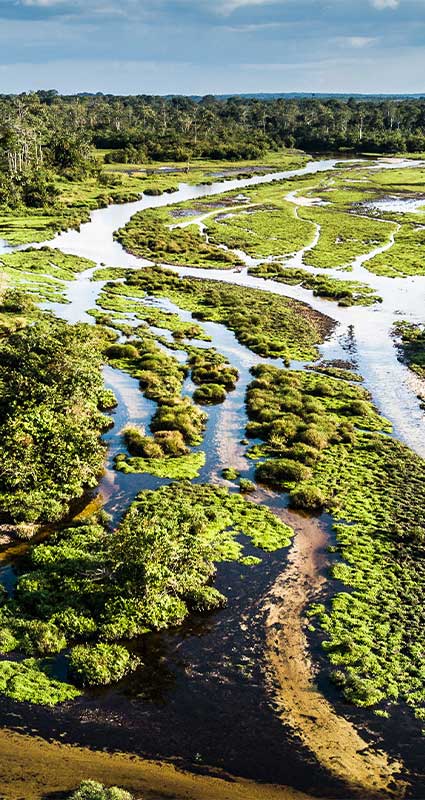
The landscape spans dense primary forest, open Marantaceae forest – named for the arrowroot-family plants forming its distinctive head-high understory – and gallery forest lining the floodplains of the Mambili and Lokoué Rivers, both tributaries of the Congo. Dry savannas dotted with enormous termite mounds mark the forest margins, creating an otherworldly atmosphere. But the defining feature of Odzala is the forest baïs: natural mineral-rich clearings where soils draw wildlife in from miles around – the stage on which most of the park's greatest encounters unfold.
Gazetted in 1935, the park surveys now show stable and recovering populations of both western lowland gorillas and forest elephants. The park belongs to its landscape and its people, and tourism here feeds directly back into both.
Things to do in Odzala-Kokoua National Park
Watch gorillas from a baï treehouse: Three minutes from Camp Imbalanga, an elevated covered lookout overlooks Imbalanga Baï, where wild silverbacks come to feed on grasses and herbs. No time limit, no trek permit or mask required, no hiking. Multiple sightings in a single day are not unusual.
Trek for habituated gorillas: Coming soon: A guided forest trek to spend one hour at close quarters with a habituated lowland gorilla family, the lowland equivalent of the classic mountain gorilla experience.
Day trip to Moba Pool: A 90-minute forest drive and short walk to a larger baï, where forest elephants wallow chest-deep in mineral mud, forest buffalo gather, and flocks of grey parrots and green pigeons descend to drink.
River cruises on the Mambili and Lokoué: Slow motorboat journeys along Congo River tributaries reveal tigerfish, slender-snouted crocodiles, sitatunga, mangabeys, De Brazza's monkeys and exceptional forest waterbirds.
Forest hikes on elephant trails: Expert Congolese guides lead walks through the Marantaceae understory – coloured butterflies, liana water, giant whitewood trees with cathedral buttress roots, and the possibility of an African golden cat.
Night walks: After-dark guided walks from camp for pottos, galagos, dwarf crocodiles and duikers – the forest transforms entirely after the sun goes down.
What animals will I see in Odzala-Kokoua National Park?
Odzala-Kokoua offers huge biodiversity and species unavailable elsewhere - a truly unique wildlife safari. Scientists estimate that the forest is home to some 4,500 plant, over 100 mammal and over 440 bird species, including:
The 'forest 5' - western lowland gorilla, forest elephant, forest buffalo, bongo and giant forest hog.
Other primates such as the common chimpanzee, Demidoff’s galago, grey-cheeked mangabey, moustached monkey, crowned monkey, agile mangabey, De Brazza’s monkey, putty-nosed monkey and Guereza colobus.
And then there are the African golden cat, leopard, serval, spotted hyena, sitatunga, marsh mongoose, red river hog, palm civet, Congo clawless otter, and various duiker species.
The bird species tally of over 440 includes delights such as Hartlaub's duck, Nkulengu rail, spot-breasted ibis, Congo serpent eagle, long-tailed hawk, vermiculated fishing owl, bare-cheeked trogon, white-crested hornbill, chocolate-backed kingfisher, lyre-tailed honeyguide, African piculet, grey parrot, African pitta, rufous-bellied helmetshrike and western bluebill
Where to stay in Odzala-Kokoua
Odzala-Kokoua's accommodation is deliberately limited. Camp Imbalanga, the park's only lodge in the far north, is run by African Parks. This area has the largest lowland gorilla population and is the only place where gorillas can be reliably viewed from elevated treehouses. It is a rustic, fully catered, off-grid tented camp for up to 12 guests. Six ensuite canvas chalets sit on raised decks beneath palm-frond roofs, connected to the central dining room, lounge and firepit by shaded forest paths. The baï lookout is three minutes away along a raised walkway.
The cuisine is authentically Congolese: fish and vegetables wrapped in Marantaceae leaves, manioc and sweet potato, freshly baked bread and dips of ground nuts and smoked catfish. There are no pools, no air conditioning and no Wi-Fi. Camp Imbalanga is built for those who want to be inside the forest.
For the traveller seeking Western-world-standard luxurious accommodation, there are three lodges in the southern part of the park that offer an excellent tourist experience. Ngaga, Lango and Mboko Lodges offer luxurious accommodation and furnishings, as well as excellent gorilla trekking, at significantly higher prices.
Trusted by thousands of ecstatic travellers
✔️ 5-Star Trustpilot Rating ✔️ Condé Nast Travel Specialist Award Winner
✔️ Accredited by SATSA ✔️ 5,000+ Exceptional Safaris Since 1991
Why choose Africa Geographic to plan your safari?

"The organization of our trip to Congo Brazzaville, Odzala N.P. and Camp Imbalanga was exceptional and communication didn't seize after we were on our way... We can only recommend organizing tours with the assistance of the trip advisors of Africa Geographic. A big plus is that a part of the money paid for the trip is utilized for the benefit of the community around the area visited."

"Africa Geographic are the ULTIMATE in African trip planning! Thank you so much for our once in a lifetime experience! ... It was worth every penny spent!! Every detail about this trip were seamless from each meal to every transfer. We have already recommended Africa Geographic to many folks. God bless you all and thank you again for sharing your incredibly beautiful continent!!!"

"Africa Geographic was amazing to work with. They tailored a trip specifically for us based on our wants and needs. They take the time to listen to you and understand what you are looking for from this sometimes once in a lifetime experience. They are professional, courteous, friendly and with you every step of the way. Their job does not end until you are home. If I could give them more than 5 stars I would!"
Wish you were here?
Frequently asked questions
Odzala-Kokoua combines experiences found nowhere else in Africa: watching wild, unhabituated western lowland gorillas from elevated treehouses at mineral-rich forest clearings with no time limit and no trek permit required. Unlike mountain gorilla trekking, the encounter here is rawer and less managed.
Also, observing the "Forest Five" at a single destination: western lowland gorilla, forest elephant, forest buffalo, bongo and giant forest hog.
This is one of the most common questions from guests who have previously tracked mountain gorillas in Rwanda or Uganda. Western lowland gorillas are found in the tropical lowland forests of West and Central Africa. They are slightly smaller than mountain gorillas and, because they live at lower, warmer altitudes, their fur is less dense. Crucially, because their diet is heavily fruit-based, they are significantly more arboreal – spending more time in the trees and constantly on the move through the canopy and forest floor. This makes encounters with them wilder and less predictable than the typically relaxed, ground-level mountain gorilla experience. Watching a western lowland silverback stride into a sunlit baï clearing is a rawer, more instinctive encounter – and many guests who have done both describe it as the more visceral of the two.
A baï (pronounced "bye") is a natural, often swampy clearing in the forest rich in minerals and salts. The word comes from the Mbenga people of the Congo Basin. Baïs are created and maintained by the footfalls of wildlife – particularly forest elephants – digging for nutrient-rich water and grazing on the mineral-laden soil and vegetation. These clearings act as a magnet for a remarkable concentration of species: forest elephants, forest buffalo, bongo, western lowland gorillas, giant forest hog, vast flocks of African grey parrots and green pigeons, sitatunga and much more. They are the defining wildlife-viewing feature of Odzala-Kokoua and the stage on which most of the park's greatest encounters unfold. Guests view wildlife at baïs from elevated covered treehouses, which keep human scent and movement from disturbing the animals below.
Odzala-Kokoua is open year-round and its wildlife does not migrate. Lying directly on the equator, temperatures are stable at 25–28°C throughout the year. There are two drier periods that offer the best general wildlife viewing:
June to September: The primary dry season. Fewer rain days, cooler temperatures, baïs at their most active. Peak season – book 12–18 months ahead.
December to March: A shorter, gentler dry period. Hazy air, lower humidity, good wildlife viewing and typically better availability and rates.
April to June and September to November: The two main wet seasons bring heavier rain and higher water levels. Boating excursions can extend further into the forest, and the equatorial storm skies are spectacular for photography. Gorilla viewing from the baï treehouses continues uninterrupted.
Rain is part of the Odzala experience at any time of year. Waterproofing for cameras, binoculars and luggage, plus two pairs of quick-drying shoes, are non-negotiables.
The headline species is the Critically Endangered western lowland gorilla. Odzala holds the highest gorilla density on the continent, with an estimated 7,500 individuals. The "Forest Five" – gorilla, forest elephant, forest buffalo, bongo and giant forest hog – are all regularly seen at the park's baïs. Common chimpanzees are present throughout the forest, but seldom seen. Other primates include Guereza colobus, grey-cheeked and agile mangabeys, De Brazza's monkeys, moustached monkeys and Demidoff's dwarf galago. Carnivores include leopard (documented on camera traps), African golden cat and serval. Birding is exceptional across 440+ species, including grey parrot, Congo serpent eagle, vermiculated fishing owl, chocolate-backed kingfisher and African pitta.
Gorilla watching (unhabituated gorillas): A 3-minute walk from Camp Imbalanga leads to an elevated covered lookout at Imbalanga Baï. Wild gorillas enter the clearing to feed. No time limit – guests can stay all day, and multiple sightings are common. No trek permit required, no hiking, no masks. This is the signature Odzala experience, available at several baïs across the park.
Gorilla trekking (habituated gorillas): A guided trek through the forest to spend up to one hour with a habituated family group at close quarters. Maximum one visit per day. Hiking through Marantaceae forest is involved. Masks required. A trek permit (~US$400 per person) is required in addition to safari costs. Guests participating in gorilla tracking must also submit a Medical Declaration Form, signed by a doctor, confirming fitness and the absence of TB symptoms, and confirming up-to-date polio and measles vaccinations.
Marantaceae (pronounced mah-ron-tuh-say) is the dense, dark, glossy plant that forms the dominant understory in large parts of the Odzala-Kokoua forest. It belongs to the arrowroot family and grows in thick, head-high stands that can be difficult to penetrate. Western lowland gorillas use Marantaceae as both a food source and as protective cover – it is the vegetation you push through on gorilla treks. Despite its apparent impenetrability, skilled trackers navigate it with ease, hacking a path that regenerates within weeks. The open Marantaceae forest also teems with insect life and is a productive habitat for forest birds and smaller mammals.
All routes begin with a flight to Maya-Maya International Airport, Brazzaville (BZV), served by Air France (via Paris CDG), Ethiopian Airlines (via Addis Ababa), Royal Air Maroc (via Casablanca) and RwandAir (via Kigali).
From Brazzaville, there are two ways to reach the park:
By air (recommended): A scheduled weekly flight on a 12-seat LET L-410 aircraft operated by Air-Tec connects Brazzaville to the park's private airstrip at Mboko. The flight takes approximately 1 hour 45 minutes, departing Brazzaville around 1pm on Mondays and Thursdays. The return departs Mboko at 9am. Baggage is strictly limited to 15kg total per person, including hand luggage; soft bags are strongly recommended. This is the access route used by Kamba lodge guests.
By road: Camp Imbalanga (Ukuri) is accessible via the tarred N2 national highway from Brazzaville, a 9–10 hour transfer of approximately 800 km with a lunch stop in Oyo. The road is in excellent condition; forest elephants and gorillas are often spotted along the roadside in the final stretch, as the route skirts the park boundary.
Yes. A visa is required to enter the Republic of Congo (Congo-Brazzaville). It should be obtained from your nearest Congolese consulate at least 30–45 days before departure. Your tour operator will provide a Letter of Invitation, which is required at immigration – print several copies and carry them in your hand luggage. If obtaining a visa in advance is not possible, a visa on arrival can be arranged through your operator with at least six weeks' notice (an additional fee applies). Ensure your passport has at least two blank pages and is valid for six months beyond your arrival date. Your yellow fever certificate will also be checked at immigration.
Malaria: The park is in a malarial zone. Begin antimalarial medication as recommended by your doctor, typically 2–3 days before departure. Use insect repellent (ideally containing DEET) and consider spraying clothes with permethrin before travel. Wear long sleeves and trousers at dawn and dusk.
Yellow fever: A valid yellow fever vaccination certificate is compulsory for entry into Congo-Brazzaville. The vaccine generally takes around 10 days to become effective – confirm this is complete well ahead of travel.
Gorilla tracking health requirements: Guests participating in gorilla trekking must submit a Medical Declaration Form signed by a doctor, confirming fitness, no TB symptoms, and up-to-date polio and measles vaccinations. A COVID-19 vaccination certificate is also required for gorilla tracking. These requirements exist to protect the gorillas from human-transmitted disease.
Tsetse flies: Present in parts of the park, particularly on river excursions. Wear khaki and light-coloured clothing – tsetse flies are attracted to dark colours.
Water: Do not drink tap water. Filtered water is provided at all lodges; bring a refillable bottle.
Medical emergencies: Odzala-Kokoua is a remote area. Comprehensive travel and medical evacuation insurance is essential. African Parks uses SATIB24 for emergency evacuation from the park.
Guests should be able to walk at a normal pace, unassisted, for more than 8 km (5 miles) and for at least two hours at a time. Terrain is uneven and will likely involve walking through rivers, marshes and dense Marantaceae forest. It is not steep, but it is physically engaging. Gorilla treks in particular require a reasonable level of fitness and agility. If you have any concerns, consult your doctor before booking. The minimum age for all lodges in the park is 15 years, due to the remote location, gorilla trekking requirements and the nature of a rainforest environment.
Yes. Congo-Brazzaville (the Republic of Congo) is a stable, safe and welcoming country for international visitors and should not be confused with the neighbouring Democratic Republic of Congo. Brazzaville is one of the cleanest and safest capital cities in Central Africa – walkable, with colourful markets, French colonial architecture and excellent riverside restaurants. Many Odzala visitors spend one or two nights in the city before and after their safari, which is well worth building into your itinerary. The N2 road to Odzala is in excellent condition, and the park is managed by African Parks with a strong ranger presence throughout. Carry sufficient CFA Francs cash (ATMs in Brazzaville accept Visa), dress conservatively in the city, and ensure you have comprehensive travel and medical evacuation insurance.
Safaris typically cost from US$700 per person per night, all-inclusive of accommodation, all meals, activities, guide services, park fees, airport transfers and 24/7 support from our team. Gorilla trek permits cost approximately US$400 per person per trek and are booked separately; baï gorilla watching does not require a permit. Peak season (June–September) requires 12–18 months advance planning; off-peak trips can be arranged 6–9 months ahead, often with better availability and rates.
All payments are processed through Flywire a leading international payment gateway with high security standards. Contact us for a tailored quote.
A minimum of 5 nights covers the core experiences: multiple baï sessions at Imbalanga, a gorilla trek, a day trip to Moba Pool, a Mambili River cruise and time to absorb the forest atmosphere. Five nights also allows for the unpredictability of wildlife – cloudy mornings can yield extraordinary afternoons.
Seven nights is ideal: it allows for the overnight adventure to Lokoué Baï, additional gorilla sessions, deeper birding and forest hikes, and the unhurried pace the forest rewards. We also recommend adding one to two nights in Brazzaville at the start or end of your trip to enjoy the city and buffer against any flight delays.
Yes, directly and measurably. Odzala-Kokoua is managed by African Parks, and 100% of tourism revenue flows back into conservation and local community development: village liaison teams, mobile health clinics, school environmental education for 1,000+ children annually, and sustainable livelihood programmes. By booking through Africa Geographic, you additionally support our conservation publishing work and the projects we fund through a portion of every safari sold. Your choice to travel here makes a real difference. Thank you.
Click here to schedule a no-obligation call with one of our Safari Experts or fill in our 2-minute form with your questions. Our team of experts are here to help! Whether you’re curious about the best time to travel, want to hear first-hand about an experience or need help planning your safari.
Explore more African destinations
Start planning your dream safari
Our travel experts will craft a no-obligation itinerary just for you. We have crafted over 5,000 safaris since 1991. Your personal details are protected; we only use this information to contact you.
Why book your safari with us?

Deep Experience & Knowledge
Handcrafted experiential safaris since 1991.
Travel in Africa is about knowing when and where to go, and with whom. A few weeks too early/late or a few kilometres off course, and you could miss the greatest show on Earth. And wouldn’t that be a pity?

Trust & Safety

Make A Difference
We donate a portion of the revenue from every safari sold to carefully selected conservation projects that make a significant difference at ground level.
YOUR safari choice does make a difference - thank you!