

Safari experts & storytellers. Since 1991


Trust us to find you the rarest animals, the most spectacular wildlife events, the remotest landscapes and deeply meaningful cultural encounters!
When to See the Great Migration: A Month-by-Month Timing Guide
The Great Migration river crossings peak in August and September at the Mara River on the Kenya–Tanzania border. The calving season peaks in February in Tanzania's southern Serengeti National Park. The migration is a year-round cycle — the best time to visit depends entirely on what you want to see.
This guide answers the specific timing questions asked by travellers who are actively planning a Great Migration safari. Each section opens with a direct answer, followed by the detail you need to make a confident booking decision.
When Do the Mara River Crossings Happen?
Quick answer: The Mara River crossings occur from July to October. The peak is August and September, when wildebeest herds are at maximum density in Kenya's Masai Mara National Reserve.
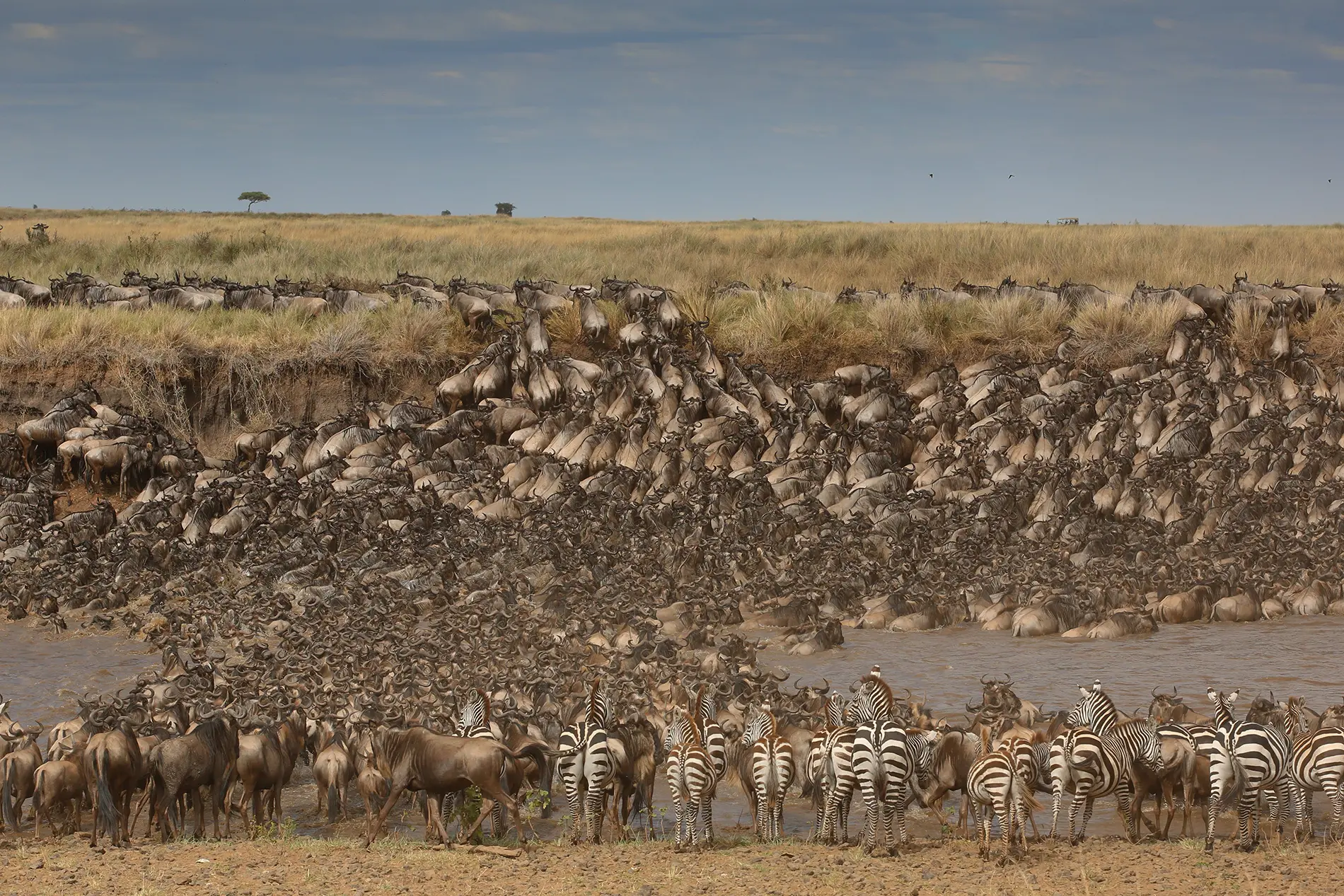
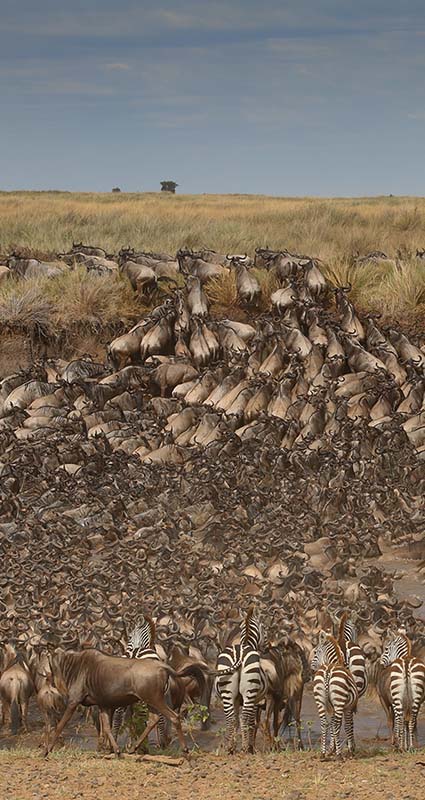
The Mara River crossings are the most requested wildlife spectacle associated with the Great Migration. Approximately 1.5 million wildebeest, along with 400,000 zebra and 200,000 Thomson's gazelle, cross the Mara River between Tanzania's Serengeti National Park and Kenya's Masai Mara National Reserve during this period.
The crossings are not predictable by date. Herds stand at the riverbank for hours or days before crossing, driven by instinct and herd pressure rather than any fixed schedule. They cross, retreat, and re-cross the same point repeatedly. Safari guides monitor herd movements and position vehicles at established crossing points — including the Mara Triangle on the west bank, and the Sand River and Serena crossing points on the east bank — and wait for the herds to move.
Rainfall in Tanzania's Serengeti National Park determines when the herds push north. In drought years, herds reach the Masai Mara as early as June. In wet years, they may not arrive in numbers until August. No operator can guarantee a crossing date, and travellers should be cautious of any who do.
What each month in crossing season offers:
July: Herds assembling in northern Serengeti National Park and pushing into the Masai Mara. First crossings often occur, but the main body may not yet have arrived. Less crowded than August.
August: Peak crossing month. Maximum herd density in the Masai Mara, highest crossing frequency, peak season pricing and visitor numbers.
September: Crossings continue with slightly fewer visitors than August. Strong value relative to peak.
October: Crossings still occur but herds begin moving south as Tanzania's short rains arrive. Herd numbers thinning by late October.
Minimum recommended stay to witness a crossing: four nights at a single crossing-area camp. A one- or two-night stay is a significant gamble.
When Is the Great Migration Calving Season?
Quick answer: The Great Migration calving season peaks in February in the Ndutu area of Tanzania's southern Serengeti National Park. Approximately 500,000 wildebeest calves are born in a six-week window from late January to March.
Calving season produces the highest predator activity of any period in the Great Migration cycle. Lion, cheetah, leopard, and spotted hyena concentrate on the open short-grass plains of Ndutu, hunting abundant newborn calves. The mass calving is an evolutionary strategy called predator saturation — so many animals are born simultaneously that predators cannot consume more than a fraction, ensuring the survival of the majority.
For travellers, this means consistent, high-frequency predator activity in open terrain with excellent visibility. Unlike the Mara River crossings, which require patience and positioning, calving season delivers near-daily action.
Calving season coincides with Tanzania's green season. Safari camp rates are lower, camps are quieter, and the short-grass Ndutu plains are photographically exceptional in the soft early-year light. The Ndutu area sits within the Ngorongoro Conservation Area, adjacent to Serengeti National Park's southern boundary.
Book calving season camps by October for the following February. The best-positioned camps around Ndutu sell out months in advance.
Full Annual Cycle: Great Migration Month by Month
The Great Migration is a continuous, year-round cycle. The table below shows where the herds are, and what travellers can expect, in each period.
Period | Location | What's Happening |
|---|---|---|
Jan – Mar | Southern Serengeti National Park / Ndutu | Calving season; predator density at annual peak; green season rates |
Apr – May | Western corridor, Serengeti National Park | Long rains begin; herds move northwest; lowest visitor numbers; lush landscape |
May – Jun | Grumeti River, western Serengeti National Park | Grumeti River crossings; smaller scale than Mara but far more exclusive |
Jul – Aug | Northern Serengeti National Park / Masai Mara National Reserve | Herds enter Kenya; first Mara River crossings; peak season begins |
Aug – Sep | Masai Mara National Reserve, Kenya | Peak crossing season; maximum herd density; highest visitor numbers |
Oct – Nov | Masai Mara National Reserve / northern Serengeti National Park | Herds return south; short rains arrive; crowds thin, rates soften |
Dec – Jan | Central to southern Serengeti National Park | Herds reach southern plains; build-up to calving |
Should I Go to Kenya or Tanzania for the Great Migration?
Quick answer: Go to Tanzania's Serengeti National Park for calving season (January to March) or Grumeti River crossings (May to July). Go to Kenya's Masai Mara National Reserve for the Mara River crossings (July to October). A combined Kenya and Tanzania itinerary is the most complete option.
Tanzania's Serengeti National Park is where the Great Migration herds spend the majority of the year. The Serengeti covers approximately 14,750 square kilometres and encompasses the full migration corridor from south to north. Tanzania National Parks (TANAPA) enforces stricter vehicle limits per sighting than Kenya's equivalent authorities, resulting in a more exclusive game-viewing experience overall.
Kenya's Masai Mara National Reserve covers approximately 1,510 square kilometres and is where the famous Mara River crossings take place between July and October. The Masai Mara also holds one of the highest resident lion densities in Africa, making it rewarding at any time of year.
A combined Tanzania and Kenya itinerary — pairing northern Tanzania (Serengeti National Park and Ngorongoro Conservation Area) with the Masai Mara National Reserve — is the most complete approach to the Great Migration. This works well as a 10 to 14-day itinerary, particularly during July and August when the herds are in transit between the two countries.
Are the Grumeti River Crossings Worth Seeing?
Quick answer: Yes. The Grumeti River crossings in western Serengeti National Park take place from May to July and are significantly less crowded than the Mara River crossings. The Grumeti River is home to some of the largest Nile crocodiles in Africa.
The Grumeti River crossings are consistently underrated by travellers focused on the Mara River. The wildebeest herds cross the Grumeti River in western Serengeti National Park as they move northwest through the migration corridor between May and July.
The crossings are smaller in scale than those at the Mara River, but the Grumeti offers notable advantages: far fewer safari vehicles, a more remote setting, and resident Nile crocodiles that rival any on the continent in size. Fewer permanent camps operate in the Grumeti area than in the Masai Mara, which keeps visitor numbers low.
The Grumeti crossings suit travellers who want crossing drama with a more exclusive experience, or those whose travel dates fall outside the July to October Mara River window.
Is the Great Migration Worth Seeing During the Rainy Season?
Quick answer: Yes, with conditions. The short rains (October to November) do not significantly disrupt game viewing and offer good value. The long rains (April to May) are more disruptive but offer the lowest rates and fewest vehicles of the year.
East Africa has two rainy seasons, and they are very different in character.
The long rains (April to May) bring sustained rainfall across Tanzania and Kenya. Some Serengeti National Park camps close during this period, and some bush tracks become impassable. Game viewing continues but logistics become more complex. Travellers who go during the long rains encounter dramatically reduced rates, empty camps, and the western corridor herds with virtually no other vehicles present. This period suits experienced, flexible travellers.
The short rains (October to November) typically produce brief afternoon showers that do not significantly affect game viewing. The Masai Mara National Reserve and northern Serengeti National Park remain fully operational. Rates soften as peak season ends and visitor numbers drop. October in the Masai Mara — as the herds begin their return south — can represent excellent value. Safari operators frequently recommend the short rains as one of the best-value periods of the migration year.
What Is the Least Crowded Way to See the Crossings?
Quick answer: Viewing the Mara River crossings from the Tanzania side — specifically the Lamai Wedge or Kogatende area of northern Serengeti National Park — offers the same crossings as the Kenyan side with significantly fewer vehicles, due to Tanzania National Parks' (TANAPA) strict vehicle limits per sighting.
The Mara River forms the boundary between Kenya's Masai Mara National Reserve and Tanzania's Serengeti National Park. Crossings occur along the full length of the river, on both sides of the border.
On the Kenyan side, particularly at high-volume crossing points such as the Mara Triangle and the Serena and Sand River crossings, peak-season crossings can draw a large number of safari vehicles. On the Tanzania side, TANAPA regulations restrict the number of vehicles permitted at any single wildlife sighting. Fewer safari camps operate in the Lamai Wedge and Kogatende area, keeping overall visitor density lower.
Travellers who prioritise exclusivity at the crossings should book camps in the northern Serengeti National Park on the Tanzania side of the river.
Common Misconceptions About Great Migration Timing
"The Great Migration happens at a fixed time each year." This is false. The migration is driven by rainfall patterns, which vary year to year. The herds can arrive at the Mara River weeks earlier or later than the previous year depending on conditions in Tanzania's Serengeti National Park. Historical patterns provide a reliable general framework, but not a fixed calendar.
"You can plan a single day to see a crossing." This is false. The Mara River crossings cannot be scheduled or predicted within a single day. Herds may wait at the riverbank for multiple days before crossing. A minimum stay of four nights at a crossing-area camp is the widely recommended minimum for a reasonable chance of witnessing a crossing.
"The Masai Mara is the only place to see the Great Migration." This is false. The Great Migration takes place across a circuit of approximately 800 kilometres within Tanzania's Serengeti National Park and Kenya's Masai Mara National Reserve. Tanzania hosts the herds for the majority of the year, including the calving season in February and the Grumeti River crossings from May to July.
"The rainy season means no game viewing." This is false. Tanzania's short rains (October to November) produce brief afternoon showers that do not meaningfully affect game viewing. Even the long rains (April to May) do not stop the migration — the herds continue moving and wildlife remains active throughout.
"August is always the best month." August is the most statistically reliable month for Mara River crossings. It is not always the best month for every traveller. Calving season in February consistently delivers higher volumes of predator activity. The Grumeti crossings in June can be equally dramatic with a fraction of the vehicles. The "best" month depends entirely on what the traveller wants to experience.
Key Timing Decisions at a Glance
To see Mara River crossings: Travel in August or September. Stay a minimum of four nights at a single crossing-area camp. Consider the Lamai Wedge or Kogatende in northern Serengeti National Park for fewer vehicles.
To see calving season and predator action: Travel in February to the Ndutu area of Tanzania's southern Serengeti. Book by October for the following February — camps sell out.
For value and fewer crowds: Travel in October to November (short rains) in Kenya's Masai Mara or Tanzania's Serengeti, or April to May (long rains) in Tanzania.
For the most complete migration experience: Combine northern Tanzania (Serengeti National Park, Ngorongoro Conservation Area) with Kenya's Masai Mara National Reserve in a 10 to 14-day itinerary during July or August.
For crossing drama without Mara crowds: Target the Grumeti River in May to June, or the Lamai Wedge in northern Serengeti National Park in July to September.

Why choose us to craft your safari?
Handcrafted experiential safaris since 1991.
Travel in Africa is about knowing when and where to go, and with whom. A few weeks too early/late or a few kilometres off course, and you could miss the greatest show on Earth. And wouldn’t that be a pity?

Trust & Safety

Make a difference
We donate a portion of the revenue from every safari sold to carefully selected conservation projects that make a significant difference at ground level.
YOUR safari choice does make a difference - thank you!