
Safari experts & storytellers. Since 1991


Trust us to find you the rarest animals, the most spectacular wildlife events, the remotest landscapes and deeply meaningful cultural encounters!
Best Time to See the Great Migration in Tanzania & Kenya
The best time to see the Great Migration depends on the safari experience you want.
January to March: Calving season in Tanzania’s southern Serengeti
April to June: Large herds moving through central and western Serengeti
July to October: Mara River crossings in northern Serengeti and Kenya’s Maasai Mara
November to December: Return migration, greener landscapes and fewer crowds
The Great Migration is not a single event that happens at a fixed time each year. It is a continuous movement of more than 1.5 million wildebeest, zebra and gazelle through Tanzania’s Serengeti ecosystem and Kenya’s Maasai Mara, driven almost entirely by rainfall and grazing conditions.
For travellers planning a safari around the migration, the real question is not “When is the migration?” but rather “Which phase of the migration do I want to experience?”
Some travellers prioritise dramatic Mara River crossings. Others want calving season predator action, quieter camps, fewer safari vehicles or better seasonal value. Understanding the timing of each migration phase is what ultimately leads to the best safari experience.
Great Migration Month-by-Month Guide
Months | Main Migration Area | Best For |
|---|---|---|
January – March | Southern Serengeti & Ndutu | Calving season and predators |
April – June | Central & Western Serengeti | Large herds and fewer crowds |
July – October | Northern Serengeti & Maasai Mara | Mara River crossings |
November – December | Eastern & Southern Serengeti | Return migration and value |
When Is the Great Migration in Tanzania?
Tanzania offers the longest and most varied Great Migration experience because the herds spend most of the year within the Serengeti ecosystem.
For travellers wanting flexibility and diversity, Tanzania is often the strongest overall migration destination.
January to March: Calving Season in Southern Serengeti
January to March is the best time to see the wildebeest calving season in Tanzania.
During these months, the migration gathers on the short-grass plains of the southern Serengeti and Ndutu region, where nutrient-rich grazing supports the birth of hundreds of thousands of calves. February is usually the peak calving month.
For experienced safari travellers, this is one of the most rewarding phases of the migration. Lions, cheetahs, hyenas and leopards concentrate around the newborn herds, creating extraordinary predator sightings across open plains washed green by the seasonal rains.
Best for:
Predator action
Wildlife photography
Green-season safaris
Fewer crowds than peak river crossing season
The migration is overwhelmingly concentrated in Tanzania during this period, making Kenya less reliable for migration safaris early in the year.
When Do the Mara River Crossings Happen?
The Mara River crossings usually happen between July and October.
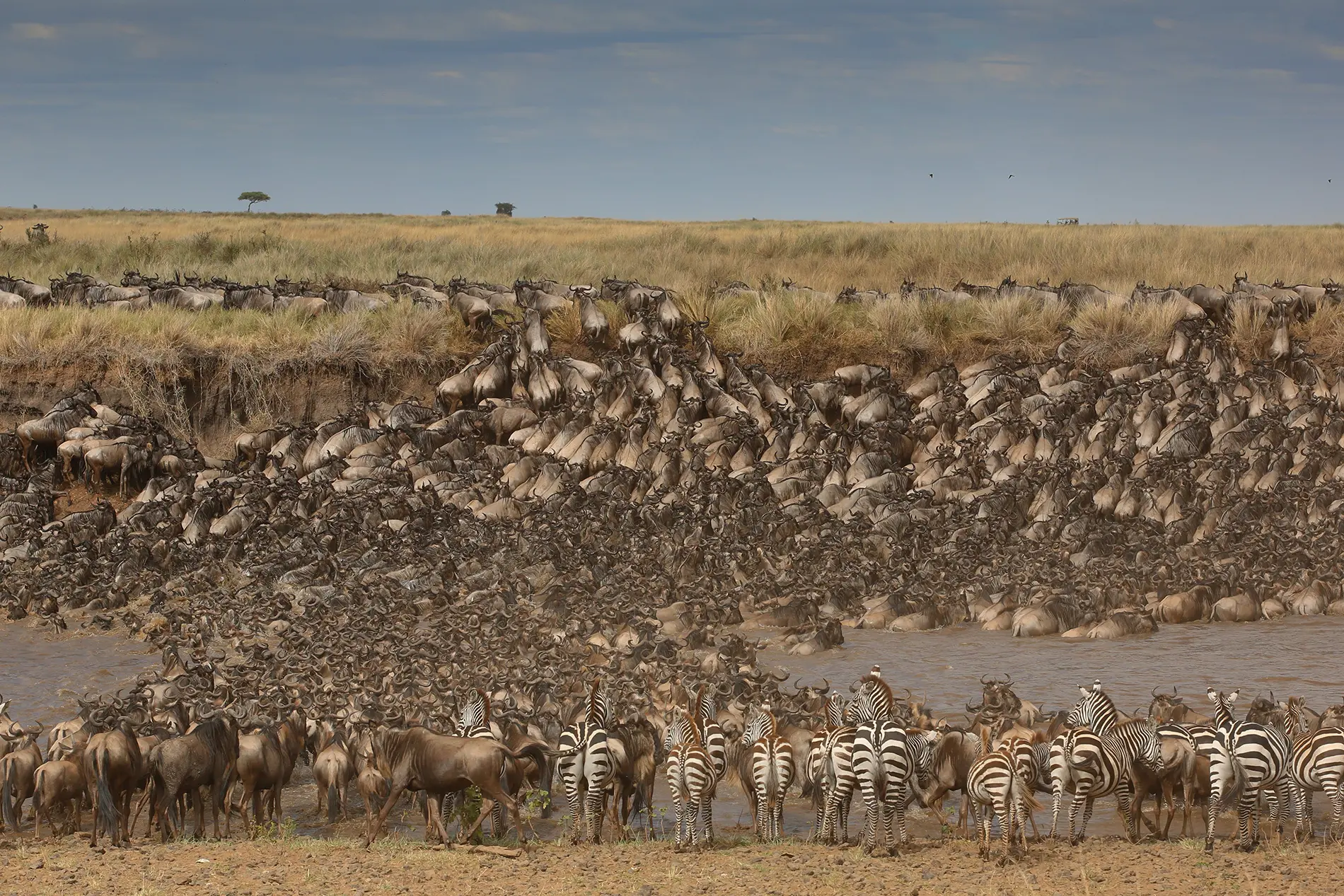
This is the phase most travellers imagine when they picture the Great Migration: long columns of wildebeest gathering nervously along steep riverbanks before plunging into crocodile-filled waters.
As the dry season intensifies, the herds move north through Tanzania’s northern Serengeti toward Kenya’s Maasai Mara. August and September are typically considered the peak crossing months, although exact timing changes every year depending on rainfall patterns.
River crossings are never guaranteed because wildebeest movements follow rain and grazing conditions rather than fixed calendar dates.
Some herds may cross multiple times in one day. Others may wait at the river for days before moving.
Best for:
Mara River crossings
Dry-season safaris
Iconic migration photography
Dense wildlife concentrations
Is Kenya or Tanzania Better for the Great Migration?
Kenya and Tanzania offer very different migration experiences. The best choice depends on what type of safari you want.
Choose Kenya for:
Classic Maasai Mara crossings
Easier logistics
Shorter safari itineraries
Peak migration concentrations in August and September
Choose Tanzania for:
Longer migration presence
Larger wilderness areas
Fewer safari vehicles
More varied migration phases throughout the year
Many experienced safari travellers increasingly favour northern Serengeti camps during crossing season because they often offer a less congested wildlife experience than the Maasai Mara during peak migration months.
What Happens During April to June?
April to June is one of the most underrated periods for Great Migration safaris. As the rains move through East Africa, the herds begin pushing north through central Serengeti and into the western corridor. By May and June, large wildebeest concentrations often gather near the Grumeti River.
This is a transitional phase of the migration, shaped heavily by rainfall patterns and therefore less predictable than the river crossing season further north.
For many safari travellers, however, this period offers an excellent balance between strong migration sightings and lower visitor numbers.
Best for:
Large herds
Quieter safari camps
Better seasonal value
Fewer vehicles
Travellers wanting a more relaxed migration safari without peak-season congestion should strongly consider this period.
Is November a Good Time for the Great Migration?
Yes. November can be an excellent time to see the Great Migration with fewer crowds and lower safari prices.
As the short rains begin, the herds gradually move south from Kenya through the eastern Serengeti toward the southern plains. The landscapes begin turning green again, resident wildlife remains excellent, and safari traffic is significantly lighter than during the peak dry season months.
For travellers prioritising space, value and quieter wildlife experiences, November is often one of the smartest times to travel.
Best for:
Lower safari rates
Fewer vehicles
Green landscapes
Strong general game viewing
Are Mara River Crossings Guaranteed?
No. No safari operator can guarantee a river crossing on a specific date.
The Great Migration is driven by rainfall and grazing conditions, which means herd movements vary every year. Even highly experienced guides cannot predict exact crossing days months in advance.
Travellers planning a migration safari should focus less on chasing precise crossing dates and more on:
travelling during the most likely migration window,
choosing the correct safari region,
and spending multiple nights in one area.
In practice, this usually leads to a far better safari experience.
Great Migration Timing Quick Answers
Best months for river crossings: August and September
Best month for calving season: February
Best time for fewer crowds: May, June and November
Best time for predator sightings: January to March
Best overall country for migration diversity: Tanzania
Best for classic Mara River crossings: Kenya
Are river crossings guaranteed? No
Final Thoughts on Great Migration Timing
There is no single “best” month for the Great Migration.
The best time depends entirely on whether you prioritise river crossings, calving season, predator sightings, photography, fewer crowds or seasonal value.
Travellers who understand the broader seasonal movement of the migration almost always have a better safari experience than those focused on a single crossing moment.
For some, the defining memory will be thousands of wildebeest crossing the Mara River beneath towering dust clouds. For others, it will be the stillness of the southern Serengeti during calving season, when predators shadow newborn herds across rain-soaked plains.
Understanding the migration's rhythm — rather than chasing a fixed date — is what ultimately leads to the most rewarding safari.

Why choose us to craft your safari?
Handcrafted experiential safaris since 1991.
Travel in Africa is about knowing when and where to go, and with whom. A few weeks too early/late or a few kilometres off course, and you could miss the greatest show on Earth. And wouldn’t that be a pity?

Trust & Safety

Make a difference
We donate a portion of the revenue from every safari sold to carefully selected conservation projects that make a significant difference at ground level.
YOUR safari choice does make a difference - thank you!