

Tailor-made safaris. Since 1991



Makgadikgadi: vast salt pans & migrating herds
Makgadikgadi Pans at a glance:
Location: north-eastern Botswana, Kalahari Basin | Access: via Maun and Kasane Airports to several light-aircraft bush-landing strips. Road access via Nata & Gweta |
Pan system: roughly 16,000 km² of salt flats and desert | National parks: Makgadikgadi Pans NP (3,900 km²) & Nxai Pan NP (2,590 km²) |
Best time to visit: The zebra migration: December–March, and salt pan walks & quad-biking: April–October | Signature sightings: zebra, meerkats, flamingos, big cats |
Key dry-season water: Boteti River | Malaria: high-risk zone, prophylaxis recommended year-round |
Why visit Makgadikgadi salt pans?
In the heart of northern Botswana lies a landscape so vast and still that it seems to bend time itself. The Makgadikgadi Pans are the dried bed of an ancient super-lake — a shimmering expanse of salt-crusted clay, fringed by golden grasslands and solitary baobabs. For travellers willing to reach this remote corner of the Kalahari, the reward is a profound sense of space and silence found in few other places on the continent.
Yet this apparent emptiness is deceptive. When the summer rains arrive, the parched flats are transformed into nutritious grasslands that draw tens of thousands of zebras and wildebeest, trailed by lions, cheetahs and wild dogs. Flamingos gather on the flooded pans, while elephant, giraffe and oryx move through the surrounding savanna.
This is a destination of contrasts: desert and wetland, isolation and abundance, deep human history and untamed wilderness. Whether you come to walk the salt flats beneath star-filled skies, sit among habituated meerkats, or witness one of Africa's great migrations, the Makgadikgadi rewards those who slow down and surrender to its scale.
5 Reasons We Love the Makgadikgadi Pans
Zebra migrations: Witness one of Africa's longest land migrations as more than 20,000 zebras pour into the Nxai Pan and Makgadikgadi grasslands each green season, shadowed by hungry Kalahari predators.
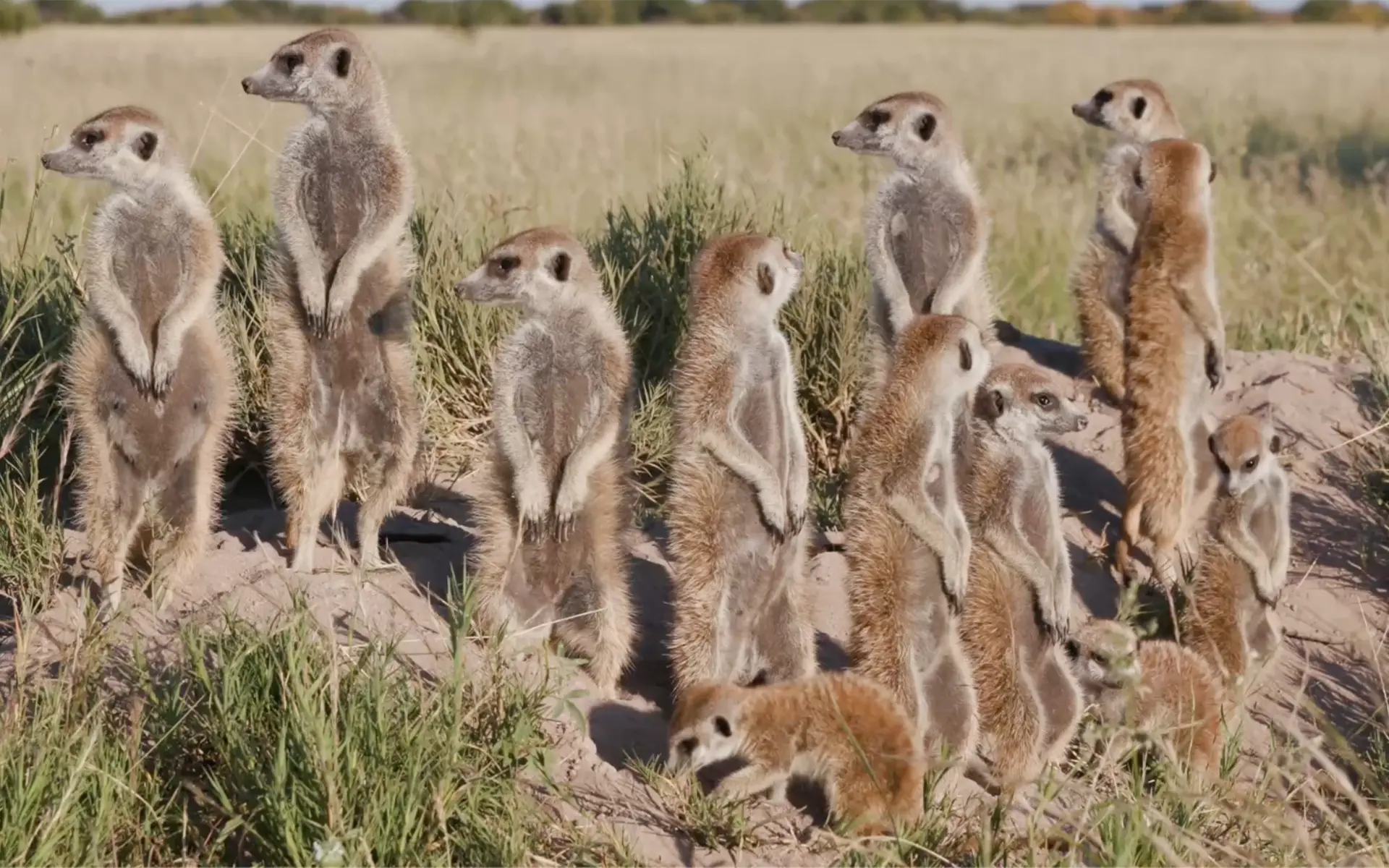
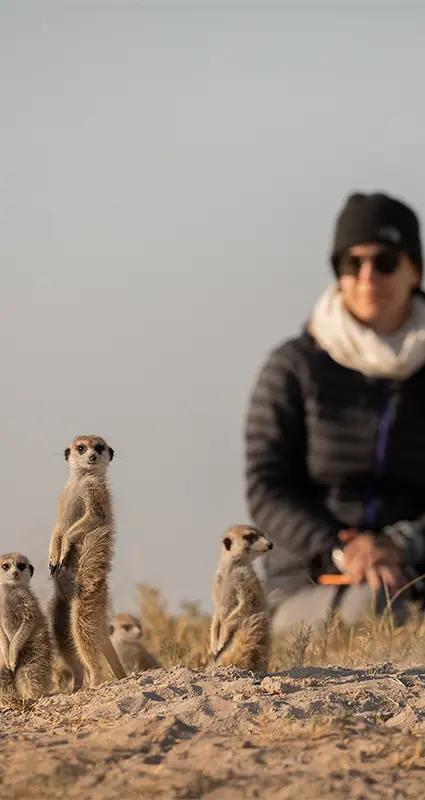
Habituated meerkats: Sit at eye level with habituated meerkat families that treat patient visitors as part of the scenery, occasionally climbing onto a still shoulder to gain a better vantage point.
The salt-flat wilderness: Walk, quad-bike or sleep out on a horizon-to-horizon expanse of cracked salt, where the silence is absolute and the night skies rank among the clearest and darkest on the Planet.
Baobabs and deep history: Stand beneath the ancient baobabs of Kubu Island and Baines' Baobabs — landmarks steeped in human history at a place some scientists regard as a cradle of humankind.
Flamingos and birdlife: In years of good rain, watch flamingos turn the flooded pans pink alongside pelicans, wattled cranes and a host of migrant waterbirds at the Nata Bird Sanctuary.
Our favourite Makgadikgadi Pans safari ideas
All you need to know about Makgadikgadi
About Botswana's salt pans
The Makgadikgadi is not a single pan but a sprawling complex of salt flats separated by sandy desert and rolling grassland, covering roughly 16,000 km² of the Kalahari Basin. The largest are Sua (Sowa), Ntwetwe and Nxai pans. They are all that remains of Lake Makgadikgadi — a paleolake once larger than Switzerland, fed by the Okavango River before tectonic shifts cut off its supply and it evaporated tens of thousands of years ago.
Today, much of this wilderness is protected by two adjoining national parks: the 3,900 km² Makgadikgadi Pans National Park and the 2,590 km² Nxai Pan National Park to its north. The Boteti River traces the western boundary of the Makgadikgadi park and is the area's only permanent water source through the dry months. Rising from Sua Pan, the granite outcrop of Kubu Island, crowned with ancient baobabs, is a national monument and a sacred site. Stone tools scattered across the pans speak to deep human history; some researchers consider this region a cradle of our species.
What wildlife will I see in the Makgadikgadi Pans?
The Makgadikgadi's wildlife rhythm is dictated by water. During the green season, the pans and grasslands host one of Africa's great gatherings of zebra and wildebeest, drawn by mineral-rich grasses and shadowed by predators. Once the herds disperse, resident game and a remarkable cast of desert-adapted species remain.
Highlights include:
Plains wildlife such as elephant, springbok, giraffe, oryx (gemsbok), eland and red hartebeest.
Large predators include black-maned Kalahari lion, leopard, cheetah, wild dog (painted wolf), and both brown and spotted hyena.
Smaller carnivores like the bat-eared fox, black-backed jackal, aardwolf, aardvark and the elusive striped polecat.
Habituated meerkats, which may use a visitor as a lookout post.
Spectacular birdlife when the pans flood. Greater and lesser flamingos, great white and pink-backed pelicans, wattled cranes, avocets, spoonbills and secretary birds. The community-run Nata Bird Sanctuary on the northern edge of Sua Pan protects one of southern Africa's most significant flamingo breeding sites.
Where to stay in the Makgadikgadi Pans
Accommodation ranges from traditional lodges to romantic, vintage-styled tented camps, clustered in three areas:
On palm-fringed islands amongst the Makgadikgadi central pans sit three sister camps: the classically elegant Jack's Camp, the intimate and seasonal San Camp, and the more relaxed Camp Kalahari. Each offers activities found nowhere else in Botswana, from quad-biking the salt flats to walking with San trackers and meeting habituated meerkats.
On the fringes of Nxai Pan sits Nxai Pan Camp, a traditional thatched lodge and the only permanent camp in Nxai Pan National Park. This lodge is well-situated for the zebra migration and for visiting Baines' Baobabs.
Along the Boteti River, on the western edge of the salt pans, Meno A Kwena and Leroo La Tau overlook the water that draws wildlife throughout the dry season.
Because the region is remote and its activities immersive, most camps recommend a stay of at least three nights.
Trusted by thousands of ecstatic travellers
✔️ 5-Star Trustpilot Rating ✔️ Condé Nast Travel Specialist Award Winner
✔️ Accredited by SATSA ✔️ 5,000+ Exceptional Safaris Since 1991
Why choose Africa Geographic to plan your safari?

We booked 5 accommodations and 4 Okavango Delta domestic flights. The experiences and animal observations were very special and unique ... The lodges and camps were all of excellent quality, and the staff were very well trained ... All in all, we had a wonderful trip and will definitely book with Africa Geographic again.

Africa Geographic delivers dreams. We spent just over 3 weeks in Namibia, Botswana and Vic Falls this summer. Delivering the holiday of a lifetime starts with imagination and expert planning by someone who really knows where you are going and thoughtfully adds in all the little extras to make it more than just an ‘off the shelf’ holiday....

AG arranged the perfect trip to Botswana for my family. The consultant really listened to our brief and arranged an awesome itinerary within our budget. All transports were on time - we did not have a single hiccup or moment of stress ... I have travelled a lot, and this would be one of my greatest travel experiences. Thanks Africa Geographic for organising it!
Wish you were here?
Frequently asked questions
The Makgadikgadi is one of the largest salt-flat systems on Earth and the bed of an ancient lake that once rivalled Switzerland in size. It pairs an extraordinary sense of emptiness and silence with seasonal wildlife spectacles, baobab-studded islands and some of the continent's darkest night skies.
The best time to visit depends on what you want to see. The green season, roughly December to March, brings the zebra migration, newborn antelope, flamingos and lush grasslands, though the pans themselves can become largely inaccessible. The dry months, from April to October, are best for walking, quad-biking and stargazing on the hard salt flats, with wildlife concentrating along the Boteti River.
Botswana's salt pans lie in north-eastern Botswana and are most often reached via Maun, the regional safari hub, with overland access also possible between Nata and Maun, or from Gweta. Many lodges arrange light-aircraft transfers or guided road transfers as part of a safari, which is the simplest way to reach the more remote camps.
Botswana hosts two major zebra migrations centred on the Makgadikgadi–Nxai Pan ecosystem. The Chobe–Nxai Pan migration is a round trip of over 1,000km, recognised as one of Africa's longest land migrations. The Okavango–Makgadikgadi migration covers around 500km. Both were revived after veterinary fences blocking ancient routes were moved in the mid-2000s. Read more about Botswana's zebra migrations.
The best time to see zebras feeding on the green grasses of the Makgadikgadi ecosystem is during the rains, from about December to March. More than 20,000 zebras typically disperse across Nxai Pan National Park from December to February, with March being when the herds mass for their return journey. This coincides with Botswana's quieter, lower-cost low season.
Yes. The central pans are famous for groups of habituated meerkats that have grown accustomed to people. They go about their daily routines unbothered by visitors and, lacking tall vantage points on the open flats, will sometimes climb onto a human to scan for predators.
Beyond the migratory zebras and habituated meerkats, the Botswana salt pans region supports resident springbok, impala, giraffe, oryx, eland, hartebeest and elephant. Predators include black-maned Kalahari lions, leopard, cheetah, wild dog and hyena, alongside bat-eared foxes, aardwolves and aardvarks. When the pans flood, birdlife is exceptional, with flamingos, pelicans and many waterbirds.
In years of good rainfall, the flooded pans attract large numbers of greater and lesser flamingos. The community-managed Nata Bird Sanctuary on Sua Pan protects one of the most important flamingo breeding sites in southern Africa, making the wet season a remarkable time for birders.
Activities vary by camp and season but typically include game drives, guided walks, meerkat encounters and cultural experiences with San communities. In the dry season, when the flats are firm, many camps offer quad-biking expeditions, sleep-outs under the stars and exceptional stargazing.
Horseback safaris and visits to Kubu Island and Baines' Baobabs are available at some properties.
Kubu Island is a granite outcrop rising from the flat expanse of Sua Pan, studded with ancient baobab trees. It is a Botswana national monument and a sacred site for the region's indigenous people, and is scattered with stone relics that point to its long human history.
Baines' Baobabs are a cluster of large baobab trees in Nxai Pan National Park, made famous by the 19th-century British artist Thomas Baines, who painted them while travelling through the Kalahari. The trees stand near Kudiakam Pan and remain remarkably unchanged, more than 160 years later.
Yes, the Makgadikgadi pairs naturally with Botswana's other great wilderness areas. The Okavango Delta lies to the west and the Chobe River and floodplains to the north, both linked to the Makgadikgadi by the same zebra migration routes. Combining the pans with the Delta or Chobe makes for a varied, contrast-rich Botswana itinerary.
Our safaris typically cost from US$700 per person, per night, depending on the accommodation comfort level, time of year and activities. This price usually includes accommodation, all meals, game drives, experienced guides, airport transfers, and 24/7 support from our team.
You only make your first payment when you book your holiday. Your second (last) payment is about 105 days before you travel.
Peak season bookings require 12–18 months of advance planning. Trips outside of peak season can be arranged 6–9 months ahead, with better rates and availability.
Click here to schedule a no-obligation call with one of our Safari Experts or fill in our 2-minute form with your questions. Our team of experts are here to help! Whether you’re curious about the best time to travel, want to hear first-hand about an experience or need help planning your safari.
Explore more African destinations
Start planning your dream safari
Our travel experts will craft a no-obligation itinerary just for you. We have crafted over 5,000 safaris since 1991. Your personal details are protected; we only use this information to contact you.
Why book your safari with us?

Deep Experience & Knowledge
Handcrafted experiential safaris since 1991.
Travel in Africa is about knowing when and where to go, and with whom. A few weeks too early/late or a few kilometres off course, and you could miss the greatest show on Earth. And wouldn’t that be a pity?

Trust & Safety

Make A Difference
We donate a portion of the revenue from every safari sold to carefully selected conservation projects that make a significant difference at ground level.
YOUR safari choice does make a difference - thank you!