
Tailor-made safaris. Since 1991


Kwando & Linyanti: wild exclusivity at its best
Kwando & Linyanti at a glance:
Location: Far north of Botswana, between Chobe National Park to the east and the Okavango to the south | Access: Light aircraft only; accessible via scheduled charters from Maun and Kasane |
Kwando Reserve: 232,000 hectares with only two safari camps | Linyanti Reserve: 125,000 hectares, remote, unfenced, accessible only to lodge guests |
Best time to visit: June–October (dry season, peak wildlife concentration) | Activities: Game drives, night drives, guided walks, boating, fishing, canoeing, sleep-outs in hides |
Wildlife highlights: African wild dog, elephant, buffalo, lion, leopard, cheetah, sable antelope, roan antelope | No fences: animals move freely between the reserves and the surrounding national parks |
Why visit Kwando & Linyanti?
In the far north of Botswana, where the Kwando and Linyanti rivers flow south from Angola and form a V-shape border with Namibia, two of Africa's most remote and rewarding private reserves occupy a stretch of wilderness that few travellers ever reach, and fewer still forget. The Kwando Reserve and the Linyanti Reserve share a northern frontier, a permanent water supply, and a reputation for wildlife encounters that consistently rank among the finest on the continent.
What makes this area distinctive is not only what lives here, though the wild dog packs, the massive elephant herds, and the density of predators are extraordinary, but the conditions under which you encounter it. There are no fences between the reserves and the surrounding national parks. Animals move freely across this landscape, following water and grazing as the seasons shift. When the dry season draws wildlife from across northern Botswana toward the permanent waters of the Kwando and Linyanti Rivers, the resulting concentrations are among the most dramatic wildlife spectacles in Africa.
The Kwando Reserve covers 232,000 hectares and has only two safari camps within its boundaries. The Linyanti Reserve covers 125,000 hectares and is accessible only to guests of its small collection of intimate camps. In both reserves, the limited number of visitors is not a logistical constraint: it is the point. The Botswana Tourism Organisation describes the feeling this area evokes as one of extreme isolation and complete removal from the world, where camps host perhaps only twenty or so guests at a time: just you, the bush, and a remarkable assembly of wild animals waiting to be discovered.
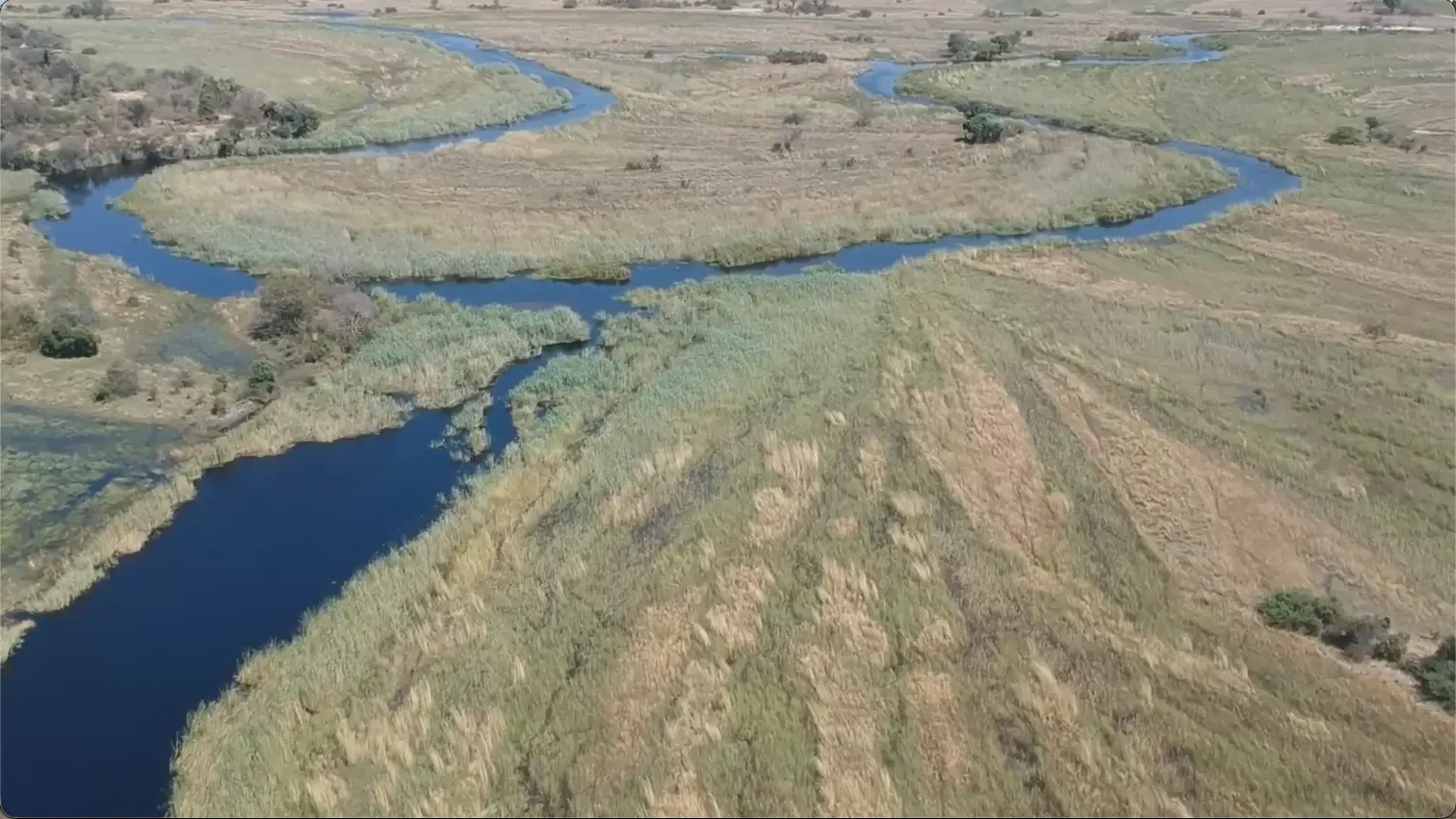
The terrain varies across both reserves. In the Kwando, the Kwando River flows along the eastern boundary, with the Linyanti Marshes defining the southern edge. Habitats range from riverine forests, marshes, and vast floodplains to islands of Borassus palms and patches of wooded savannah. In the Linyanti, riverine woodland atop high sandy banks overlooks the floodplain below, with the landscape shaped by the behaviour of the Linyanti River and the extraordinary, historically erratic Savute Channel.
5 Reasons We Love Kwando & Linyanti
Predators: Kwando and Linyanti are especially known for their large populations of wild dogs, lions, leopards, cheetahs, spotted hyenas, African wildcats, and servals.
Permanent water year-round: The Kwando and Linyanti Rivers form the border with Namibia, providing reliable water even during the dry season, when wildlife concentrations are unusually high.
Absolute exclusivity: The Kwando Reserve has just two safari camps within its 232,000 hectares, and Linyanti Reserve's handful of intimate camps serve a small number of guests at any one time. This translates directly into what most travellers struggle to find anywhere: genuine exclusivity.
A wider range of activities than national parks allow: As private reserves, Kwando and Linyanti permit off-road driving, night drives, guided walks, boating, fishing, and sleep-outs in hides; activities not available in adjacent national parks.
Landscapes that rival the Okavango: The picturesque channels, lagoons, papyrus stands, reedbeds, and majestic riparian forest lining the waterways are as beautiful as those of the more famous Okavango Delta, with fewer visitors.
Our favourite Kwando | Linyanti safari ideas
All you need to know about Kwando & Linyanti
About Kwando & Linyanti
The Kwando and Linyanti Reserves sit in the extreme north of Botswana, occupying a corridor between Chobe National Park to the east and the Okavango to the south. The Kwando River, flowing south from Angola across the Caprivi Strip into Botswana, forms a border with Namibia as it runs along the eastern boundary of the Kwando Reserve. The Linyanti River, which the Kwando flows into, where these ecosystems meet, forms another border with Namibia and gives rise to the Linyanti Marshes and Swamps.
These swamps carry magnificent natural history: channels, lagoons, papyrus stands, and reedbeds, lined by riparian forest with majestic, towering trees. The Kwando Reserve is 232,000 hectares and hosts only two camps. The Linyanti Reserve extends across 125,000 hectares. Both are unfenced, allowing unrestricted movement between the reserves and the adjacent national parks. The dry season window of June to early November is when wildlife concentrations are at their most intense, as permanent river water draws animals from across the region. Guests arrive by light aircraft only.
Things to do in Kwando & Linyanti
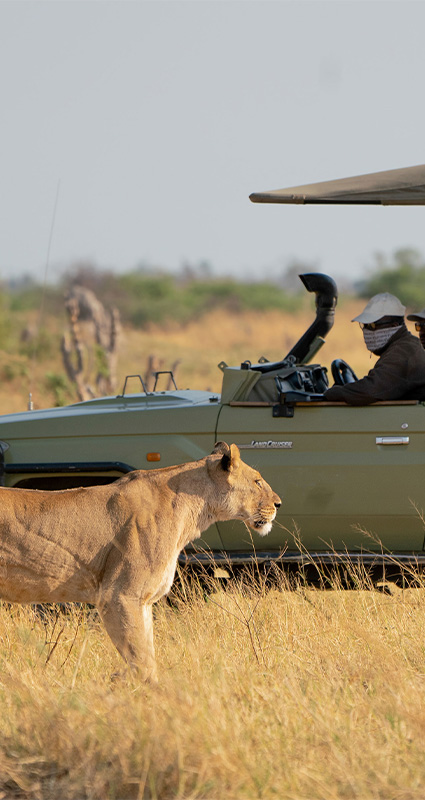
Game drives and night drives: Morning and evening drives through the floodplains, woodland, and along the rivers form the core of any stay. Night drives, not permitted in adjacent national parks, reveal the full nocturnal range of predators and smaller wildlife.
Guided walking safaris: Expert guides lead walks through the riverine forest and open habitats of both reserves, reading tracks and engaging directly with the landscape in ways that a vehicle cannot replicate.
Boat safaris: The navigable Kwando and Linyanti Rivers add a water-based dimension to the safari, providing a different perspective on the riverine habitat and the wildlife that uses it. Drifting slowly down the wide rivers allows relaxed encounters with elephants, hippos, crocodiles and many bird species.
Mokoro: The Linyanti's quieter channels offer guests outings in traditional dugout canoes. Gliding silently past water lilies, colourful reed frogs, and exquisite kingfishers, and watching elephants drink at eye level, is one of Botswana's signature experiences.
Scenic Helicopter flights: Both Kwando and Linyanti offer exhilarating scenic flights for a completely different perspective of these vast, remote landscapes.
What wildlife will I see in Kwando & Linyanti?
African wild dog (painted wolf): Kwando Reserve is especially known for frequent wild dog sightings, and packs have established dens in the area in recent years. The open floodplains make them relatively easy to track when hunting.
Lion, leopard, and cheetah: All three are resident and regularly seen. Lions occur throughout the reserves, leopards favour the wooded areas in more broken country, and cheetahs prefer open plains.
Elephant and buffalo: During the dry season, the permanent waters of the Kwando and Linyanti Rivers draw large herds of both species from across northern Botswana. High concentrations of elephants are a defining feature of the dry-season experience at both reserves.
Sable and roan antelope: Both species are present in the drier forests of the Kwando & Linyanti area, and are among the wildlife highlights of the reserves.
Plains species and antelope: Zebra, wildebeest, giraffe, impala, kudu, waterbuck, reedbuck, red lechwe, and tsessebe are all resident or seasonal. Eland concentrate in the drier forests. The reclusive sitatunga is occasionally seen in reed beds.
Spotted and brown hyena: Both species are present, with spotted hyena seen regularly, and brown hyena less frequently.
Hippo and crocodile: Both inhabit the permanent river systems and are commonly seen.
Where to stay in Kwando & Linyanti
Accommodation in Kwando and Linyanti is deliberately limited, and that scarcity is inseparable from the experience.
The Kwando Reserve's two camps, Lagoon Camp and Lebala Camp, are both within the 232,000-hectare reserve and are particularly well-positioned for wild dog encounters, with enthusiastic guides and trackers. Lagoon Camp focuses on general predator viewing; Lebala is particularly well-placed for wild dog sightings.
In the Linyanti Reserve, our guests prefer Linyanti Bush Camp and the nearby Linyanti Ebony for their combination of relative simplicity, good guiding, and numerous activities, including seasonal mokoro safaris not offered in Kwando. Linyanti Bush Camp is a romantic, spacious haven for couples and solo explorers, while the intimate, adjacent Linyanti Ebony features interconnected family tents and a private splash pool, making it the ultimate family retreat.
All camps in both reserves are accessible by light aircraft only. The combination of small guest numbers, private reserve access, and the full range of specialist activities makes Kwando and Linyanti a qualitatively different experience from lodge-based safaris in national parks.
Trusted by thousands of ecstatic travellers
✔️ 5-Star Trustpilot Rating ✔️ Condé Nast Travel Specialist Award Winner
✔️ Accredited by SATSA ✔️ 5,000+ Exceptional Safaris Since 1991
Why choose Africa Geographic to plan your safari?

"Could not recommend Agrica Geographic highly enough! We decided to go for a mobile camping safari in Botswana and, to date, this has got to be one of our best trips! We saw 70 lions, 14 Hyena, 7 African wild dogs, 5 Leopards (including a cub!) Thank you so much for helping us have an unbelievably amazing trip!"

"I had a wonderful experience during my trip to Botswana. The whole family enjoyed it, from grandparents to the kids. Perfect organization and guided with the heart. Thanks to our guide, we could watch the guepard from the perfect side and Look to the Wilde animals in their daily activities as I would have never imagined. I will never forget this trip. Thanks to the African Geographic Team!"

"A top company to help organise and arrange your perfect safari trip. I would thoroughly recommend Africa Geographic, if you want peace of mind for your perfect once in a lifetime trip then this is the company for you. Will definitely be recommending them and using them again if and when we visit Africa!"
Wish you were here?
Frequently asked questions
The Kwando Reserve covers 232,000 hectares in the far north of Botswana and has the Kwando River flowing along its eastern boundary and the Linyanti Marshes on its southern border. It has only two camps, Lagoon Camp and Lebala Camp, and is specifically known for its wild dog sightings. The Linyanti Reserve covers 125,000 hectares and is shaped by the Linyanti River and the Savute Channel. It has a small collection of intimate camps, including Linyanti Bush Camp and Linyanti Ebony. Both reserves are unfenced, private, and accessible only by light aircraft. Both offer the same extended range of activities, game drives (day and night), guided walks, boating, and helicopter flights, while only Linyanti offers mokorro safaris.
The dry season from June to early November is the primary window for wildlife concentration, when the permanent waters of the Kwando and Linyanti Rivers draw large herds of elephant and buffalo, along with all associated predators, from across northern Botswana. Vegetation thins through this period, making animals progressively easier to locate. September and October, the hottest and driest months before the first rains, typically produce the most intense concentrations around water.
The Kwando Reserve is specifically known for frequent wild dog sightings, with packs that have established dens in the area. Across both reserves: elephant, buffalo, lion, leopard, cheetah, spotted and brown hyena, hippo, crocodile, giraffe, zebra, wildebeest, impala, kudu, waterbuck, reedbuck, red lechwe, tsessebe, and the rare sable and roan antelope. Eland are found in the drier forests. The shy sitatunga is occasionally encountered along the waterways. No fences restrict movement between these reserves and adjacent national parks, so the wildlife assemblage is shaped by seasonal patterns rather than boundaries.
Yes. Night drives are available at both the Kwando Reserve and the Linyanti Reserve as private reserves. This is one of the specific advantages they offer over adjacent national parks, where night drives are not permitted. Night drives open access to nocturnal wildlife behaviour, including predator activity and smaller nocturnal species not seen during the day, such as honey badgers, genets and servals.
Both reserves are accessible only by light aircraft. Guests typically fly into Maun or Kasane and connect via a scheduled charter flight to one of the private airstrips within or near the reserves. Ground transfers are not the standard routing; the remoteness of both reserves and their deliberate distance from road infrastructure are part of their identity. Africa Geographic handles all flight logistics for any booked itinerary.
As private reserves, Kwando and Linyanti permit a range of activities not available in adjacent national parks: day and night game drives (including off-road), guided walking safaris, boating, and scenic helicopter flights. Only Linyanti offers seasonal mokoro (traditional dugout canoe) outings. flights.
The Kwando Reserve has only two safari camps within its 232,000 hectares: Lagoon Camp and Lebala Camp. This extremely limited visitor capacity is the reserve's defining quality; the combination of enormous area and minimal guest presence creates a sense of exclusivity that is vanishingly rare in African safari destinations.
Kwando Reserve's combination of open floodplain terrain and suitable denning sites allows wild dog packs to range freely through large territories. The open plains make them relatively easy to follow when hunting. Packs have established dens in the Kwando–Linyanti area in recent years, increasing the reliability of sightings during denning periods.
Yes, both reserves naturally pair well with other northern Botswana destinations. A Botswana itinerary that combines Kwando or Linyanti with the Okavango Delta delivers contrasting water-based and riverine experiences within a single trip.
The Kwando Reserve's habitats include riverine forest along the eastern boundary of the Kwando River, marshlands associated with the Linyanti system to the south, vast floodplains, islands of Borassus palms, and patches of wooded savannah. This variety of habitats is directly linked to the diversity of species present; different wildlife communities use different habitat types, and the range of terrain makes for a varied and productive experience throughout any stay.
The Linyanti Reserve's landscape is shaped by the Linyanti River and the Savute Channel. Riverine woodland atop high sandy banks overlooks the floodplain below. The swamps carry the same character as the Okavango: channels, lagoons, papyrus stands, and reedbeds lined by riparian forest with towering trees.
Our safaris typically cost from US$700 per person, per night, depending on the accommodation comfort level, time of year and activities. This price usually includes accommodation, all meals, game drives, experienced guides, airport transfers, and 24/7 support from our team.
You only make your first payment when you book your holiday. Your second (last) payment is about 105 days before you travel.
Peak season bookings require 12–18 months of advance planning. Trips outside of peak season can be arranged 6–9 months ahead, with better rates and availability.
All payments are processed through Flywire a leading international payment gateway with high security standards. Contact us for a tailored quote.
By booking through Africa Geographic, a portion of the revenue from every safari sold supports carefully selected conservation projects at ground level, alongside Africa Geographic's conservation publishing work. The private reserve model in both Kwando and Linyanti, limited camps and strict vehicle protocols, is itself a conservation mechanism, ensuring that the land and its wildlife are protected as part of a functioning ecosystem rather than managed for maximum visitor throughput.
Click here to schedule a no-obligation call with one of our Safari Experts or fill in our 2-minute form with your questions. Our team of experts are here to help! Whether you’re curious about the best time to travel, want to hear first-hand about an experience or need help planning your safari.
Explore more African destinations
Start planning your dream safari
Our travel experts will craft a no-obligation itinerary just for you. We have crafted over 5,000 safaris since 1991. Your personal details are protected; we only use this information to contact you.
Why book your safari with us?

Deep Experience & Knowledge
Handcrafted experiential safaris since 1991.
Travel in Africa is about knowing when and where to go, and with whom. A few weeks too early/late or a few kilometres off course, and you could miss the greatest show on Earth. And wouldn’t that be a pity?

Trust & Safety

Make A Difference
We donate a portion of the revenue from every safari sold to carefully selected conservation projects that make a significant difference at ground level.
YOUR safari choice does make a difference - thank you!